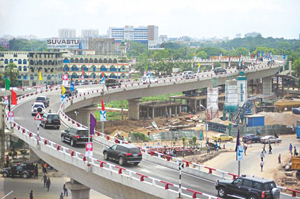
 Kuril Flyover brings relief to commuters.
 Keeping the grim realities vis-à-vis the present deteriorating state of Dhaka's livability in view, local urban experts advocate a comprehensive plan for the burgeoning metropolis. Few will differ with them. While discussing the city's myriad problems and woes with a news agency recently, they have stressed upon shifting excessive burdens off its shoulder. As they feel, the foremost task on the part of the authorities will be stopping the Dhaka-bound influx of people from all over the country.
Elaborating on it, local government expert Dr Tofail Ahmed believes that an effective way to prevent this trend could be devised by setting up modern urban centres across the country. All of these should have the amenities like those in the capital. This is not a radical nor too innovative an idea. Over the couple of decades, it has been intermittently proposed by experts at seminars and roundtable meets. But the proposal, along with the concepts of decentralisation and devolution, remained confined to papers.
Successive governments have been equally vocal about the urgent necessity of Dhaka's 'load-shedding'. But except shifting a few offices to the divisional cities, the grand plan has not got off the ground. Taking a cue from Dr Ahmed's placing of the idea afresh, we would like to believe that setting up more cities and towns with all civic amenities, jobs, business opportunities and government privileges is truly a pragmatic idea. It will stop the influx to Dhaka over time. It will enable the city to operate like a vibrant and fully functional capital.
The experts, who included Prof Nazrul Islam, noted city planner and former chairman of University Grants Commission (UGC), also proposed relocation of large industries to places away from the capital. Dr Ahmed underscores the immediate implementation of the Detailed Area Plan (DAP) for Dhaka. It is essential, he observes, for proper development and management of land in the overpopulated capital. Prof Nazrul Islam estimates, almost 10 per cent of the country's population now lives in Dhaka. As both the experts feel, relocation of industries will take much of the population pressure away from the capital. The cases of RMG and tannery sectors have been pointed out by them. Relocation of tanneries sector, however, has started. A single location for the RMG industries is being weighed. But for Dhaka to become a fully functional metropolis, it has to get rid of numerous mills and factories. A lot of government, semi-government and non-government offices need to be shifted to newly set up or redesigned locations.
Coming to Dhaka's chaotic traffic management, Dr Tofail Ahmed does not seem to be much enthusiastic about the ambitious flyover projects. Instead, he lays emphasis on freeing Dhaka's footpaths of all kinds of encroachment, which often extends to the busy roads. Given the traffic scenario in Dhaka, his proposal demands special attention. In order to live in Dhaka free of traffic congestions, its roads must have to be vehicle-focused --meaning the roads should be managed in a way that motorised transports can ply those without hindrances. According to the local government expert, by freeing Dhaka's footpaths of illegal occupations the government will be much benefited. The step will eventually reduce transport pressure on Dhaka roads by 30 per cent, he added.
At present Dhaka has a population a little more than that of Kolkata, but less than Karachi. Its population is also less than that of Delhi. In view of the population size in the three South Asian cities mentioned, Dhaka can look forward to better days as coping with its rising population does not appear to be a difficult task. But the necessary measures ought to be in place before it is too late. The way the number of its residents is shooting up, its population may surpass that of Delhi in near future, if not Tokyo's.
That unplanned and ubiquitous urban growth is behind Dhaka's dismal performance in terms of population need not be repeated. But city planners, architects and environmental activists keep singling out the many ills as the main culprits responsible for the various kinds of pressure being endured by the country's capital. The city is mainly buffeted by its ever-increasing population, afflicted with scores of urban maladies. Apart from these, it has long been lumbering with rundown infrastructure in the areas of transportation, utilities, road network, housing, upkeep and lots of other amenities.
In spite of this unwelcome urban ambience, thousands of people are migrating to the city from every corner of the country. They include lower-strata people including day labourers, female domestic help, the unemployed, as well as comparatively better placed people bent on fortune seeking, educated but jobless youths, and also those looking for a secure life. The migrants include those losing the battle of survival in their century-old profession.
In terms of the many-faceted nature of livelihoods of the people living in the city, Dhaka can well be called a mini 'melting pot'. The experts and city planners have once again repeated their ideas about how to make Dhaka a real livable city. For we keep clinging to the 2nd position from the bottom in a global index of over a hundred large cities' livability.
The most urgent task on the part of the city's authorities is to rein in its population. The city is becoming uninhabitable with every passing day. Perennial traffic gridlock, water-logging, messy management of solid waste etc., have already earned for the city the ill repute of the unlivable. We cannot build a new capital like Naypyidaw, Myanmar, overnight. Nor can we shift the 400-year-old city to another location. It's the very Dhaka on which we will have to concentrate all our efforts, zeal and creativity to metamorphose it into an ideal metropolis.
As Prof Nazrul Islam has said, well-thought-out plans ought to be taken to save Dhaka when it comes to its population pressure. He stressed upon strict monitoring in order to ensure proper implementation of the plans and restraint from frequent changes in plans.
shihabskr@ymail.com
© 2026 - All Rights with The Financial Express

