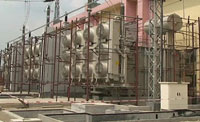
 The state-run Power Grid Company of Bangladesh (PGCB) importing 422MW of power from Indian grid since December 03, 2013.
 Bangladesh and India agreed in principle to develop an electricity network, which will allow transmission of 6,000 MW power from eastern Indian states to the energy-starved Indian state north-west of Bangladesh. A decision has been made to constitute a technical committee to explore feasibility of building the power corridor for connecting Rangia Raota in Assam with Borakpur, Bihar through Barapukuria, Dinajpur within the next six months by the seventh India-Bangladesh Joint Steering Committee on power cooperation that met in Dhaka recently. The immediate benefit Bangladesh is projected to derive from such a power corridor is the country will earn wheeling charges for transmitting power. In addition, Bangladesh is expected to get connected with the planned power lines, which ultimately will connect the country with the regional grid for importing power from the neighbours. India has a plan to start transmitting the power through the planned power lines from 2017 as reported. Indian Power Secretary PK Sinha informed the press that a number of projects for generating power in the eastern Indian states were going on and the plants would start generating power soon. The planned power lines can help transmit power through the proposed power corridor.
Bangladesh Power Development Board (BPDB) expects that 1,000 MW more power from India can be imported through the planned power lines. Eastern Indian states have a lot of potentials for power generation but constraints including power evacuation and market access stood in the way of tapping the potentials. Experts say Arunachal Pradesh, the Indian hilly state in the east, alone has the potential of generating 50,000 MW of hydro electricity. Bangladesh is receiving 470 MW power through the existing Bheramara-Bahrampur interconnecting power lines. India can sell and transmit additional 30 MW power to Bangladesh using the existing power lines. If the Bheramara-Bahrampur power grid capacity is enhanced, Bangladesh may import more electricity from India through the line. The Palatana gas-fired power plant under construction in eastern Indian state of Tripura may export additional 100 MW power to Bangladesh through a separate grid line connecting Tripura and Bangladesh. The Power Division of the Ministry of Power, Energy and Mineral Resources estimates that approximately Tk 2.0 billion would be required to establish the 30-40 km long new grid lines alongside supporting infrastructure to import power from Tripura. Earlier, Chief Minister of Tripura expressed his willingness to supply surplus power from the Palatana power plant to Bangladesh. Implemen-tation of such an initiative will be mutually beneficial. Bangladesh helped India to transit heavy equipment and machinery to Tripura through Ashuganj for implementation of the Palatana Power Plant.
Bangladesh has been purchasing power from India within the scope of intergovernmental agreements for cross-border power transmission. The agreed transmission of 500 MW power (equivalent to 4,000 million units) for Bangladesh has significantly eased power supply in the north western parts of the country. The arrangement also helped the government of Bangladesh to save its resources. The alternative at this stage could be the power purchase from the liquid fuel-based short-term rental power plants at an average rate of Tk 16 per unit. As Bangladesh purchases power from India at the rate of Tk 6.0 per unit on an average, the difference of Tk 10 per unit for approximately 500 MW annually makes a big difference. Bangladesh intends to import approximately 3,500 MW power through the regional grids within 2030.
Also, the power potentials of eastern India remains unutilised. The potential hydropower sources, if developed, would ensure power supplies to industries and growth centres. For example, the per capita Indian power generation annually has reached nearly 900 kWh (per capita power generation in Bangladesh stands at 321 kWh/annually). But the Indian state of Bihar could make available approximately 150 kWh electric energy per capita per annum. If the hydropower potentials of the eastern Indian states are materialised, the generated power may reach the energy-hungry states like Bihar and help the people living there prosper. Without investments and infrastructure building the potentials will remain unutilised. Bangladesh has initiated power import, not only from India but also from Nepal and Bhutan. The new power corridor, once materialised, will expand further and Bangladesh Power Development Board (BPDB) is actively considering extension of the power transmission corridor to connect Nepal and Bhutan in future. A number of interconnecting power grids are planned like interconnection between Bongaigaon (India)-Jamalpur/Barapukuria (Bangladesh)-Purnea, Bihar (India), interconnection between Shilchar in Assam and Fenchugonj in Bangladesh. Power from Bhutan through Bongaigaon and from Nepal through Purnea is to be transmitted.
Discussions are going on at different levels for joint investments to develop hydropower projects and for developing power grids to connect India, Nepal, Bhutan and Bangladesh for harnessing the untapped hydropower potentials in India, Nepal and Bhutan. A regional power grid will significantly help improve trade and economic cooperation among the countries in the region. Also mutually beneficial power trading will help resource rationalisation and alleviate poverty, the main enemy to development. If the energy-starved region can carry forward the cooperation in the power sector, it will find it easy to positively negotiate other issues of mutual interests.
The author is a mining engineer and writes
on energy and
environmental issues.
mushfiq41@yahoo.com
© 2026 - All Rights with The Financial Express

