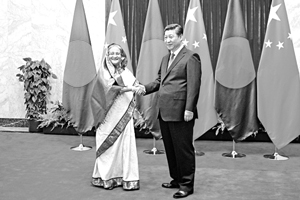
 Chinese President Xi Jinping (R) meets with Bangladeshi Prime Minister Sheikh Hasina in Beijing on June 10, 2014: Xi said that the two sides should maintain high-level exchanges and expand pragmatic cooperation to boost their comprehensive partnership.
 Bangladesh and China have enjoyed traditional bonds of friendship and multi-faceted cooperation for nearly four decades. Our bilateral relations have steadily been consolidated through our common commitment to peaceful co-existence, mutual trust and respect for sovereignty, territorial integrity and non-interference in internal affairs of any country. China has also been a reliable development partner and has contributed towards Bangladesh's socio-economic development.
This process has been further consolidated by Prime Minister Sheikh Hasina's six-day visit to China from June 06-11. She held significant official bilateral discussions in Beijing with the Chinese President Xi Jinping and the Chinese Prime Minister Li Keqiang. She also inaugurated the 2nd China South Asia Exposition and addressed a gathering of China-South Asia Business Forum in Kunming.
Necessary goodwill was initiated by the Bangladesh side before the start of the Prime Minister's visit by the important decision to award the construction work contract of the much-discussed 6.15 km Padma Bridge to the China Major Bridge Engineering Company. The bridge will hopefully be constructed by 2018.
Important and wide-ranging issues figured in discussions during the Prime Minister's China visit. They included not only political and economic areas but also facets of engagement that may be intensified through greater cooperation as one of China's strategic partners.
It may be recalled that in the context of foreign policy, Bangladesh has consistently supported China's core issues related to its national interest - it's 'One China Policy' with regard to Taiwan and Tibet being an integral part of China. This time round, both China and Bangladesh reiterated their belief in strengthening regional cooperation within South Asia. They also agreed to actively participate in and promote the BCIM (Bangladesh, China, India, and Myanmar Economic Corridor) regional economic cooperation process.
Bangladesh needs to take this process forward by actively engaging with China's efforts to create a strategic regional integration. This may be done through the establishment of overland connectivity - direct road and rail links to China via Myanmar. It is only fitting that greater and more meaningful connectivity be addressed given the evolving situation in South and South-east Asia (India, Pakistan, Afghanistan and Thailand) in the recent past.
Nevertheless, the broad spectrum emphasis was on matters related to economic affairs, including the facilitation of bilateral trade, overcoming existing challenges in this area and possible investment from China in Bangladesh. It may be noted here that economic cooperation and trade have constituted important features of our comprehensive bilateral partnership for the past decade. Economists have recently pointed out that the volume of bilateral trade between Bangladesh and China reached USD 10.3 billion last year and that it is heavily tilted in favour of Beijing.
This aspect was specifically addressed by both the Chinese President and Prime Minister. Both of them shared their concern with regard to this issue with Sheikh Hasina and agreed that necessary steps need to be taken to reduce this imbalance by diversifying imports from Bangladesh and also considering other necessary measures like preferential tariff treatment that would reduce tariffs on Bangladeshi products.
It may be mentioned here that Chinese Ambassador to Bangladesh Mr. Li Jun stated in a newspaper interview on the eve of Sheikh Hasina's visit to China that his country hoped to expand zero-tariff facilitation to 95 per cent Bangladeshi goods so that there could be a more balanced bilateral trade paradigm. His comment indicates that China understands that this is necessary in the growing interdependence that characterises today's world, particularly in matters of trade, FDI (foreign direct investment) and financial inflow.
Within the economic parameter, there was also specific discussion between the two countries within the ambit of the Joint Economic Commission. It is understood that Bangladesh sought relaxation of country-specific participation in tenders, discarding of the trading house awarding system, greater transparency and reduction in credit terms for soft and hard loans and allowing open competition and more local involvement in implementation. China was also urged to declare its Country Assistance Strategy and review existing rules pertaining to the use of trading houses as contractors, mandatory use of goods and services of Chinese origin and lesser degree of local participation. While doing so, appreciation was made of the diverse areas where Chinese assistance has been made available - coal mining, power generation, power transmission, fertilisers, food security, telecom and information and communication technology.
Both countries have been, for quite some time, been actively engaged in the sectors of agriculture, transportation and infrastructure development on the basis of equality and mutual benefit. This effort towards bilateral cooperation has been particularly meaningful through Bangladesh accessing to research carried out by Chinese scientists and agronomists in the sphere of agriculture - in hybrid rice cultivation technology, agricultural machinery technology, exchange of crop resource data, advances made in agro-processing and in the sphere of training of technical personnel.
This time, during the visit of Prime Minister Sheikh Hasina, this process of sustainable cooperation was carried forward with the signing on June 09 of five instruments, one MoU and exchange of two Letters aimed at enhancing mutual cooperation in sectors like trade and investment, power generation and climate change. This will include establishing a coal-based 1320-MW power plant in Patuakhali. The LoEs included obtaining of the second batch of calamity rescue equipment and a feasibility study on flood protection and management in Bangladesh. The two countries have renewed the agreement on hydrological data sharing and flood control of the Yarluzangbu River (the Brahmaputra) in view of its importance for disaster reduction in Bangladesh. At the request of Bangladesh, China has also agreed in principle to assist Bangladesh with technological expertise required for dredging of riverbeds and for capacity building of required technical personnel.
Bangladesh and China are working together to facilitate cooperation in information and media technology, culture, health, sports and tourism. In this context, Bangladesh has, during this visit, sought Chinese government's support for implementing five proposed projects: a National ICT Intra-Network for Bangladesh- Phase III, construction of Rajshahi WASA Surface water treatment Plant, construction of Second Railway-cum-Road Bridge over River Karnaphuli at Kalurghat Point near the existing railway bridge, construction of a new Dual Gauge Railway line from Chittagong to Cox's Bazaar via Ramu and establishment of Eastern Refinery Unit-2 and Single Point Mooring project. The Chinese Prime Minister has assured serious consideration of these projects and has apparently asked the Chinese Commerce Ministry to prepare necessary methodological studies pertaining to these proposals. Chinese seriousness in moving forward with Bangladesh in the area of infrastructural growth was stressed later on through the signing on June 09 of a MoU for construction of a tunnel beneath the Karnaphuli River in Chittagong. It is understood that this tunnel will be built by the Chinese at a cost of USD 1.0 billion.
During Prime Minister Sheikh Hasina's visit to China, the representatives of the BGMEA (Bangladesh Garment Manufacturers and Exporters Association) and the Oriental International Holding, a Chinese company, signed an agreement to develop a new garment industrial park in Gazaria, Munshiganj on 470 acres at an approximate cost of USD 1.2 billion. Both parties, interestingly, have decided that their agreement would be governed by British laws and in case of a dispute, the matter would be resolved by the International Chamber of Commerce. It is expected that establishment of such a zone will encourage re-location of Chinese industries to Bangladesh and enhance investment potential. This is based on the belief that the Chinese manufacturers could benefit from lower production and transportation costs in Bangladesh and we could profit from Chinese technical experience and assistance in the fields related to bio-gas, bio-fuel, wind and solar power.
Some analysts have, however, pointed out to one supposed downside pertaining to the visit. They have mentioned that the issue of constructing the Sonadia Deep Sea Port could not be concluded and finalised. It is true but that does not mean the discussion on this project is over. Both countries are still examining various details regarding terms of the expected loan related to the construction of this Port. That is a strategic compulsion for both countries and it needs to be respected as such.
Muhammad Zamir, a former Ambassador, is specialised in foreign affairs, right to information and good governance.
mzamir@dhaka.net
© 2026 - All Rights with The Financial Express

