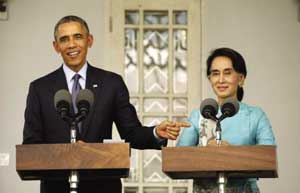
 US President Barack Obama and Myanmar\'s democracy icon Aung San Suu Kyi hold a press conference in Naypyidaw on November 13, 2014: Standing next to Aung San Suu Kyi, President Obama said that the law barring her from becoming president \"doesn\'t ma
 There have been reports in the media that Myanmar President Thein Sein has denied that minority Muslim Rohingyas have been fleeing 'torture' in its western Rakhine state. This retort was focused upon in the Voice of America Burmese service. The President has been quoted as having said: "It is just a media story that boat people are fleeing torture". In this context, the President also drew attention to the fact that contrary to media observations more people wanted to live in Myanmar "because it is spacious, with many places to live and work".
There appears to have been some efforts to promote stability, including the inking of ceasefire agreements with 14 of the 16 major armed ethnic groups. However, this process of engagement, according to international reports, does not tend to include equality of treatment towards Rohingyas - another ethnic minority inside Myanmar. This discriminatory approach with regard to the Rohingyas was focused upon on November 21 in the United Nations when it adopted a resolution urging Myanmar to grant citizenship to its Muslim minority and scrap its controversial identity plan. The initiative in this regard was taken by the OIC (Organisation of Islamic Cooperation).
The Myanmar President, instead of acknowledging the distressing situation has instead accused that 'some people are writing negative things with malice' and that some 'international organisations are also helping them well'. His comments have reflected the government line regarding more than a million Rohingyas, mostly Muslim, who have been denied equality of status within the Myanmar governance process as citizens of that country (despite having lived in that country for many generations). The President's comments were in defiance of reports by domestic and international media as well as leading international NGOs (non-governmental organsations). Matters came to a head on this point because of recent comments by Thai authorities who were critical of the Myanmar government for the treatment meted out to Rohingyas that has been forcing them to flee Myanmar and seeking sanctuary across the border in Thailand. It may be mentioned here that according to the Arakan project, which plots migration across the Bay of Bengal, about 100,000 Rohingyas have left Rakhine since 2012, with many of them also seeking sanctuary in Bangladesh. It may also be added here that international estimates suggest that since 2012, violent clashes with ethnic Rakhine, Buddhists have killed hundreds and left 140,000 homeless, most of them Rohingya. Reuters has reported that some of the Rohingyas seeking to flee violence have fallen victim to trafficking gangs who have held them at jungle camps in Thailand until relatives paid ransom to secure their release.
The special focus on Myanmar has re-surfaced after the latest East Asia Summit held in its capital Naypyidaw. It was clear to most participating countries and to the international media that there are few tangible results from the political and economic reform process that started nearly four years ago. Ko Ko Hiang, a senior Myanmar official, has acknowledged that there might have been some 'backsliding', but has claimed that the efforts towards reform by the Myanmar authorities are better than other transitions - like in Indonesia and South Korea - in the early years of their reform.
Myanmar's pro-democracy leader and head of the opposition National League for Democracy, Aung San Suu Kyi has differed with this claim. Larry Jagan, a political analyst, based in Bangkok, in his article, 'Myanmar's reform miracle stalls' has quoted Suu Kyi as warning the western powers that they had been too optimistic and gullible in believing that Thein Sein was committed to the transition to democracy. The opposition leader added, "If they really study the situation in this country they would know that this reform process started stalling early last year. In fact, I would like to challenge those who talk so much about the reforms process [to point out] what significant reform steps have been taken within the last 24 months".
Khine Win, a social commentator and associated with a Myanmar NGO, has commented in this regard that the biggest problem has been that farmers and the poorer segment of the population in urban areas have not reaped any benefit from the reforms process as a form of democracy dividend.
Some analysts have been particularly harsh and have claimed that the Thein Sein government was never really committed to ushering in true democracy and economic liberalism and never envisaged anything other than 'guided democracy' as practised by former military strongman Than Shwe. They have pointed out that the aim of the current government was really to get Myanmar 'accepted by the international community and to roll back sanctions'. One is reminded in this regard of the efforts undertaken by a Pakistani military ruler in the 1960s when he tried to implement 'Basic Democracy' in Pakistan.
Suu Kyi, who was awarded the Sakharov Prize for Freedom of Thought in 1990 and the Nobel Peace Prize in 1991, has been the symbol of hope across Myanmar. Columnist Tim Robertson has noted that 'the people of that country has for more than two decades seen her as a link between an era of great national pride and achievement and a future of promise' through democratic reforms. She is seen as a champion of 'those repressed and persecuted by tyranny'. Nevertheless, the columnist notes in his article, 'Suu Kyi: colluding with tyranny' that 'she has been cagey on the question of whom exactly she regards as citizens (in Myanmar) and thus, to whom these reforms should apply. In this context, Robertson mentions that the Rohingyas in Myanmar 'are now forced to live in deplorable conditions in camps where their housing, health, security, food and water needs are restricted by those charged with protecting them'. It has been hinted that Suu Kyi 'has chosen a more populist mute' approach and refused to speak out decisively against the racist sentiments' fearing that this might jeopardise her mass popularity among the Myanmar Buddhist population and also put her at clear odds with the present government. One can only hope that such an assumption is eventually proven wrong.
In the meantime, Myanmar's powerful army (despite Suu Kyi keeping quiet on the Rohingya issue) has made it clear in the Parliament that it opposes changing junta-drafted constitutional provisions that presently bars Suu Kyi from becoming President of the country. Matters came to a head when, during US President Obama's visit to Myanmar, Suu Kyi indicated her desire to run for the presidency and said that existing constitutional principles were not only discriminatory but also 'unfair, unjust and undemocratic'. She was referring to Clause 59 of the Myanmar constitution that bars those with a foreign spouse or children from holding the presidential office.
Obama immediately picked up the cudgel on behalf of his Nobel Peace Prize colleague and commented that constitutional reforms required "inclusion rather than exclusion".
Observers have noted, as reported by AFP on November 18, that the military junta which kept Suu Kyi under lock and key for 15 years never wanted the veteran activist to have a chance at the presidency'. It has also been clarified that under Section 436, 'any changes to the Constitution would require a majority vote of more than 75 per cent, thereby giving the last say to the military'. The army has made it clear that they are not supportive of constitutional reform and this position would remain "irrespective of Obama's feelings on the matter".
Legislators are expected to choose a new president in Myanmar after a general election in November 2015, which Suu Kyi's National League for Democracy is expected to win. Her inability to be President in this new matrix will obviously be a letdown for her supporters.
A glimmer of hope amid this gloom emerged in a recent article by U Soe Thane, a retired Admiral in the Office of the President of Myanmar. He has reiterated that Myanmar "is determined to end the humanitarian crisis in our western Rakhine State, a site of recent communal violence. We will very soon release a final action plan to address the totality of issues in Rakhine State, one that conforms to accepted international standards in all respects, including on issues of humanitarian access, resettlement, livelihoods and citizenship". It has also been promised that "there will be no forced resettlement of people".
Bangladesh, a frontline neighbour of Myanmar, hosting tens of thousands of Rohingya refugees, will, in particular, looks forward to a speedy resolution of this problem.
Muhammad Zamir, a former Ambassador, is an analyst specialised in foreign affairs, right to information and good governance.
mzamir@dhaka.net
© 2026 - All Rights with The Financial Express

