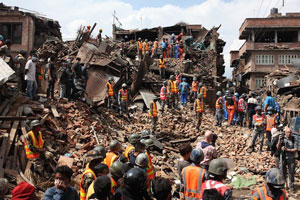
 RESCUE OPERATIONS: A handout picture provided by the International Federation of Red Cross and Red Crescent Societies shows the rescue operation in Bhaktapur district, Nepal, in the aftermath of the earthquake that struck on April 29, 2015.
 The recent earthquake of 7.8 seismic magnitude that devastated central Nepal and the Kathmandu Valley in the last week of April drew world's attention once again to the terrible consequences that are faced by those who have survived but have been affected by such a cataclysmic event. The death toll from this latest natural disaster has exceeded 7,500. It has also left more than 12,000 injured and, in one way or the other, left its imprint on nearly 9.0 per cent of Nepal's population - a majority of them homeless.
Generally, the word 'earthquake' is used to describe any seismic event - whether natural or caused by humans - that generates seismic waves. Earthquakes are normally caused by rupture of geological faults. Other events such as volcanic activity, landslides, mine blasts, and nuclear tests can also generate such activity.
Seismologists have estimated that around 100,000 earthquakes occur each year, detectable with current instrumentation. About 10,000 of these can be felt by those near the earthquake's epicentre. Minor earthquakes occur nearly constantly around the world. Larger earthquakes, however, occur less frequently. Earthquakes of magnitude 7 and over potentially cause serious damage over larger areas, depending on their depth. The largest earthquakes in historic times have been of magnitude slightly over 9. The most recent large earthquake of magnitude 9.0 or larger was a 9.0 magnitude earthquake in Japan in 2011. It was the largest Japanese earthquake since records began.
The United States Geological Survey has estimated that, since 1900, there have been an average of 18 major earthquakes (magnitude 7.0-7.9) and one great earthquake (magnitude 8.0 or greater) per year, and that this average has been relatively stable. In recent years, the number of major earthquakes per year appears to have decreased, though; this is probably a statistical fluctuation rather than a systematic trend.
Most of the world's earthquakes take place in the 40,000 km long, horseshoe-shaped zone called the circum-Pacific seismic belt, known as the Pacific Ring of Fire, which for the most part bounds the Pacific Plate. Massive earthquakes tend to occur along other plate boundaries, too, such as along the Himalayan Mountains.
The latest one in Nepal was a case in point. Spring in Nepal has always been the time for weddings and tourists arriving for trekking and climbing mountains. This year it is going to be different.
Shaking and ground rupture created by this earthquake resulted in severe damage to buildings and other rigid structures. Its severity was compounded by the complex combination of the earthquake magnitude, the distance from the epicentre and the local geological and geomorphological conditions that might have amplified or reduced wave propagation. There were also landslides that killed many climbers who had gone towards Mount Everest. As anticipated, it also caused fires by damaging electrical power lines. The situation was exacerbated by the rupturing of water mains which in turn caused loss of pressure and made it difficult to stop the spread of a fire in certain parts of Kathmandu.
Rescue workers from several countries, including Bangladesh, assisted the Nepalese government not only in recovery of bodies but also in dealing with injury and loss of life. Teams of engineers also focused on re-opening communication routes by addressing road and bridge damage, general property damage, and collapse or destabilisation (potentially leading to future collapse) of buildings. They also focused on prevention of spreading disease and providing of basic necessities to combat food shortages. The biggest problem they faced was the paucity of helicopters to reach devastated villages inaccessible with local road transport.
It is estimated that Nepal with an impoverished economy of about US Dollar 20 billion will require, according to its Finance Minister D. Rana, about US Dollar 10 billion. The United Nations has already launched a US Dollar 415 million appeal for assisting Nepal in its efforts towards recovery. Jamie McGoldrick, the UN Resident Coordinator for Nepal, has suggested that this amount will be required for the first step of the relief effort. Subsequently it will turn into a recovery and then into a reconstruction process.
In this context one needs to refer to several factors that have important connotations for the Gangetic Delta, particularly Bangladesh. As pointed out by Shihab Sarkar in his article in the Financial Express on May 01, 2015, Dhaka is situated in an active seismic pocket. We have had two massive earthquakes in 1885 and 1897. He has also drawn attention to the fact that an active fault in Madhupur near Tangail, not far from Dhaka 'acts as an ever-present threat to the country'. There was a major earthquake in the Bengal-Arakan belt in 1762 that altered the flow of several rivers in what is now Bangladesh. The 1885 earthquake wrecked havoc in several districts, both in the northern and central regions of our country - Rangpur, Bogra, Sherpur, Mymensingh, Dhaka and Pabna.
There has not been any major earthquake since then. We have, however, experienced several low-strength tremors at different times. In fact, during this latest earthquake in Nepal, several regions of northern and central Bangladesh, for three successive days, felt low-intensity after-shocks.
What worries most people about the possibility of a serious earthquake affecting Bangladesh is the potential calamity that awaits the urban citizens of unplanned Dhaka and Chittagong cities - home to nearly 18 million people. It may be noted that according to Dr. Abdul Matin, a Bangladeshi nuclear engineer, the Stanford-based earthquake disaster risk index lists Dhaka as one of the 20 most vulnerable cities in the world. The Guardian development network similarly includes Dhaka in the few cities which have the highest probability of facing a major earthquake.
Most of the high-rise buildings in these cities are built without proper seismic considerations with regard to their load bearing walls and foundations. Architects and structural have been pointed out repeatedly in seminars that the vast majority of these buildings need to be demolished and re-built or be retrofitted according to specifications of the National Building Code. They have also urged that the government should provide special credit facilities for such reconstruction. It has also been mentioned that buildings with proper seismic designs should enjoy concessions in payment of municipal taxes. These checks on buildings need to include those which are used for academic or as work places. We have seen in the last few days photos of the terrible condition of several hostels being used by more than 10,000 students of Dhaka University. There is replication of such sub-standard construction in many schools and colleges located in the mufassil areas in several parts of the country.
Another important problem that continues to haunt city dwellers of Dhaka are the numerous narrow pathways and lanes that provide communication networking in the older parts of our urban areas. They are far too narrow for heavy equipment and vehicles to pass through in case they are urgently required. We need at least 20 feet roadways for this purpose. There is also very little space between the buildings and parks and open spaces are virtually absent in most city areas. This means that in case of a severe tremor, people cannot even find sanctuaries. There is, besides, paucity of heavy equipment that will be required for removing rubble from affected areas. We still remember what happened in the case of Rana Plaza disaster and how it took more than a week to clear the rubble and free those trapped inside the rubble. Despite all efforts more than 1100 died in that building collapse. Imagine what might happen in metropolitan Dhaka after a severe tremor which demolishes five thousand buildings. The death toll could reach six figures.
One also needs to include in this nightmare the very scanty medical facilities that would enable us to offer proper treatment to those injured. This includes the non-availability of sufficient blood banks and burn victim treatment centres.
One seismologist drew my attention the other day to the fact that large metropolitan Dhaka had very few water bodies left in the city. He pointed out that the matter had become more complex due to the steady fall in the groundwater level in the underground water aquifers. This had apparently created vacuum spaces underground in most parts of the city. There was likelihood that in case of a strong earthquake, several parts of the city might collapse and sink. He suggested that as part of disaster preparedness, there was need for all institutions to practise escape drills which might be needed in times of emergency. Such drills should be carried out in all educational institutions as well as offices and workplaces. We should also arrange to store sufficient drinking water, emergency medicines and an alternative escape stairways that can be used when necessary.
Japanese Professor Hiroaki Takahashi, the seismologist from Hokkaido University, Japan has stressed the need for the media to play an important role. They can create necessary awareness about disaster preparedness. We have to remember that disaster mitigation cannot achieve optimal results unless there is understanding and cooperation among all actors.
One can only hope that the newly-elected Mayors of Dhaka and Chittagong will give their full attention on a priority basis to tackling the ramifications of such a terrible disaster scenario. This is a problem that will affect everybody.
The writer, a former Ambassador, is an analyst specialised in foreign affairs, right to information and good governance.
muhammadzamir0@gmail.com
© 2026 - All Rights with The Financial Express

