I have recently delivered a paper at a seminar organised by the Centre for Bay of Bengal Studies (CBoBS) at Independent University, Bangladesh, where I concluded that there is a severe deficit in maritime education. There is no alternate to knowledge, and until we establish a knowledge-based society, our advancement will remain stagnant in all areas, including maritime trade, preventing us from achieving our desired socio-economic progress. Moreover, most individuals who are not seafarers or professionals involved in maritime safety regulations and surveys within commercial shipping have very little understanding of maritime trade. Other facets of society, such as the media, mirror this deficiency, often rushing into reporting without conducting thorough investigations, as exemplified in the current debate over the enhancement of the Chittagong port tariff.
First of all, we need to appreciate that ocean shipping is the most international of all trades, and global events, including geopolitics, are impacted by it. Secondly, the cost of shipping or freight is dependent on a multitude of factors, not just port costs, which lie at the bottom of the freight structure. Thirdly, many countries, particularly the developing nations, subsidise port expenses, and their tariffs are not on par with other countries or reflective of economic cost.
Shipping has gone through a transformation at a meteoric speed since the 1990s with the advent of containerisation and technological advancements, including digitisation and implementation of artificial intelligence, but many countries have failed to keep up with the pace due to their inability to make the required capital outlay, lack of infrastructures both physical and digital; and skilled and qualified human resources, etc. The global carriers often exploit the situation by using trivial justifications to impose unjust surcharges, and the countries comply due to the carriers’ dominant market power.
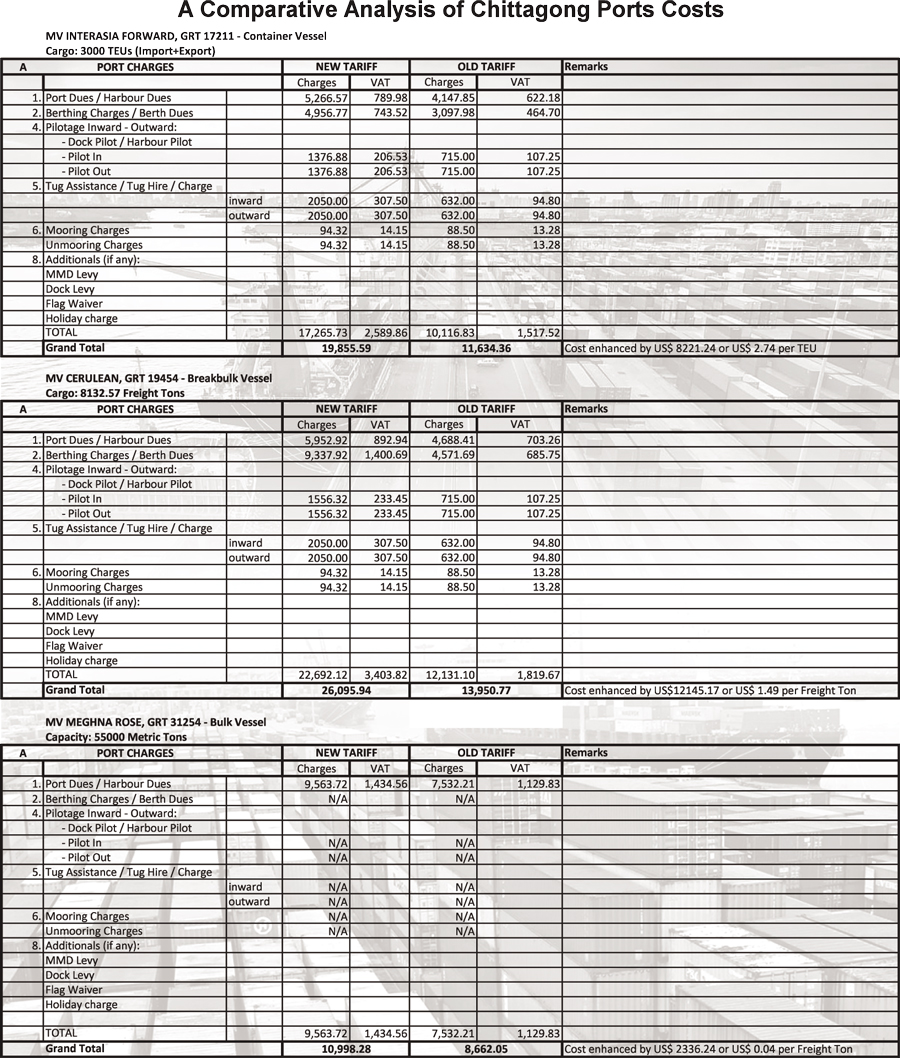
Personally, I find the revision of the tariff has been long overdue because over the last 39 years, costs of business in Bangladesh as well as globally have multiplied, with the only exception of the port tariff here. The revision has been reasonable enough and hardly makes any impact on costs of trade. Chittagong port should have come up with the cost assessments with a public disclosure, but instead their inability to do so has created room for adverse reporting. I have, however, done my own assessments to point out that the impact of tariff enhancement is absolutely negligible. I have taken three vessels for assessment; one is a container feeder vessel, one is a break-bulk vessel, and one is a bulk carrier to bring my point home.
In doing my calculations, I have taken only the cost items on account of the vessel, including port dues, pilotage, berth hire, tug charges, and berthing and unberthing charges.
The break-bulk vessel, m/v CERULEAN, having a GRT of 19,454 with 8,132.57 freight tonnes of cargo discharged at Chittagong port, incurred a port cost of US$ 13,950.77 as per the old tariff, while it would be US$ 26,095.94 under new tariff regime, leading to a cost enhancement of US$ 12,145.17 that may read a bit significant, but in reality it is insignificant as the unit cost comes to US$ 1.50 per freight tonne.
For the container feeder vessel, m/v INTERASIA FORWARD, having a GRT of 17,211 with an average capacity to carry 1500 TEUs, i.e., 1500 TEUs to discharge and 1500 TEUs to load, the port cost is US$ 11,634.50 as per the old tariff but US$ 19,855.59 under the new tariff structure, giving a mere rise of US$ 8221.24, which comes to US$ 2.75 per TEU, again an insignificant figure.
Now let us check the port costs for a bulker.
The M/V MEGHNA ROSE, a supramax vessel having a GRT of 31254 with a carrying capacity of 55000 metric tonnes of cargo, would have attracted a port cost of just US$ 8662.05 as per the old tariff and a slightly higher US$ 10998.28 as per the new tariff, a cost enhancement of US$ 2336.24 or US$ 0.04 per tonne of cargo.
Now a ship owner or a carrier that cannot sustain a cost enhancement of US$ 2.75 per TEU or US$ 1.50 per metric ton should not be in business. I do not believe the owners in break-bulk or dry-bulk trade are concerned with the tariff enhancement; it is primarily the container vessel operators who are making a big fuss without any justification. The traders here also have no real ground to create waves because most of our cargo, e.g., food grain, fertiliser, clinker and other industrial goods, is carried by bulkers, and a rise of freight by US$ 0.04 is just not worth the time even to read. I wonder why the Chittagong Port Authority could not do simple mathematics and eliminate all the misinformation that is widely circulated in the media that the cost will rise by 41 per cent for implementing the new tariff. The authority should have organised a press conference to clear the misconception that has built up among consumers and traders alike.
The fact of the matter is that global carriers or shipping cartels are so dominant that smaller economies are helpless to counter their malpractices. We can negotiate with them, but to negotiate, we also need to have something in our hand for a successful negotiation. This is where our policymakers have gone wrong, and our national fleet has focused on procuring bulk carriers instead of container feeder vessels. I am also not sure if our policy makers have paid any attention to the imposition of fees on Chinese-built ships. The USTR Billing Code 3390-F4 clearly stipulates
“Annex II Service Fee on Vessel Operators of Chinese-Built Vessels For the purposes of this Annex: (e) Chinese-built vessel. A Chinese- Republic of China, consistent with the definition of place of build in CBP and U.S. Coast Guard (USCG) regulations and would be so identified on the Vessel Entrance or Clearance Statement (CBP Form 1300) or its electronic equivalent.
Collections, supplemental payments, and refunds: (a) Time and place of liability. Subject to the coverage and special rules of this Annex, upon the arrival of a Chinese-built vessel to a U.S. port or point from outside the Customs territory on a particular string, a vessel operator that is not a vessel operator of China (as defined in Annex I, paragraph (f)) must pay the higher of these two fee calculation methods:
Effective as of October 14, 2025, a fee in the amount of $18 per net ton for the arriving vessel
Effective as of April 17, 2026, a fee in the amount of $23 per net ton for the arriving vessel
Effective as of April 17, 2027, a fee in the amount of $28 per net ton for the arriving vessel
Effective as of April 17, 2028, a fee in the amount of $33 per net ton for the arriving vessel”
(Source: USTR Notice of Action and Proposed Action in Section 301 Investigation of China’s Targeting the Maritime, Logistics, and Shipbuilding Sectors for Dominance)
It may be noted that the fees shall not be applicable for vessels under 55,000 dwt. BSC hence made an error of judgement, first, for buying Chinese-built vessels and second, buying above 55000 dwt vessels. According to reports, “The Corporation (BSC) will purchase the ships from the previously selected US-based firm Hellenic Dry Bulk Ventures LLC. Each vessel will have a capacity of 55,000-66,000 deadweight tons (DWT)”.
These vessels although purchased from a USA company but they fall under the definition of Chinese-built ships. Moreover, these vessels shall not qualify for exemption provided to vessels under 55,000 dwt vessels. BSC board made the decision in September 2025 while the USTR published the imposition of fees on 17 April 2025. This is the short-sightedness of BSC management. They should have procured 50,000 dwt vessels to avoid the fees or even better procured a few gearless cellular vessels to participate in our vital international liner trade i.e. container shipping by taking the advantage of Bangladesh Flag Vessels Protection Act 2019.
The international liner trade is too important for us because exports of apparels and other consumer goods are a major contributor to our GDP and foreign reserve. It is learnt that the proposed container terminal at Laldia, Chittagong, will have a permissible LoA of 250 metres with a draft of 11.5 metres, in which case vessels with a capacity of about 4000 TEUs may berth here, given the fact that our export containers are very light and carry an average payload of 10 metric tonnes per TEU, facilitating 40,000 dwt vessels to berth at Laldia.
BSC, therefore, should seriously consider the opportunity and turn its focus on buying a fleet of gearless cellular vessels, which are less costly compared to geared ones. Once we have a reasonable capacity in the feedering trade, we will then have the bargaining capacity to minimise malpractices by mega carriers in the international liner trade of Bangladesh.
Khandaker R Zaman is the managing director of Allseas Shipping Ltd. He is an alumnus of Australian Maritime College, University of Tasmania and was elected a Fellow of the Chartered Institute of Logistics & Transport, Australia in 1996. zamankr@gmail.com
© 2026 - All Rights with The Financial Express

