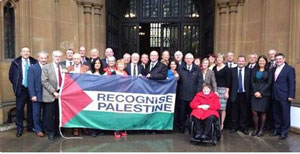
 Rally in London demanding recognition of Palestine: The British parliament voted on October 13, 2014 in favour of a non-binding motion to recognise the state of Palestine, in a majority vote of 274-12.
 Recognition of Palestine as an independent State, the negotiating process associated with the two-State theory and holding Israel responsible for creating challenges within this dynamics have been in the focus of international interest for the last three weeks. There has also been renewed attention to the Israeli authorities' disregard of resolutions adopted earlier in the United Nations Security Council consistent with international law.
Exasperation with Israeli decision-making was reflected recently in comments by Jeffrey Feltman, United Nations Under-Secretary General for Political Affairs. On October 29, he called on Israel to 'rescind' its plans to build 1,000 new homes, which was described correctly as violation of international law and contrary to the expected 'Two-State solution'. An emergency session of UN Security Council was convened at the request of Council member Jordan on behalf of the Palestinians. It may be recalled that tension had soared in the recent past between Arabs and Jews over Israel's plans to build 600 additional housing units in Ramat Shlomo and 400 housing units in Har Homa districts of East Jerusalem. This step was taken when some Israeli politicians reiterated that Jerusalem would forever be Israel's capital because of historical, religious and security reasons.
The international community, including the US, does not recognise Israel's annexation of the eastern sector of Jerusalem. The Palestinian Authority, as expected, has informed the UN Security Council that Israel's "illegal actions are exacerbating the conflict and obstructing a peaceful solution". The European Union has asked for clarification of Israel's plans and suggested that if the expansion is confirmed, "it will call once again into serious question Israel's commitment about a negotiated solution with the Palestinians".
The UN meeting was held in the midst of heightened tension between the USA and Israel over an unnamed official of US President Obama's Administration calling the Israeli Prime Minister a "chickenshit" (a comment made in 'The Atlantic' magazine) over Israeli policy on settlement building in the occupied Palestinian territories. As expected, US Secretary of State John Kerry tried to calm turbulent waters by terming the above reference as 'disgraceful, unacceptable and damaging' and clarifying that this comment did not reflect the views of Obama or his Cabinet.
Mr. Kerry, it may be recalled, is under pressure over his failure to hammer out a peace deal between the Israelis and Palestinians. This process collapsed earlier this year amid bitter recriminations on both sides. Israeli disappointment with the USA has been driven home with Israel's Defence Minister dropping the purchase of V-22 Osprey aircraft. This has raised concerns that this decision could further chill already frosty relations with Washington.
It needs, however, to be pointed out that some leaders within Netanyahu's coalition have already vocally expressed their worry over the growing crisis with the United States. Yair Lapid, the Israeli Finance Minister, in particular, has reiterated that differences need to be resolved before it endangered Israeli interests. This has been interpreted as in-built anxiety over US efforts to reach a diplomatic agreement over Iran's nuclear programme (that fails to remove the threat of Iran acquiring a nuclear bomb). US is possibly withholding its vast military aid to Israel and reducing its efforts to protect Israel from diplomatic attacks at the United Nations either through persuasion or through the use of veto.
SPECIAL FOCUS: In the meantime, the Palestinian issue has received special focus in the international arena due to three other steps.
The first was the recent symbolic vote in the British House of Commons, where its members overwhelmingly passed a non-binding resolution to give diplomatic recognition to a Palestinian State. The vote was 274 in favour to 12 against. In a manner of speaking, it was a reflection of the "growing global dissatisfaction with Israel and its intransigent policies". It also drew Israel's attention to a gradual shift in public opinion, even in Europe. It was an example of Europe indirectly rebuking Israel for the breakdown of US-sponsored peace negotiations and the armed conflict in Gaza that led to nearly 2,000 civilian deaths, including hundreds of women and children and destruction of infrastructure and property worth more than US$ 5.0 billion.
During discussions inside and outside the British Parliament, left of the centre British politicians were critical that British recognition of Palestine had become dependent on Israel's agreement rather than the principles of existing international law. Some termed it as similar to Israel wielding a veto over Palestinian self-determination with the tacit backing of the United States. The vote in the British Parliament was consequently perceived as an important development.
The second important factor was more significant in terms of its strategic connotation. At the end of October, Sweden, another West European State and an important member of the European Union, officially recognised the State of Palestine. This announcement came from Margot Wallstrom, Stockholm's Foreign Minister, less than a month after the new Swedish government had earlier announced its intention to make this unprecedented move. This recognition means that 135 of the 193 UN member-countries have given diplomatic recognition to the State of Palestine. It may be added here that seven EU members from Eastern Europe have already recognised Palestine. These are Bulgaria, Cyprus, the Czech Republic, Hungary, Malta, Poland and Romania. Non-EU member Iceland is another West European nation in this growing list of nations.
The Israeli response to Sweden's decision was immediate and expected. Israel has recalled its Ambassador from Sweden. An Israeli Foreign Office spokesperson has said that this recall of the Ambassador was for an unspecified length of time. The Israeli Foreign Minister A. Liebermann has disparagingly denounced the Swedish 'deplorable' decision and indicated that this would 'only strengthen extremist elements and Palestinian rejectionism'.
Mahmoud Abbas, President of the Palestinian Authority, has, on the other hand, hailed the Swedish decision and termed it as 'brave and historic'. He has called on other West European countries to follow suit.
The third element in the evolving international dynamics is that experts in the United Nations Human Rights Committee criticised Israel on October 21 for its alleged rights abuses, ranging from the demolition of Palestinian houses to limiting Palestinian access to water and their farmland. The Israeli government apparently provided only written information about Israel to the Committee and tried to defend themselves through this process. Committee Chairman Nigel Rodley has, in particular, voiced his criticism over Israeli violations of human rights in the occupied territories and restrictions being imposed on the freedom of movement of the Palestinians. Another Panel member, Cornelis Flinterman, recalled that the Panel had called on Israel in 2010 to halt construction of settlements in the occupied territories but the number of such illegal settlements had doubled since then.
It would be interesting to note here that, as a result of all these developments, Emi Palmor, a Director General of Israel's Justice Ministry (who led the 13-member Israeli delegation to the above Panel hearing) has mentioned for the first time that while Israel was 'making progress in upholding human rights, more needs to be done'.
THE ISIS FACTOR: International disquiet over Israel and its violation of international law and accepted social practices associated with religion have finally persuaded the USA to be more pro-active in its efforts to find a way out of the impasse. The ever-increasing threat of the Islamic State of Iraq and Syria (ISIS) in Syria, Iraq and the broader region has led Kerry to suggest once again that efforts need to be made to re-start the frozen peace process. He will be having discussions on the possible 'way forward' in a Middle East peace deal and the current situation in the Gaza strip with Saeb Erakat, a Palestinian leader. The aim of this exchange of views would be aimed, particularly, in 'lowering tensions in Jerusalem' according to Jen Psaki, US State Department spokesperson. It may be recalled that Al-Aqsa, in the older part of Jerusalem and adjacent neighbourhoods have in the past few months seen a lot of violence, with Palestinian Muslims fiercely resisting perceived Jewish attempts to take control of the third most holy place of Islam.
One can only hope that the United States and its current Administration would be able to take the necessary steps to bring forth peace and justice in the region. One also hopes that through such a measure they will be able to justify the decision of the Nobel Committee to have awarded the prestigious Nobel Peace Prize to President Obama.
Muhammad Zamir, a former Ambassador, is an analyst specialised in foreign affairs, right to information and good governance.
mzamir@dhaka.net
© 2026 - All Rights with The Financial Express

