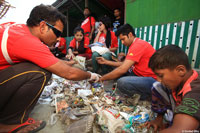
 Building an Ocean Cleanup Brigade in Bangladesh: An ever-increasing amount of plastic pollution is entering our ocean every day. Surprisingly, many countries around the world lack the most basic trash collection services.
We all know water mass comprises two-thirds of the Earth's surface. How will you feel if you see this volume of water eventually becomes vast pools of thick, fetid liquid with marine lives dying away one after another? This gloomy prediction may give us goose bumps. But probably it's going to be the reality in the future. Environmentalists and marine biologists have lately come up with this forecast. The way plastic-made wastes are wantonly being thrown into the sea this wonderful embodiment of nature may no longer arouse the feeling of awe in us with which mankind has been stricken since time immemorial.
According to a US-Australian study released recently, a total of eight million tonnes of plastic garbage now enter the world's oceans a year. They are equivalent to five grocery bags filled with plastic for every foot of coastline in the world. The study result is the first of its kind among various others coming from pollution-related surveys at global scale. The message hidden in the study result cannot but disturb the environmentally conscious people around the world. At a time when both the industrialised and developing countries are struggling to arrive at a lasing solution to global warming, and work out strategies to adapt to climate change, the latest finding only adds to our worries. With the developed and the developing worlds engaged in a protracted ritual of alibis and blames, the global environmental crisis keeps deteriorating. Beginning from pageantries around the so-called earth summits, resolutions filled with lofty goals, tiffs and disagreements, to desperate appeals for help, the world's environmental front is still strewn with knotty issues. Meanwhile, time keeps ticking away.
Alongside greenhouse gas emission, melting of polar ice, sea-level rise, etc. newer bad news about ecological health continues to pour in. The one about sea water choked with plastic litter is among them.
Apart from long-term pollution-related implications, the plastic-filled seas pose great risks to marine species. Besides, the non-biodegradable garbage finally washes up on the beaches after floating in the seas for a long time. The sea creatures face lots of hazards from these marine pollutants. Those include entanglement of dolphins and turtles in the plastic materials. Some of them may swallow those objects. The most alarming aspect of the plastic-infestation of marine water is disintegration of the debris into tiny particles. The plastic objects in this normally undetectable form can be absorbed by microscopic invertebrates.
The study collects relevant data from over 100 countries with coastlines on the Atlantic, the Pacific and the Indian Oceans, and the Mediterranean and the Black Seas. The survey has listed the world's 20 biggest sources of mismanaged plastic waste. Bangladesh has been ranked 10th with 867,879 tonnes of plastic debris. Surprisingly, the top 20 include low and middle-income countries. The US stands at the 20th position. It may appear striking to many that India is not among these 20 countries.
Unlike the scenario of greenhouse gas emission, in which the US emerges as a major polluter, the industrialised giant emerges here with a clean chit. It's clear that the country-wise positions in the list have much to do with the degree of awareness of the issue on the part of the people living there. We can believe that the US has stringent laws in place in so far as pollution of sea water is concerned. Moreover, the developed nations have the necessary technical know-how and infrastructure for proper disposal of their plastic litter. Recycling is integral to their industrial march. On these critical counts, the poorer and developing nations perform sloppily.
As the list of marine-water pollutant countries reveals, the worst offenders are located in Asia and Africa. They are China, Indonesia, the Philippines, Vietnam, Sri Lanka, Thailand, Egypt, Malaysia, Nigeria and Bangladesh. As it finds, China is behind releasing 28 per cent of all mismanaged plastic wastes. It is followed by Indonesia with 10 per cent. The study predicts the plastic pollution of the seas worldwide could rise tenfold by the year 2025.
Given the continued emphasis on industrial development in the countries irrespective of economic status, the production of synthetic objects has undergone a phenomenal rise. In line with this, plastic goods having varied uses are coming out of manufacturing units. Upon the end of their usability, a vast number of them are drained into the sea through water channels.
The low-income countries with coastal lines are highly vulnerable to the plastic menace. But the problem is the environmental damages are not limited to a particular country only. The plastic hazard has the grave potential for spreading to the littoral state-territories that have so far been free of it.
Perhaps realising this and other consequences, the study leader Jenna Jambeck of the University of Georgia, USA, has stressed a "combination of local and global efforts" in order to reach an effective solution to the problem. In this regard Ms Jambeck has also referred to job and economic opportunities that may open up after a shift in the style of plastic waste management. Being a middle-income aspirant country with a long coastline, Bangladesh had better prepare itself to fend off a feared plastic invasion of its marine waters. Unfortunately, it belongs to the 20 countries found to be the worst polluters of the seas.
shihabskr@ymail.com
© 2026 - All Rights with The Financial Express

