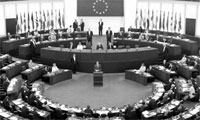
 The European Parliament adopts a resolution on Bangladesh on September 18, 2014.
 Over the last few years, the European Union Parliament has been discussing various issues impacting different countries of the world, including Bangladesh and helping resolve those. The human rights issue gets topmost priority on its agenda.
In a resolution passed on September 18, 2014 the European Union (EU) Parliament expressed its concern again over human rights violation in Bangladesh. The resolution also deplored enforced disappearances, extrajudicial killings, political violence and human rights violation by the Rapid Action Battalion (RAB). It called upon the Bangladesh government to bring back the state security forces, including police and the RAB, within the bounds of law. It advocated for setting up of an effective and fully independent human rights commission. It also expressed concern on the recently adopted media policy and proposed NGO (non-governmental organisation) law. It emphasised on recognition and respect for freedom of the press and media and urged the Bangladesh authorities to revoke the new media policy. It further emphasised the importance of an independent, impartial and accessible judicial system to enhance respect for the rule of law and the fundamental rights of the people. It also condemned violent attacks by opposition groups against both civilians and government targets.
The issues that have been discussed in the EU Parliament are the ones which are being widely talked about at home and abroad in the recent years. Incidents of enforced disappearances and extrajudicial killings have been occurring in the country for the past several years. Different national and international human rights organisations release information on these incidents. Newspapers also report such incidents frequently. Ain O Salish Kendro (ASK), a human rights organisation, released some figures in July 2014 covering first six months of the year. According to its report, 117 people were killed in political violence, 94 people died in alleged cross-fire or in custody and 74 people were picked up or kidnapped allegedly by law enforcement agencies of which 23 dead bodies were recovered later. During the period, 71 dwelling houses, 192 business organisations and 164 idols and mandirs of the Hindu community were ransacked. According to this report, 265 women were raped, 140 were victims of dowry and 20 were victims of acid throwing. Furthermore, four women, who were victims of rape, committed suicide and three males and two females were killed for opposing sexual abuses.
The ASK further revealed that during six months under review, three journalists were killed and 130 media men were wounded. During the same period, eight Bangladeshis were killed in BSF firing, four Bangladeshis were tortured to death and 25 persons were injured by them.
Some RAB personnel are alleged to be involved in the gruesome seven-murder incident which occurred at Narayanganj in April last. They have already been arrested. The EU Parliament urged the Bangladesh government to end the RAB's impunity in their illegal activities.
Now, it is up to the government of Bangladesh how it will react to the resolution of the EU Parliament. One approach is to ignore such a resolution, as it did in the case of other resolutions which asked for a fair, inclusive and credible parliamentary election, cessation of violence, improvement in the garment sector and improving human rights situation in Bangladesh. The alternative approach is to correct the adverse situation of human rights, improve the condition in the garment sector and take political and constitutional initiatives for a mid-term credible election.
The policymakers should note that Bangladesh is not a big power nor is it a rising power like China or India. The country's position is not even comparable with Brazil in South America, Iran in the Gulf, Malaysia or South Korea in South-East Asia.
All circumstances suggest that Bangladesh has a deep relation with India, friendly ties with the USA, good relationship with Japan and China.
The EU is very important for Bangladesh. Strained relationship with the EU is not desirable. In terms of the volume of exports, particularly readymade garments, the EU is the principal importer. Bangladesh has already suffered a setback as the US suspended GSP (generalised system of preferences) facilities for the country. Analysts think that this move by the US has a strong linkage with Bangladesh's domestic labour relations and politics.
Policy-makers should realise that by concluding a cooperation agreement with the EU in 2001, Bangladesh benefited greatly and got duty- and quota-free access of all its exports to European markets. About 70 per cent of exports go to the EU countries. About 88 per cent of the total exports of readymade garments and knitwear from Bangladesh enter the EU markets. The country earns about 10 billion Euro, which is more than half of the country's total exports, by exporting goods to the EU.
The 28-member EU matters diplomatically and economically. Moreover, there are many strong political and human rights groups in Europe which closely monitor the events happening in many regions and countries, including Bangladesh. It is to be noted that the latest resolution in the EU Parliament was jointly moved by some strong political groups like Alliance of Liberals and Democrats for Europe, Alliance of European Conservatives and Reformists, Progressive Alliance of Socialists and Democrats, European United Left-Nordic Green Left, Group of the Greens European Free Alliance, Group of the European People's Party (Christian Democrats) and European Democrats.
One should not think that the EU will not monitor and follow up the resolution of its parliament. The Bangladesh government should proactively respond to the EU Parliament's resolution and try to settle the issues amicably and as promptly as possible.
The writer is an economist and columnist.
chowdhuryjafar@ymail.com
© 2026 - All Rights with The Financial Express

