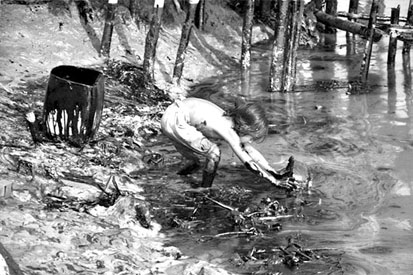
 A little girl contributes to cleaning up oil spill in the Sunderbans.
 Enough has been written and told about the Sundarbans, the world's largest mangrove forest, after the spill of 3,58,000 litres of furnace oil following sinking of oil tanker Southern Star 7 in the Shela River on December 09, 2014. The forest lies along the coastal areas of India and Bangladesh. In Bangladesh, it covers an area of about 0.60m ha, of which 0.41m ha is land and the remaining area is under water in the form of rivers, canals, creeks and estuaries It is about 4.2 per cent of the total land area of the country and about 51 per cent of the total forest areas, managed by the Forest Department.
Systematic management of the Sundarbans was introduced in the 1860s after the establishment of the Forest Department in the then province of Bengal. It was declared a reserved forest in 1875-76 under the Forest Act. The water areas in the Sundarbans comprise fresh water that originates from the Ganges and saline water from the Bay of Bengal. For its extraordinarily diverse wildlife, the World Heritage Committee of the UNESCO marked the Sundarbans of Bangladesh as the World Heritage Site in 1997. Accordingly, the government also declared it so in that year.
It was as early as in 1903 that a total of 245 general and 334 plant species were recorded in the Sundarbans. Since then, there have been considerable changes in the status of mangrove species. Sundari and Gewa are the two most extensively-growing trees in the forest. There are various other plants like Gewa, Golpata, Dhundul, Hogla, Passure, Keora, Goran, Karanja, Garjan and many others.
The Sundarbans is very rich in wildlife. A total of 425 species have been found to exist there. Of these, 49 species are mammals, 315 birds, 53 reptiles and 8 amphibians. Among the mammals, the Royal Bengal tiger, plambious dolphin, spotted deer, barking deer, wild boar, monkey, flying fox, mongoose, etc. are famous. Among the common reptiles, crocodile, angle monitor, yellow monitor, rock python, green turtle, flap-sheel turtle etc are found in abundance in the Sundarbans.
The birds of different categories abound in the Sundarbans. Various fishes including Hilsa Shad, Seabass, Giant and Tiger Prawns, Fatty Catfish, Giant Oyster, Silver Jewfish etc. are available.
The Sundarbans plays an important role in the economy of the south-western region of Bangladesh by providing raw materials of wood-based industries, forest products like honey, bees-wax, fish, thatching materials, crustaceans and mollusks resources. The fisheries in the Sundarbans support about 150,000 fishermen who use about 25,000 registered non-mechanised and mechanised fishing boats. Dubla Island is situated in the extreme south of the Sundarbans and is renowned for huge fishing activities. About 30,000 fishermen work during October-March period every year. Seventy per cent of fish production in the Sundarbans comes from Dubla Island fishing.
The Sundarbans is the best gift of nature. It protects southwestern Bangladesh from severe tidal bores and cyclones. Scientists and environmentalist say that the forest saved Bangladesh from the horror of the deadliest natural disaster, the Tsunami that occurred on December 26, 2004 due to the existence of the largest mangrove forest. The Tsunami and the Indian Ocean earthquake of 2004 were so severe that it killed 2,30,000 people in 14 countries. This catastrophe hit the landmass bordering the Indian Ocean. The coastal areas were inundated with waves up to 30 metres (100 feet) high. It was caused by an earthquake with a magnitude of 9.1-9.3, the largest ever recorded on a seismograph that made the entire planet to vibrate. Indonesia was the hardest-bit country, followed by Sri Lanka, India, Thailand, the Maldives, Somalia, Myanmar, Malaysia and the Seychelles.
The economic, social and environmental impact of the Tsunami was severe. It grievously damaged the ecosystems along the coasts of the Indian Ocean starting from Sumatra and spreading up to Somalia in Africa.
The preservation and protection of the Sundarbans is the moral and legal responsibility of the government and the people of Bangladesh. The movement of vessels through the Sundarbans and the oil spill should not be taken lightly. UN bodies like the UNESCO and the Ramsar and the International Wildlife Conservation Society strongly voiced their concerns over the oil spill in the Shela River and the plying of commercial vessels through the rivers of the Sundarbans. The Parliamentary Standing Committee on the Forest and Environment Ministry also expressed its concern. It deplored the Shipping Minister's remarks that the oil spill in the Sundarbans would not adversely affect the forest and its biodiversity. The Shipping Minister is reported to have rejected the Environment Ministry's plea to permanently ban plying of commercial vessels on the Shela River to save the Sundarbans.
However, the fact is that such kind of incident, according to global experience, would have a long-term effect on the mangrove forest and environment. It may affect the flora and fauna in the Sundarbans if co-ordinated efforts are not undertaken. According to a survey, conducted by the US-based Wildlife Conservation Society and Wild Team, there is no trace of dolphins along 120 km area from Mongla to the Bay of Bengal. In the Shela River, dolphins were used to be found almost throughout the year as it is known as a sanctuary of dolphins and crocodiles. Initially, over 70 km was littered with oil spill in the Sundarbans. It has spread to different areas further through different branches of the rivers.
Now the task is to assess the impact of the oil spill and also that of the movement of commercial vessels in the rivers of the Sundarbans. The enquiry committee of the Ministry of Environment and Forests completed its probe saying that the damage is less than what was thought of. A UN team is now visiting the Sundarbans and collecting samples of water and soil. Its report will come after a couple of days.
Oil spill in the Shela River, in fact, gives a message that the Sundarbans is at stake from man-made calamities. The forest should be managed by an authority to be created by law with full legal, administrative and financial powers. Movement of cargo and commercial vessels in the rivers of the Sundarbans should be stopped immediately. Alternatives routes for ships and vessels should be developed.
The Sundarbans should be protected to save eco-systems. It should be saved to face the ferocity of Tsunami.
The writer is a former environment secretary and a columnist.
chowdhuryjafar@ymail.com
© 2026 - All Rights with The Financial Express

