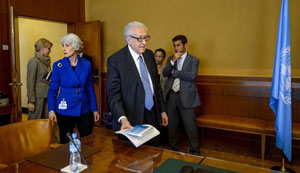
 UN-AL envoy to Syria Lakhdar Brahimi (C) and US Undersecretary of State for Political Affairs Wendy Sherman (L) are seen in Geneva.
 No-one really expected a lasting Syrian peace deal and political solution to emerge in Switzerland over the fourth week in January. The Geneva II peace talks convened through the joint efforts of the United Nations Secretary General Ban Ki-moon, Arab League Envoy Lakhdar Brahimi, US Secretary of State John Kerry, British Foreign Secretary William Hague and Russian Foreign Minister Sergei Lavrov was instead seen by most as an important step towards possible understanding between actors playing out their role within a complex political paradigm. Optimists, on the other hand, had hoped that a decision for a durable ceasefire and some breakthrough might eventually emerge after the talks in Montreux and then in Geneva. This latter expectation has not come about.
Western intelligence agencies had apparently built their hopes on some sort of breakthrough on purported signs that support for the Syrian regime was brittle and that some senior regime figures from the governing Assad regime was prepared to defect. Such an assumption was, however, shot down with Syrian Foreign Minister Walid Muallem, head of the Syrian delegation, clearly indicating that senior regime figures were not prepared to turn on President Assad and negotiate a future without him. Mr Assad's future was a "red line" that could not be crossed, he told the Syrian state news agency.
In almost three years of civil war, there was no dialogue before between the Assad regime and the opposition. And even in Geneva, the opposition figures who were talking do not, by and large, speak for the armed groups doing the fighting. Nevertheless, getting the Geneva process under way can be looked upon as an achievement by itself.
It may be recalled here that during the UN-backed meeting in 2012, a communique was issued on June 30, 2012 after a meeting in Geneva of the UN-backed Action Group for Syria. It stated that any political settlement must deliver a transition that offered a perspective for the future that can be shared by all in Syria, establish clear steps according to a firm timetable towards the realisation of that perspective, could be implemented in a climate of safety for all, stability and calm, reached rapidly without further bloodshed and violence, and was credible. It was also suggested that the key steps in the transition should include: establishment of a transitional governing body with full executive powers that could include members of the government and opposition, formed on the basis of mutual consent, participation of all groups and segments of society in Syria in a meaningful national dialogue process, review of the constitutional order and the legal system, free and fair multi-party elections for the new institutions and offices that have been established and full representation of women in all aspects of the transition.
None of the above has taken place. In the meantime, more than 130,000 people have died and more than two million Syrians have fled their country and sought sanctuary in Turkey, Jordan, Lebanon and Iraq. Another two and half million, by conservative estimate, are internally displaced and living a dire existence without adequate food, shelter and medical support.
The initiative for a peaceful resolution in Syria, however, received a boost and gained impetus after a chemical weapons attack on the outskirts of Damascus killed hundreds of people on August 21, 2013. One month later, on September 27, the UN Security Council unanimously adopted Resolution 2118, which demanded the destruction or removal of Syria's chemical stockpile by mid-2014 and also called for the "convening, as soon as possible, of an international conference on Syria to implement the Geneva Communique", and for "all Syrian parties to engage seriously and constructively" and be committed to the "achievement of stability and reconciliation". The Geneva II peace talks, a result of Resolution 2118, had, however, to tackle another problem. It related to Ban Ki-moon's unexpected invitation on January 19, 2014, to Iran, a crucial ally of Syrian President Assad, to join the start of the peace conference. He did so based on the belief that Iran was part of the solution to the crisis in Syria.
As soon as it was announced that Tehran had accepted the offer and pledged to play a "positive and constructive role", the opposition National Coalition declared that it would refuse to attend the talks unless Iran was excluded. The US said it viewed Mr Ban's invitation "as conditioned on Iran's explicit and public support for the full implementation of the Geneva Communique". It also noted that Iran had deployed military personnel in Syria and supported the Lebanese Shia Islamist movement, Hezbollah, which has sent fighters to bolster Mr Assad's forces.
A day later, Mr Ban rescinded his offer after Iran refused to endorse the Geneva Communique, particularly its call for a transitional government.
The controversy highlighted once again the regional and international complexities that bedevil the current Syrian situation. In this context, one also needs to remember other vexing issues that exist with regard to Syria as understood by the United States, Russia, Saudi Arabia, Israel, Hezbollah and some others within a difficult ideological paradigm that influences events within this sensitive region. Iran eventually did not participate in the talks but its President Rouhani made it clear in Davos, during his participation in the World Economic Forum, that elections would be the best way to end the civil war. He has also warned that the West could not impose a political solution on Tehran's neighbour and ally. It may be recalled here that Iran's central role in Syria mirrors, and is part of, its wider positioning and influence across the Middle East.
Rami G. Khouri, director of the Issam Fares Institute for Public Policy and International Affairs (IFI) at the American University of Beirut, has correctly pointed out that Iran has deeply invested in the current and future condition of the Assad government and has shown beyond doubt that it is prepared to go to great lengths and expend much money, arms, troops, and political support to maintain Assad's incumbency. Iran's relations with Syria and Hezbollah in Lebanon have been the most tangible and lasting regional successes of the Islamic revolution that overthrew the Shah in 1979. A strong political relationship with Damascus is consequently critical for Iran's continued tight alliance with Hezbollah. These three actors form the "Deterrence and Resistance Front" that seeks to check or roll back the influence of the US and Israel in the region, while also assisting local actors in other countries that join it in confronting the policies of Saudi Arabia across the region.
The overthrow of the Assad government would be a major blow to Iran's regional network of allies and would seriously weaken its stature and influence across the Middle East. It would probably also embolden Saudi Arabia and others, who fear Tehran's links with Shiite Arab populations, to step up their political confrontations with Iran in countries like Lebanon, Iraq, Yemen and Bahrain.
It would be useful to refer here also to the response to the ongoing efforts in Geneva in some of the countries involved in this exercise. Their respective media have drawn their own inference. Russia has been backing the Syrian regime from the start of the uprising. The Russian media pundits believe that the meeting has failed to overcome major disagreements. Pavel Tarasenko has pointed out in the daily Kommersant that the meeting failed to find an answer regarding the future of Syrian President Bashar al-Assad. Yuriy Paniyev, writing in Nezavisimaya Gazeta, has however taken comfort from the fact that the meeting took place and the government and opposition representatives sat down together despite existing challenges. The US media, which has followed the evolution in Syria very closely, due to the influence of the Jewish lobby, has not been happy with the efforts of the US Administration. The influential Washington Post took the Obama administration to task over its policy on Syria, pointing out that it was all very well for John Kerry to refer to the Syrian regime's "systematic torture and execution of thousands of prisoners", but that "the diplomatic initiative that Mr Kerry launched offers no means to hold the regime of Bashar al-Assad accountable for these atrocities, or even to stop them". "On the contrary", the paper fears, "it may serve to prop up the Assad government by treating it as a legitimate party to negotiations about Syria's future. The media in Qatar, Turkey and Saudi Arabia, known for their support of the Syrian opposition, have been pessimistic about the Geneva process. They have, instead, urged on the expeditious departure of President Assad from the scene and have reiterated that only a political solution minus Assad will resolve the problem.
One can only hope that the talks will continue and least common denominators will be identified between the opposing parties. Reports are emerging that, as a humanitarian gesture, the Syrian government is willing to permit women and children to leave the war-affected zone of Homs and for food to reach the besieged areas. The Syrian opposition has also apparently agreed to provide lists of detainees held by armed groups to the government. These are constructive steps which need to be supported by the international community. The question of power transfer could be addressed slowly.
Muhammad Zamir, a former Ambassador, is specialised in foreign affairs, right to information and good governance. mzamir@dhaka.net
© 2026 - All Rights with The Financial Express

