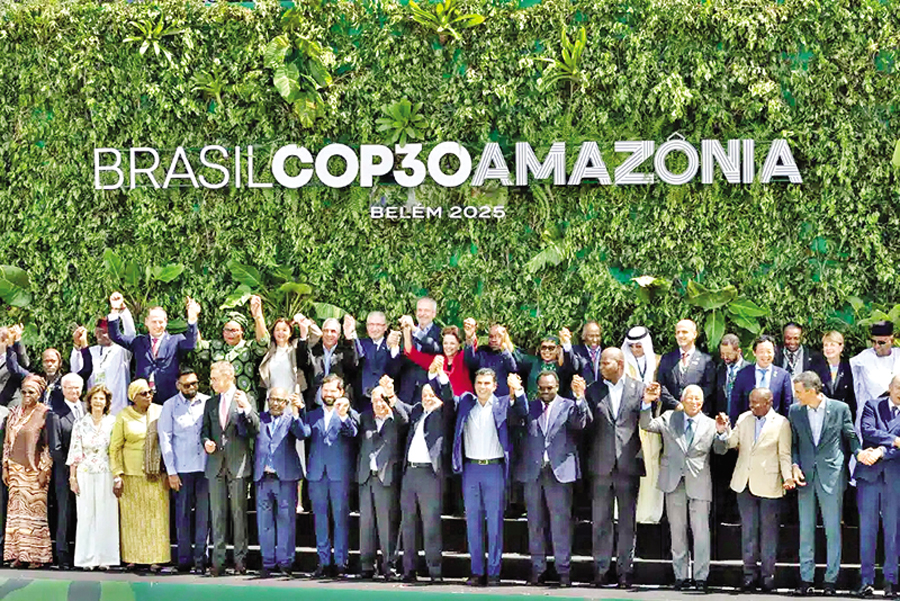
The thirtieth United Nations Climate Change Conference, (COP30) held in Belem, Brazil from November 10 to 21, concluded with a compromise agreement, meaning it fell short of expectations of the majority of participants. In a conference of a few major powers and many countries with little political and economic clout, compromise is always at the cost of the interests of the latter. This has been proved time and again in the annual meetings held under the UN Framework Conference for Climate Change (UNFCC) since-1995. The just concluded COP30 in Brazil has been no exception. Its outcome became a forgone conclusion when it was announced that United States would not send any delegation and China and India would not be represented by their head of state and government. These are the countries that are major contributors to adverse climate change leading to increasing global warming. The irony of their absence is that in recent years they have themselves experienced extremes in weather conditions, inflicting great sufferings to their own people and enormous loss to their economies. Because of the fine-tuning of the agenda by the host country Brazil, there was a sliver of hope that COP30’s achievements would be reasonably satisfactory to all stakeholders. In the event, the fossil fuel lobby laughed all the way to the bank, leaving the objective of controlling emissions of fossil fuels, particularly CO2, on the backburner. A brief review of the agenda, the discussions, the sticking points and the compromise agreement may give an idea about how, why and to what extent the expectations of the global community to avoid the doomsday scenario of global warming increase of more than 1.5 degree centigrade above pre-industrial level have once again remained unfulfilled.
Agenda of COP30: COP30’s agenda was shaped around Brazil’s vision of shifting from negotiation to implementation and to accelerate climate action, based on the results of the first Global Stocks Take (GST-1) under the Paris agreement of 2015.
The key agenda items of COP30 included: (1) Strengthening climate governance: Brazil called for more effective multilateral processes, faster decision-making and better alignment with realistic implementation.(2) Ambitious Nationally Determined Contributions (NDCs): Encouraging countries to adopt more ambitious climate targets and holding a stocktaking of current NDCs. (3) Adaptation.: Putting adaptation at the centre, including national adaptation plans, financing and following up on the Global Adaptation Goals. (4) Sustainable Development Goals linkages: Ensuring climate action is coherent with broader sustainable development and biodiversity protection. (5) Mobilising Finance: One of the most significant agenda item was climate finance to scale up support, especially for developing countries, for both mitigation and adaptation. Brazil promoted its Baku-to-Belem Roadmap to mobilise US$2.3 trillion by 2035.(6) Global Climate Action Agenda: Engaging non-state actors (civil society, business, cities) through six thematic sectors : energy, forests/biodiversity, agriculture, resilience, social development and enabling accelerating factors like finance, technology etc. (7) Fossil fuels and phase-out debate: Even though not a central item, fossil fuel transition became a highly contentious issue during negotiations. (8) Forests: Given the Amazon location of COP30, forest protection, deforestation and forest- based solutions were high priorities. Brazil announced the Tropical Forest Forever Facility (TFFF) to direct investment to forest-rich countries. (9) Trade and Climate: the Conference broached the intersection of climate policy and trade, including potential trade measures or carbon border adjustments. (10) Just Transition and Social Dimensions: Mechanisms to protect workers, indigenous peoples and communities in transition away from high- carbon industries.
Key discussions and debates: Several major discussions dominated COP30.The most salient ones were: (a) Fossil Fuel Phase-out. The most divisive issue was the debate over phasing out fossil fuels. More than 80 countries pressed for explicit language in the final agreement calling for a roadmap to phase out coal, gas and oil. However, a bloc of oil-producing countries, including Arab Group, resisted this push, warning that targeting the energy sectors could derail the entire deal. In the end, the final negotiated text omitted any binding fossil fuel phase-out language. To salvage the situation, the Brazilian presidency announced two voluntary roadmap outside the formal UNFCC process: one for a just, orderly and equitable transition away from fossil fuels; and another for forest and climate action.
Climate Finance. Finance was central to COP30. Brazil emphasized mobilising both public and private resources. The Baku-to-Belem Roadmap, introduced earlier in 2025, remained a cornerstone, targeting US$ 1.3 trillionth annually by 2035.Part of the discussion focussed on adaptation finance: how to scale up funding to help vulnerable countries cope with the impact of climate change.
Forest Protection. Given the Amazon backdrop, forests featured prominently in the Conference. Brazil launched the Tropical Forests Forever with initial pledges of US$ 5.5 billion from countries like Norway, Germany, Indonesia and France. The aim is to compensate forest-rich countries for preserving their forests. Yet, despite these pledges, negotiations failed to agree on a binding roadmap for zero deforestation by 2030, disappointing many indigenous representatives and environmental groups.
Adaptation and Resilience. COP30 elevated adaptation as delegates discussed national adaptation plans, resilience for cities and Infrastructure, water systems and social development. The Conference outcome included a commitment to triple adaptation finance by 2030.
Just Transition and Social Dimensions. Recognising the social impact of climate transitions, COP30 introduced a just transition mechanism to support workers and communities affected by the shift away from high-carbon industries. There was also progress on gender equity with COP30 adopting, for the first time, a gender action plan in its decisions.
Trade and Climate. Another major thread was the intersection of climate policy and trade. Brazil proposed a Climate Coalition with carbon markets and a border carbon adjustment mechanism , potentially penalising goods from countries not aligned with the coalition’s emissions standard.
Role of Indigenous People and local Communities. COP30 emphasized the role of indigenous people and local communities in climate action. Brazil’s presidency called for their inclusion and recognition. However, many indigenous delegates protested the lack of meaningful engagement, particularly in decisions on forests and land rights.
The bones of contention: While COP30 managed to reach a compromise agreement at the end, the obstacles and differences of views that hindered consensus and progress at every stage merit a brief recapitulation.
(1) Fossil Fuel Resistance. As noted earlier, oil and gas-producing countries strongly opposed binding fossil fuel phase-out resolutions. Their veto effectively blocked more ambitious and binding commitments, leaving only a voluntary roadmap. (2) Geo- political fragmentation. The summit took place in the midst of difficult geopolitical conditions .Tensions between America and Europe over Ukraine war has arrayed Russia and China against the Western alliance. To make matters worse, Trump administration’s foreign and trade policies have created problems within the western alliance itself. The perennial divide between developed North and developing South have pitted countries of the two blocs against each other, making consensus decisions difficult. Finally, energy producers and conservationists have further exacerbated the divide. (3)Institutional strain in the UNFCC. The inability to reach agreement on fossil fuels and deforestation has raised questions about the effectiveness and structure of the UN climate negotiation system. Some observers have pointed out that a few countries continue to hold disproportionate veto power, undermining collective action. (4) Scientific Integrity Concerns. The final text did not reaffirm the IPCC (Intergovernmental Panel on Climate Change) as the definitive ‘best available science.’ Instead, it broadened accepted references to include regional or national studies, raising alarm among scientists that global standards of scientific theory may be weakened. (5) Ambiguous Finance Commitments. Although adaptation financing was pledged, details remained vague. Sources and mechanisms for delivering the tripled adaptation finance were not clearly defined.
The compromise Agreement: Despite deep divisions, COP30 concluded with a compromise agreement. But it falls far short of what is needed to address the climate crisis. A summary of the conclusions, their impacts and future implications is presented here: (a) A package of decisions strengthening aspects of the Paris Agreement was agreed upon which cover mitigation, adaptation, finance, technology, and capacity building. (b) Brazil committed to developing voluntary road maps, one for fossil fuel transition and another for forest and climate, setting examples for other countries. (c) With the launching of Tropical Forest Forever Facility, the Forest Finance has been launched with US$ 5.5 billion pledged initially, aiming to channel funds to forest- rich countries. (d) A commitment to triple adaptation funding by 2030 has been made. (e) Agreement has been reached for the establishment of a mechanism to support workers and communities transitioning from fossil fuel-dependent economies. A proposal for a Climate Coalition including carbon markets and border carbon adjustments was floated and postponed for future discussion and decision.
END NOTE: The decisions made in the COP30 are modest and incremental. They are by no means transformational, which many think is urgently called for. COP30 has taken a step forward but far from the bold action needed to achieve the target of keeping global warming to 1.5 degree centigrade above pre-industrial age.
Dropping explicit language on phasing out fossil fuels has been a great failure of the conference as it is the root cause of climate change and global warming.
hasnat.hye5@gmail.com
© 2026 - All Rights with The Financial Express

