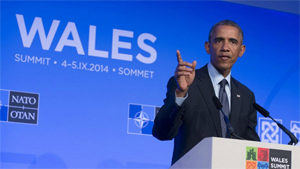
 US President Barack Obama gestures during a press conference on the second day of the NATO 2014 Summit at the Celtic Manor Resort in Newport, South Wales, on September 05, 2014: \"I leave here confident that NATO allies and partners are prepared to join
 Events over the last four weeks have revealed several developments in Iraq, Syria and the adjoining regions bordering Turkey. To this has been added the hesitation on the part of Obama to wade into the deteriorating situation as well as the heightening of the dilemma faced by the Sunni rebel population in Iraq in particular.
Analysts are pointing out for the first time that stifled by the militants of the Islamic State of Iraq and the Levant (ISIS) in their own areas, Iraqi Sunni rebels who took up arms against the Shia-dominated government of Nouri Maliki are signalling for the first time that they are ready to turn against ISIS if Sunni rights are enshrined in a reformed political order in Baghdad. The rebels, including tribal militants and former army personnel organised in military councils throughout the Sunni areas, however see American and international guarantees as crucial to any such deal. This, they believe could lead to a real political solution. For this reason, the tribal and military rebels are proposing a national reconciliation conference under international auspices, with all factions except ISIS invited and also the Shia militias, which they regard as equally bad as, or worse than, ISIS. Unfortunately, this will not help the stated cause of Obama's principle of inclusiveness. It may nevertheless be recalled that such a high-level "national accord" conference was held in Cairo in 2005, but the outcome was never followed up.
It may be recalled that the tribal and military rebels, who had been fighting government forces since January, played a significant role in the spectacular advances scored after ISIS entered into Iraq from Syria in June and captured the second city, Mosul, among other mainly Sunni areas. However, since then, some of these Sunni groups appear to have been strictly monitored, with ISIS ordering them to join its own ranks or disarm.
In response, some of these tribal militants clashed with the ISIS at Garma, near Falluja which reportedly led to the death of 16 Islamic radicals. After this incident these rebels decided to stand down, because they realised that they were not ready to fight ISIS in the current circumstances. They have also alleged that they do not have backing from Baghdad or Washington. In this context they are drawing comparison with what has been happening in Kurdistan where the Kurdish Peshmerga fighters fighting against the ISIS are being supported by the Americans and other powers.
It appears that caught between two fires, the position of the Sunni rebels from within Iraq has changed sharply since the ISIS operation began in June. Originally, at the beginning, they had hoped that a joint effort would carry the Sunni insurgency into the heart of Baghdad, ousting Prime Minister Maliki and overturning the current constitution and political order. Their leadership has disclosed to the BBC that after such an evolution, they would have turned on the ISIS militants and driven them out of Iraq, as they had earlier done with al-Qaeda in 2007. They now realise that such a scenario is more than unlikely. These rebels are also suggesting that under Mr Maliki's nominated successor Haidar al-Abadi, who comes from the same party, things are unlikely to change very much. It may be mentioned that Mr al-Abadi has to present his new Cabinet by September 10.
It is being hoped that Mr. Abadi's new Cabinet will have better power sharing. If such a deal can be hammered out, and most Sunnis regard the new arrangement as fair, the tribal rebels may find themselves with no choice but to sign up, or risk finding themselves politically isolated and physically under threat from both ISIS and a US-backed coalition on the ground.
However, national security strategists have pointed out that in case of such an eventuality, where forces are thrown into battle against ISIS-held Sunni areas with US air support under a new al-Abadi government, the Americans might find themselves doing what they have been trying to avoid - backing one side in a sectarian civil war involving horrendous carnage and destruction.
In the meantime, President Obama, in his comments to the press has noted that it is too soon to say what steps the United States will take against ISIS in Syria. In this regard he has observed that "I don't want to put the cart before the horse," and has also clarified that "we don't have a strategy yet."
Obama's remarks followed days of speculation about whether the United States had a plan to go after ISIS in Syria, after initiating token support to Baghdad against ISIS in northern regions of Iraq. Obama has also said that Iraqi and Kurdish forces are making inroads but "the idea that the United States or any outside power would perpetually defeat ISIS ... is unrealistic," unless there is a strong, trusted and inclusive Iraqi government.
His hesitation appears to have stemmed from not knowing exactly what the US Congress feels not only about the emerging situation but also about what kind of action needs to be undertaken by the US armed forces as part of its regional strategy. He has also interestingly observed that the region has to be dealt with collectively, and getting more moderate Sunnis on board who can be a real alternative for the purpose of governance.
This may however prove to be problematic as Russia, Syria's ally, has repeatedly blocked attempts by the U.N. Security Council urging Syria's President Bashar al-Assad to step down as part of an effort to end the civil war that has wracked the country for three years.
These latest hesitations on the part of the US Administration are being viewed critically by analysts. Marwan Bishara has been especially severe. He has noted that "despite retaining eyes and ears on the Iraqi ground, the advance of the Islamic State group, over the last few months has clearly taken Washington by surprise. Miscalculation and myopia have seemingly marked the execution of the Obama doctrine". Others have mentioned that "the Obama administration remained conspicuously silent as Prime Minister Nouri al-Maliki cracked down on his Sunni rivals, alienated the Kurds and undermined the unity of the country."
In the meantime, the Islamic State group's significant seizure of the Tabqa airbase in the northern Syrian province of Raqqa, after a five-day battle with the Syrian army, has raised fears the group could soon move deeper into the war-torn country and consolidate its control over eastern Syria. It would also be important to note here that the Free Syrian Army (FSA), which is opposed to the Assad regime in Damascus, appears to be losing out to ISIS in strength. The anxiety over ISIS efforts have gained over the last few days because this group is now calling for professionals - doctors and engineers - to move to its territory. This is being interpreted as a long-term state skill building project.
This in turn has raised discussion of the probability of the Assad regime being drawn into an international alliance to fight the dreaded ISIS. Some are suggesting that the perceived threat from ISIS is so great that the Western powers might forget their opposition to Bashar al-Assad, team up with him, and pressure their opposition allies to set aside their own raison d'être and turn full-time against the radicals alongside government forces. Syria, seeking international rehabilitation, would obviously be happy to be a partner in the campaign against radical ISIS, but such a prospect is being carefully scrutinised. France has been the first to oppose such a move. President Obama, on the other hand, has given the go-ahead to carry out surveillance flights over Syria, a course of action that could pave the way for airstrikes against the Islamic State in the country. US Secretary of State Kerry has also hinted at the need to form a global coalition to fight the ISIS.
The convulsive development in the Levant has led to more than three million refugees fleeing from Syria to neighbouring countries (Turkey, Jordan, Lebanon and Iraq1457), more than two million internally displaced persons inside Iraq and nearly 200,000 deaths in Syria. ISIS, in the meantime, with vast funds at its disposal, has organised itself as a highly efficient company. It uses this wealth to expand its popular base, providing public services and repairing damaged infrastructure in the areas it controls. Its use of social media is highly professional. On its websites it also issues reports containing detailed accounts of its acquisitions and operations.
It is difficult to estimate in precise terms the scale of the threat ISIS poses to countries such as Britain (which has recently upgraded the terrorist threat possibilities within Britain) or Europe. Its main targets appear to be in the Middle East. However, it needs to be remembered that over time, many Western citizens, who have gone to Syria and Iraq as ISIS fighters, will return battle-hardened and with new bomb-making skills. Therein lies the danger for greater Europe and other Western nations. This might have led Saudi King Abdullah to warn that the West might be the next target of the jihadists.
Muhammad Zamir, a former Ambassador, is an analyst specialied in foreign affairs, right to information and good governance.
mzamir@dhaka.net
© 2026 - All Rights with The Financial Express

