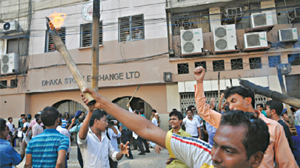
 A file photo shows investors protesting at the stock market crash in front of the Dhaka Stock Exchange building in the capital.
 The issue of ownership control and investors' protection is classic in corporate governance. The controlling shareholders (generally including sponsors/promoters and directors) and top management constitute insiders in corporate businesses. The controlling shareholders are few in number and have a joint ownership of a certain percentage of outstanding share capital, which is sufficient for them to exercise control over operating and financial policies of their business. Separation between the controlling shareholders and the corporate management becomes blurred in this condition. Their interests become congruent and they tend to exploit inside information to their advantage and against the interests of the external shareholders. An information asymmetry problem thus emerges, and a case evolves whereby the insiders tend to expropriate the external shareholders and, sometimes, even creditors and bondholders. A regulatory problem in this case is the protection of the interests of the external shareholders and bondholders.
Bangladesh Securities and Exchange Commission (BSEC) issued a directive to this end on November 22, 2011. It is noteworthy that Bangladesh capital markets experienced an unsustainable bubble in December 2010 and its bust was only inevitable. Listed equities were then being traded at prices which were many times their fundamental values. Overpricing was then common for initial public offerings (IPOs), rights issues, and convertible securities. A 'herd behaviour' ensued. Millions of small investors poured their hard-earned savings into the stock markets. Demand for a relatively fixed supply of shares continued to shift rightward and price spiralling followed. The bubble quickly turned out to be unsustainable and then busted. It happened as Bangladesh Bank pursued a contractionary monetary policy for reining in the double-digit inflation in December 2010. Disgruntled investors staged violent protests daily and the government responded with many reforms. One key reform was to restructure the then BSEC. The flagship directive of the newly-constituted BSEC issued on November 22, 2011 involved specific provisions as to the minimum shareholding by the sponsors/promoters and directors (other than the independent director(s)) of a publicly listed company.
The BSEC directive was believed to reverse the cycle of rapidly declining turnover in the stock markets and included the following provisions:
(a) Sponsors/promoters and directors other than the independent director(s) of a publicly listed company shall jointly hold a minimum 30 per cent of the outstanding shares of the company. In case their joint shareholding falls short of the minimum 30 per cent, they shall acquire the shortfall within six months from the date of the issuance of the directive;
(b) If a director owns less than 2.0 per cent of the paid-up capital and fails to meet the shortfall, a casual vacancy shall arise for his/her seat;
(c) In case of the aforesaid casual vacancy of a director, any individual holding 5.0 per cent (five per cent) or more shares in the paid-up` capital shall be entitled to be a director in the next Annual General Meeting; and
(d) If the sponsors/promoters and directors (other than the independent directors) fail to jointly hold the minimum 30 per cent of the outstanding shares of a company within the deadline, they will not be able to sell or transfer their existing shareholdings. Nor will the company be allowed to raise equity financing by issuing rights shares or repeat public offerings.
A critical review of the directive indicates that BSEC believed that a minimum 30 per cent shareholding by the controlling shareholders was an optimal shareholding, which would force them to work in the best interest of all the shareholders and bondholders. This is a flawed belief and devoid of empiricism. In an environment characterised by ineffective institutions and weak enforceability, a 20 per cent ownership by a group of shareholders (or even less than that) may also give them control over operating and financing policies of the business. Therefore, the asymmetric information problem has little to do with the percentage of ownership by the controlling shareholders. It is rather a corporate governance problem and requires effective legal and institutional oversight.
The directive included a number of contradictions too. Note that a director owning less than 2.0 per cent in the paid-up capital would find his/her seat casually vacant. In the case of a casual vacancy of a director, any individual holding 5.0 per cent or more shares in the paid-up capital shall be entitled to be a director in the next Annual General Meeting (AGM). Both the conditions are seriously prone to cause distortions. They proved damaging for good governance of corporations. Many directors who held less than 2.0 per cent of the paid-up capital but possessed relevant skills for operational and financial management of companies were forced out of corporate boards. Data indicate that many of them did not liquidate their stock holdings during the bubble but lost their directorships. More damagingly, once a board seat fell casually vacant, an individual to be entitled to become a director shall have to own 5.0 per cent or more of the outstanding shares. This is ridiculous and inherently contradictory. An outcome was that many corporate boards lost their prominent members and became paralysed.
The provision in (d) in fact destroyed the liquidity and value of stockholdings of the sponsors/promoters and directors of many listed companies. More importantly, the provision precluded companies from raising equity financing by issuing rights shares/RPOs and pursuing positive NPV projects. The directive has, therefore, contributed to value loss to the shareholders and profitability losses to the companies. Its impact on a depressed stock market is unambiguously negative.
Not surprisingly, many directors who fell short of the minimum 2.0 per cent shareholding requirement (or as such many corporate boards failing to own the minimum 30 per cent of the outstanding shares) filed petitions to the High Court. This was obvious at the very beginning that the inherently flawed directive would be highly contested in the court. The High Court on May 14 declared the BSEC directive illegal. The High Court said that the BSEC provision had superseded the Banking Companies Act, 1991 that governs the banking sector. The court further observed that the parliament's power of making laws cannot always be delegated to an agency. The Appellate Division of the Supreme Court on the following day stayed the High Court verdict.
If one applies any reasonable criteria, stock markets in Bangladesh are in a deep crisis. Risk of expropriating investors and bondholders continues to go unabated. To protect investors and bondholders from potential expropriation, the issuance of de jure directives will hardly make a difference. The High Court observation that the rule-making cannot always be delegated to an agency bears strong implications for the future of BSEC. The real problem lies with the incapacity of the stock exchanges and the stock regulator and the lack of enforceability of the rule of law. BSEC cannot deny their responsibility that the protection of external shareholders and other creditors crucially depends on its regulatory effectiveness.
It is true that day-to-day price fixing is not BSEC's duty, but the regulator must ensure that IPOs, RPOs and convertibles are fair-valued. Identification and prosecution of manipulative stock trading is truly a responsibility of BSEC. The regulator can employ expert panels to review and detect loopholes in the securities laws. The existing legal provisions are hardly effective for controlling insider trading and serial transactions. Stock exchanges are pseudo regulators. Their regulatory role is poorly defined and rarely enforced. Stringent internal control audit of the listed companies is an imperative. Time will say if the demutualisation of stock exchanges will lead to good corporate governance for the exchanges. The role of chartered accountants is, in fact, unregulated and audit opinion is rarely perceived reliable by the stakeholders. It is difficult to understand that the Institute of Chartered Accountants of Bangladesh (ICAB) can regulate the conduct of its members, who in turn constitute the ICAB Council and govern the institute. A framework of shared responsibility is urgently needed whereby the central bank, BSEC, stock exchanges, and other stakeholders shall act together for a vibrant capital market in Bangladesh.
The fact that the DSE recorded an annual turnover of only 8.3 per cent in terms of GDP in 2013 is no indication of a stable capital market in Bangladesh.
The writer teaches at the University of Dhaka. mizan@univdhaka.edu
© 2026 - All Rights with The Financial Express

