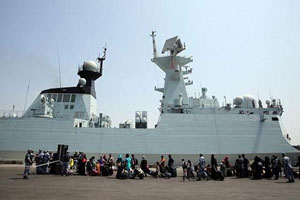
 A total of 225 people from 10 countries wait to board China\'s Linyi missile frigate in Yemen on April 02, 2015.
 Since 2012, China has emerged as one of the dominant trading partners of the Middle Eastern region. This engagement on the part of the countries from this area has continued to grow particularly because of China's growing dependence not only on crude oil but also on oil products. This reliance on the energy trade has intensified over time and now casts its own strategic fingerprint on China's bilateral relations, especially, with the Gulf Cooperation Countries (GCC), Iran and Iraq.
Both sides have resorted to adaptive strategies on the basis of their respective positions and each other's comparative advantages. It must be understood here that there has been an evolution within this paradigm. From the 1960s when the Organisation for the Petroleum Exporting Countries (OPEC) was established until the beginning of the 21st century, the energy-rich countries of the region enhanced their income on the basis of exports largely to Western Europe and North America. This trend of export energy revenue started to change over the last fifteen years. It is now acknowledged by economists that this format has moved to a different direction. In 2013, about 19 per cent of OPEC exports moved to Western Europe and North America, whereas close to 70 per cent of petroleum products went on to emerging Asian economies.
China today has become progressively more dependent on foreign oil, especially from the Middle East. Statistics indicate that in 2013, China imported 5.6 million barrels per day (b/d), second only to the 7.7 million b/d imported by the United States. It is now estimated that China might overtake the United States as the world's largest oil-importing country by end 2015. Five out of China's top ten oil suppliers are located in the Middle East: Saudi Arabia, the United Arab Emirates, Iran, Iraq, and Kuwait.
The Chinese authorities are now estimating that its foreign oil dependence could increase to 61 per cent for the five-year planning period which will end in December 2015. It is also believed that Middle Eastern countries will account for a substantial 43 per cent of the imported supplies. Saudi Arabia, it is understood will become China's single largest oil-trading partner, supplying 15 per cent of the country's total annual imports.
This Middle East-China energy trade nexus has expanded beyond oil. It now includes China's growing interest in importing natural gas. It may be noted in this regard that until 2011, natural gas constituted 4.6 per cent of China's total energy consumption mix, far below the world average of 23.8 per cent. However, since 2006, China's natural gas consumption has increased steadily at an annual rate of about 16 per cent. In 2012, the Chinese National Development and Reform Committee (NDRC) further spurred demand growth by launching an implementation policy to promote the use of natural gas in a wide range of sectors, from central heating to electricity generation.
This dynamic growth in demand has resulted in China having to rely more on foreign imports. The NDRC now expects imports in this sector to rise by almost 35 per cent by the end of 2015. At this point of time Central Asia is providing the major share of China's natural gas imports. Qatar has been supplying liquefied natural gas (LNG) to China since 2009 and has now become its second largest supplier. China is now Qatar's fifth largest natural gas customer, accounting for 6.4 per cent of its natural gas and LNG exports.
From the perspective of trade, the interdependent relationship between the Middle East and China has assumed a symmetrical balance, where the Middle East, according to experts, need China as much as that country needs the Middle East.
ENERGY INVESTMENT: There has been another important development. The Chinese, given the possible future oil paradigm requirement, are participating in energy investments and foreign direct investment in oil and gas extraction since 2007. Direct investments, either in the form of whole ownership or equity investments has increased China's access to "equity oil"-i.e., guaranteed supplies at cheaper-than-market prices. It may be mentioned here that this has been most noticeable in Iraq where China has surpassed the United States as the single-largest foreign investor in the country, and, in return, Iraq has became China's third largest oil supplier. In fact, China today imports nearly 170 million barrels of crude oil from Iraq. This has mostly happened because of its decisive investment in Iraq's oil sector.
INFRASTRUCTURE CONSTRUCTION AND DEVELOPMENT: Another factor has expanded the two-way dependency. It has been in the form of infrastructure construction and development to facilitate the intensifying energy trade. That in its own way is increasing interdependence. A case in point has been the decision in 2011 by Qatar to build its first LNG terminal in Jiangsu in the eastern coastal province of China. This was done after China National Petroleum Corporation (CNPC) signed the first long-term (25-year) LNG supply contract with Qatar for 3 million tons per year.
Meanwhile, China has also started expanding its pipeline capacity, railroads, and other transportation infrastructure through inland routes to Central Asia and the Gulf states. This is consistent with its "New Silk Road" strategy, which aims to build transport infrastructure through Eurasia, the Middle East, and Europe. It may be mentioned here that China has pledged to spend $40 billion to finance the construction of infrastructure at major checkpoints along old Silk Road trade routes, including those in the Arabian Peninsula. It is being anticipated that this constructive engagement could further extend to highly profitable sectors such as telecommunications, manufacturing, high-tech goods, logistics, and financial services. These steps, it is anticipated, will boost China-Middle East interdependence beyond just energy trade and extend to significant levels its association in commodity trade as well as in business development.
Consistent with this strategy, Chinese President Xi Jinping in June 2014 launched the "1+2+3" China-Arab cooperation strategic plan, urging deeper cooperation to include over time technological transfers and acquisitions in space, aviation, and nuclear energy.
GEO-POLITICAL OR NATIONAL INTERESTS: For many decades China did not consider conflicts in the Middle East and North African region as having a direct impact on its geo-political or national interests. This was because China was not a major stakeholder in the region. Now the dynamics has changed. China, analysts believe, has turned a new page and away from being a mere spectator relying on non-intervention. It now understands that it cannot put its larger national interests in jeopardy.
However, as pointed out by Chaoling Feng at Brookings, China's current position in the Middle East paradigm has acquired a slightly complex scenario. It has been mentioned that "China's position at the centre of a "petroleum triangle" of Saudi Arabia, Russia, and Iran has complicated the picture as its actions might then be interpreted as a measure that might shift the balance of the triangle, challenging the interests of any one of the three.
To this has been added the US view that while China is benefiting from U.S.-led NATO security sustainment operations in the region it is investing little in its stability. Such criticism has especially come to the fore after China's CNPC terminated its joint venture with the Syrian national oil company in the aftermath of the Arab Spring and also more or less withdrew its presence from Libya, after security conditions deteriorated in that country. In this context, China has been reminded that they need to be more pro-active in fighting the ISIS menace in Iraq given their large investment in that country.
A NEW FUNCTIONING MIDDLE EAST STRATEGY: The existing uncertainty in the Middle East (abrupt supply disruptions, whether caused by shifting production quotas, price wars, or violent conflict) has persuaded Chinese decision-makers to try and put together a new functioning Middle East strategy. They know that the relatively stable countries in the MENA region-mainly the members of the Gulf Cooperation Council-are attracted to the Chinese philosophy of "stability-precedes-all" model as embodied by China. The Chinese socio-political groups have been watching carefully how GCC members, particularly Saudi Arabia and Qatar, have been facing strained and sometimes troubled relations with their Western partners. China also knows that the GCC countries view China as a potential balance to their reliance on the West's provision of stability - especially now that China has become the single largest foreign business stakeholder in the region.
For obvious reasons, China will be very cautious about how it will tread the Middle East path in the coming three years. They will similarly watch carefully about developments in Iran.
Nevertheless, I strongly believe that China will also take steps to persuade the GCC bloc to focus not only on trade but also on investment in each other's regions, particularly in the peripheral sectors such as shipping, infrastructure, and high-tech goods. Discussions are apparently underway in this regard and China has been drawing GCC's attention to the fact that this can play an important role in creating new incentives for economic growth in that region and also jobs for low-skilled youths. This, in turn, would help reduce high youth unemployment rates, a fundamental source of instability in the GCC and neighbouring Middle East countries.
The writer, a former Ambassador, is an analyst specialised in foreign affairs, right to information and good governance.
muhammadzamir0@gmail.com
© 2026 - All Rights with The Financial Express

