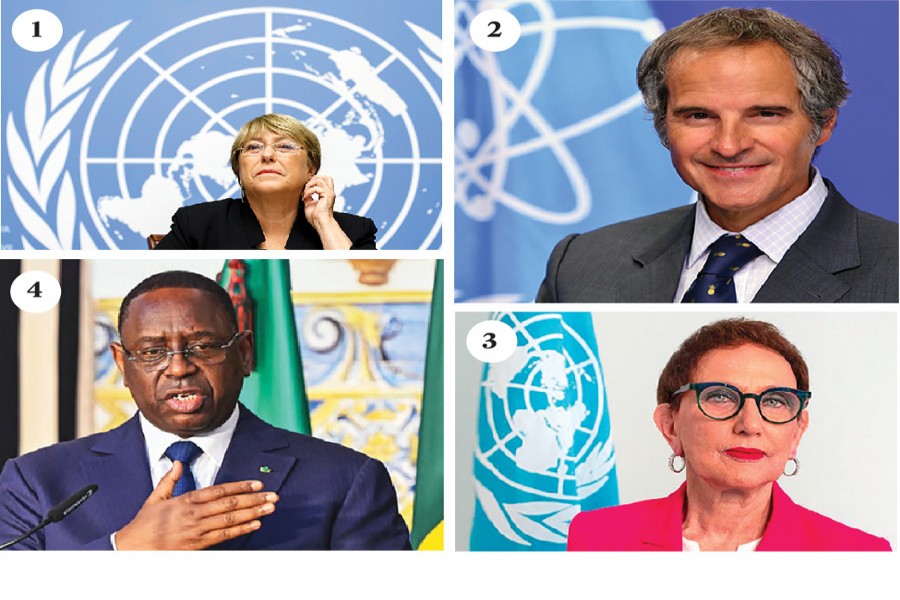
 Potential candidates: Clockwise (1) Michelle Bachelet (2) Rafael Grossi (3) Rebecca Grynspan (4) Sall
 Geo-strategic analysts monitoring the different dimensions related to the United Nations (UN) has been carefully following the emerging scenario after the race began with 1st April which was the deadline for candidates to be nominated for the next UN Secretary-General.
Two analysts Felix Dodds and Chris Spence have underlined significantly that "we are currently living in one of the most unstable times since the Second World War. Multilateralism is under threat and the UN is facing significant political and financial turbulence".
This dimension has led them to also note that the UN is attempting to address these challenges through the UN80 process, which is trying to repurpose it for the years ahead when the world is likely to become increasingly multipolar. It is being underlined that there will still be plenty for a new Secretary General to do. He or She that will inherit the institution and their staff might be likely to be unclear about exactly what their future role should be.
In this context it has been noted that on every critical issue pertaining to the candidates, the Permanent Five members (P5) of the powerful UN Security Council (China, France, Russia, the UK, and the USA) can veto a candidate. The question that has arisen in the minds of many is whether the P5 share the same outlook in terms of a future Secretary General?
One needs to remember that the United Nations was not founded to be comfortable; it was founded to be necessary. Created in the aftermath of a global catastrophe, its purpose was clear: to maintain international peace and security, to uphold international law, to defend human rights and to promote human dignity and development.
The office of the Secretary-General was never intended to be merely administrative. It was intended to be moral, political and, when necessary, courageous. As member states consider the appointment of the next Secretary-General, they face a decision that will shape not only the future of the United Nations, but also its credibility. The world today does not suffer from a surplus of institutions; it suffers from a shortage of trust in them.
The next Secretary-General must therefore be more than a careful manager of bureaucracy. The world needs a leader with vision, independence and integrity - a leader willing to uphold the Charter even when doing so is inconvenient to powerful member States. While performing required duty the Secretary General will need to remember that it will be possible to be politically expedient, but that might end up being strategically short-sighted. as looking after comfort can only lead to long-term institutional decline.
The United Nations does not need a Secretary General who simply reflects the balance of power within the Security Council; it needs a figure who upholds the principles of the Charter.
Consequently, the next Secretary-General must be courageous enough to articulate a clear vision for what the United Nations is for in the twenty-first century. That vision must be rooted in the organisation's founding objectives: preventing conflict, strengthening respect for international law, protecting human rights and promoting conditions under which peace is possible. These goals, one must remember, require not only administrative competence, but political courage and moral clarity.
The next Secretary-General must also be strong enough to maintain independence from the influence of any single Member State or a group of States. It needs to be remembered that the United Nations does not exist to legitimise the actions of the powerful. It exists to ensure that power operates within rules. The Secretary-General will have difficulty in performing the required role if the SG's office is perceived as operating under the influence of a few influential capitals. The Secretary General must not forget that its greatest asset is legitimacy - the belief that it stands for something larger than the interests of individual Nations.
That legitimacy depends heavily on the personal credibility of the Secretary-General. Ethical leadership, transparency, accountability and consistency must always be the defining characteristics of the Office.
In this regard, the world would do well to remember Dag Hammarskjöld, who showed that the authority of the Secretary-General does not come from military or economic power, but from independence, integrity and a willingness to act when action is required.
Right now particular attention is being given to the identity of the next Secretary-General - nationality, region, and increasingly gender. These questions are politically understandable, but they should not be the most important denominations. The crucial question needs to be not where the Secretary-General comes from, but what the Secretary-General stands for.
Naïma Abdellaoui, International Civil Servant for the last 22 years has correctly observed that the candidate chosen to the UNSG must be able to uphold the Charter, speak with independence, act with courage and restore integrity to the Office. The world needs a courageous Secretary-General.
There is a general expectation that the successful candidate will probably be from Latin America and the Caribbean. This is based on a general sense among UN member states that leadership rotates through the various regional groups and that it is Latin America and the Caribbean's 'turn'.
So far, there has been no public disagreement with this approach, although the regional rotations are considered more of a guideline than a hard rule, and there have been exceptions in the past. For instance, the present UN Secretary General, António Guterres of Portugal, was appointed at a time when it was generally expected that the successful candidate would come from Eastern Europe.
Another consideration is gender. The last time a Secretary General was appointed; there was a strong push to appoint a woman. This did not happen, even though seven qualified women were nominated.
In the straw polls held prior to this hiring process, António Guterres was the only candidate who did not attract a veto. In part, this was because he was the most experienced candidate and the first former Head of State to stand. However, the call for a woman leader is perhaps stronger this time around, backed by a sense that such an appointment is long overdue.
The important candidates appear to be the following-
(a) Michelle Bachelet-- nominated by Brazil and Mexico (although her own country, Chile, has withdrawn its support). Bachelet is a former President of Chile. Bachelet has held the top job in Chile not once, but twice. She has also held two senior roles within the UN. As a former Head of both UN Women and the UN High Commission for Human Rights, Bachelet's insider knowledge is considered as considerable. With the tradition that the UN Secretary-General is chosen by rotating through the various UN regions, Bachelet would likely satisfy those who believe it is Latin America and the Caribbean's "turn" to nominate Guterres' successor. However, some analysts feel that her selection might not be fully acceptable by the Big Five. This is because Bachelet has made comments in the past, particularly during her time as the UN High Commissioner for Human Rights, that may not have been welcomed by specific UN member states. With her own country withdrawing its support for her, it may also make it difficult for her candidacy.
(b) Rafael Grossi has been nominated by Argentina, Italy, and Paraguay. Grossi is the present Director of the International Atomic Energy Agency. He is an Argentine career diplomat. He has held the post of Argentina Ambassador to Austria, Belgium, Slovenia, Slovakia, and International Organizations in Vienna, and the Permanent Representative of the United Nations Office at Geneva. His track record in diplomacy is strong and he is the current Director General of the International Atomic Energy Agency (IAEA) since December 3, 2019. Grossi has dealt with nuclear safety in conflict zones. Being a Latin Leader he appears to have support from the Latin American and Caribbean Group. Some analysts have however pointed out that his aligning too closely with U.S. and Israeli interests might not be acceptable to China and Russia.
(3) Rebecca Grynspan was nominated by Costa Rica. She is the current Secretary-General of UNCTAD and a former Vice President of Costa Rica. Grynspan may not have been a President or Prime Minister, but as Vice President of Costa Rica she climbed close to the summit of her country's political platform. As the first female Secretary-General of UNCTAD, Grynspan has already broken one glass ceiling within the United Nations. She would be bringing with her more than twenty years' experience within the UN system, something that would surely be viewed as an asset during these uncertain times. Additionally, she is familiar with the internal workings of the UN in Geneva, New York and across Latin America, giving her insights into decision making at both headquarters and regionally. This breadth of experience within the UN could be useful to any future UN leader. She was also instrumental in the UN-brokered Black Sea Initiative, agreed by Russia, Türkiye, and Ukraine, that has allowed millions of tons of grain and other foodstuffs to leave Ukraine's ports, playing an important role in global food security. Grynspan also has not only strong credentials on trade, finance and development, but also in recent years she has taken a higher profile on climate change and some of the other big environmental issues of our time. However, she also has the disadvantage of not being prominently involved in peace, security, and conflict resolution. Grynspan's relative lack of experience in this dimension might be considered a possible weakness.
(d) Sall, the former President of Senegal and Chairman of the African Union was nominated by Burundi. As the former President of Senegal (2012-2024) and former Prime Minister (2004-2007), he has the seniority that a UN Secretary General might well need these days. As Chairperson of the African Union, he succeeded in lobbying for the AU to join the G20. He has also mediated in regional crises. However, Sall cannot claim strong UN credentials, but has been the Chairperson of the African Union and a Special Envoy for the Paris Pact for the People and the Planet.
Geo-strategic analysts have also drawn attention to the fact that if all four official candidates fail to win over the P5 through consensus, then other candidates may also emerge. Possibilities from the Latin American and Caribbean Group might include Ivonne Baki (Ecuador), Alicia Bárcena (Mexico), David Choquehuanca (Bolivia), María Fernanda Espinosa (Ecuador), Mia Mottley (Barbados), and Achim Steiner (Brazil). There may also be interest from beyond the region, such as Amina Mohammed (Nigeria), who is the UN's current Deputy Secretary-General.
The world will need to wait and see and also hope for a good outcome.
Muhammad Zamir, a former Ambassador is an analyst specialised in foreign affairs, right to information and good governance. muhammadzamir0@gmail.com
© 2026 - All Rights with The Financial Express

