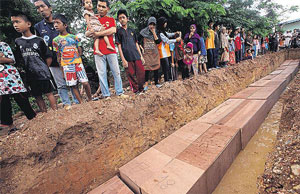
 Coffins containing the bodies of Rohingya boat people line a local Muslim cemetery in Songkhla\'s Hat Yai district, after being recovered from a mass grave last month in Padang Besar, Malaysia.
 Tales of trauma, anguish, ransom, rape and murder perpetrated in the coastal mangrove swamps and forests of Thailand and Malaysia by human traffickers have drawn the attention of conscious citizens all over the world. Anyone, even remotely aware of human rights or those directly involved as rights activists, have expressed criticism and demanded justice against those associated with or involved in these terrible occurrences.
Investigations carried out over the last three weeks have also revealed that senior corrupt officials from Myanmar, Thailand and Malaysia gave protection and facilitated this gruesome drama.
The latest report of discoveries on May 23 and 24 of mass graves has come from Kuala Lumpur. Malaysian Home Minister Zahid Hamidi has revealed that mass graves feared 'to contain the bodies of Bangladeshis and Rohingya migrants (seeking re-settlement abroad with their family members) have been found near suspected detention camps run by people-traffickers.' The Malaya-language newspaper Utusan Malaysia has reported that about 30 mass graves had been found containing 'hundreds of skeletons'.
It may be recalled that Thailand began a crackdown on human trafficking earlier this month following the discovery of its mass graves in its southern coastal forest regions bordering Malaysia. This appears to have thrown the regional trafficking routes into chaos.
The initial mass graves of Rohingya refugees in Songkhla, Thailand were uncovered through unprecedented cooperation of the concerned people and effective use of high-end technology. The international group, Freeland Foundation closely cooperated with the Thai police since January 2015 and also with other local Thai NGOs in this regard. Investigators used telephone forensics technology to detect and catch members of the international human trafficking syndicate responsible for the kidnappings, murder and eventual burial of the victims. Records of phones seized from suspected traffickers were carefully and systematically tracked and the Thai Police were able to generate an "i-2 telephone link chart" which allowed detectives to narrow down their investigation. Revealed data eventually led them to zoom in on Myanmar national Soe Naing Anwar and some of his Thai connections. It has since been ascertained that the modus operandi of these traffickers included sending a large boat into Myanmar each month. This craft would land there and then lure some 300 to 400 Rohingyas in Myanmar's Rakhine District with prospect of jobs in Thailand.
After the boat was full, it would then make its way to the port of Ranong in Thailand where trucks operated by the traffickers would load the Rohingyas and take them to Songkhla. These illegal migrants would then be placed in large detention camps in the forest in two different formats - one section for those who had relatives and friends in Thailand and the other section for those who did not. Subsequently, those in the first section would be asked to get the equivalent of about US$ 3000 from their relatives for their freedom. Freeland Foundation has since revealed that those in the second section were moved to the Malaysia border where they were sold to Malaysian farmers for US$ 1000 each. This, according to banking information, became a multi-million dollar operation with everyone in the nearby villages being involved in the exercise at all the tiers. The most unfortunate aspect was that, quite often, victims held for too long were prone to sickness and alleged rape and serious beatings, leading to their death. None of them received proper medical care or could contact relevant authorities (due to close supervision exerted by corrupt Thai police officials) for their freedom.
A BBC investigative report by Jonathan Head, its South East Asia correspondent, aired on May 22, helped to blow the lid off a well-guarded secret. It pointed out how entire communities in Thailand were involved in helping the traffickers. The connivance of local law-enforcement officials exacerbated the situation.
It has come to light over the last two weeks that Rohingya Muslims fleeing repression in Myanmar had for a long time been victims of such trafficking. Earlier, they used such boats to enter Bangladesh clandestinely; however, when this stopped due to the vigilance of the Bangladesh Coast Guards and Border Guards, they chose to pursue their path to freedom through the jungles of Thailand.
Inquiry has revealed that this dynamics started to evolve towards the middle of 2014. Groups of Bangladeshi illegal migrants, seeking work in Malaysia joined this boat trail. Hundreds of them from different parts of Bangladesh fell victim to the dreams conjured up by the human traffickers. They boarded trawlers and fishing boats from sea beaches near Teknaf and Cox's Bazar and took part in journeys which promised them to provide economic freedom, as opposed to freedom from atrocities as in the case of Rohingyas. In the context of Bangladesh, scrutiny of and reports from rescued migrants (from Thailand or from boats stranded off the coasts of Malaysia or Indonesia) have revealed that mobile phone banking transactions were often used to take part in this illegal process.
The BBC has noted in this context that with rubber trade showing signs of a distinct slump, human trafficking has emerged as a lucrative alternative in Malaysia. Local communities are being sucked into this whirlpool with monetary inducements. A Thai military source has mentioned to the BBC that anyone who managed to escape human trafficking detention centres would be captured and sold back to the traffickers. All this, it has been alleged, was undertaken with senior Thai officials aware of what was happening at the border with Malaysia.
The whole scenario has acquired a gruesome dimension because of an estimated 4000 persons, many of them Rohingya women and children, adrift in boats with dwindling supplies near the Myanmar, Thai, Malaysian and Indonesian coastlines. A Joint Statement issued by the International Organisation for Migration (IOM), the Heads of the UNHCR and the UN Human Rights Office and another by the UN Secretary General have called on Thailand, Indonesia and Malaysia 'to provide the boat people' with effective and predictable disembarkation points and places of safety 'with adequate and humane reception conditions'. These countries have also been asked to establish screening procedures to identify those in need of international protection as refugees. Ban Ki-moon, the UN Secretary-General, has also reiterated that he expects these countries to "uphold the obligation of rescue at sea and maintain the prohibition against refoulement". These calls acquired especial significance given reports of food shortages, dehydration and violence on board these boats.
Thailand, Malaysia and Indonesia had initially shown reluctance in receiving these boat refugees but have since come around their earlier response. It was, however, disappointing to note that at this crucial juncture, Australia, which is always outspoken about human rights and pledged on May 19 its backing for its regional neighbours in stemming the surge of boat-people in SE Asia, turned back vessels with suffering people on board.
One can only hope that the international community will address in a meaningful manner all the important factors associated with this unfortunate paradigm. The foremost among them is the treatment meted out to Rohingyas by the Myanmar authorities. The international community must unite and put more pressure on the Myanmar government to end discrimination against these people. The Rohingyas, who are captive in boats must be allowed to return to their homeland. Democratic politicians within Myanmar, such as Aung San Suu Kyi, must exhibit more leadership in demanding that Myanmar reverses its apartheid-like policies.
The EU has already called for an end to Rohingya persecution and the USA has called upon the Myanmar government to accord citizenship to these people. As a pointer, it has also renewed some sanctions against Myanmar until May 15, 2016. The Rohingyas have lived in that country as an ethnic community for centuries and need to be given all opportunities accorded to other citizens of that country.
Since 1978, Bangladesh, a densely populated country, have received and looked after hundreds of thousands of Rohingya refugees at different times. Consequently, it feels that it has the right to ask more sparsely populated countries like Canada and Australia to step forward and absorb the few thousand boat refugees who are now in misery.
The Bangladesh authorities should also take necessary action to ascertain the identity of the boat people who have managed to land and are in camps. Those of Bangladeshi origin should be repatriated with the assistance of the IOM. At the same time, a joint drive should be undertaken by our law-enforcement agencies to identify those involved in Bangladesh with human trafficking and they should be arrested and punished. Our Navy and the Coast Guard should patrol our coastal waters more effectively so that such human trafficking can be stopped.
The writer, a former Ambassador, is an analyst specialised in foreign affairs, right to information and good governance. muhammadzamir0@gmail.com
© 2026 - All Rights with The Financial Express

