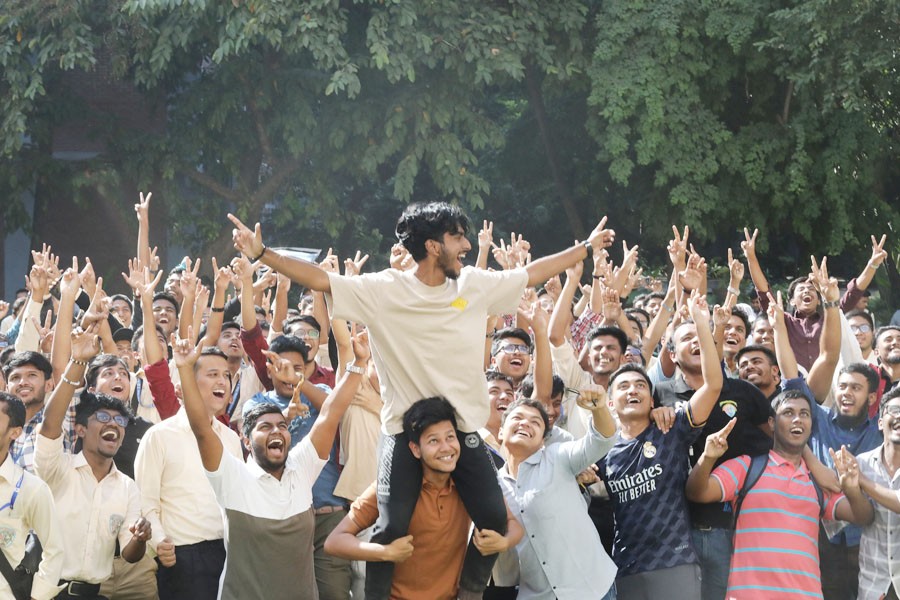
 Young people celebrate their success —FE File Photo
 Bangladesh today stands at a unique historical juncture. With nearly 40 per cent of its population under the age of 25, the nation is brimming with energy, creativity, and aspiration. This vast youth cohort is not just a demographic statistic-it is the most decisive factor in meeting the United Nations' Sustainable Development Goals (SDGs) by 2030. Youth hold the keys to innovation, resilience, and transformation. Yet, the question remains: are we fully empowering them to unlock this potential?
The answer, unfortunately, is complicated. On the one hand, progress in education, gender parity, entrepreneurship, and digital innovation has created remarkable momentum. On the other hand, structural barriers-ranging from unemployment and climate vulnerability to patriarchal norms and digital divides-continue to choke the promise of the youth dividend. If these contradictions are not resolved, the nation risks squandering its most valuable asset at the very moment it is most needed.
Bangladesh has won international recognition for its achievements in education. Net enrollment rates at primary and secondary levels have crossed 98 per cent, while gender parity has nearly been achieved. These numbers align with the spirit of SDG 4 on quality education. But behind this access story lies a sobering reality: quality remains alarmingly weak.
According to the Bangladesh Labour Market Profile 2024/25 and World Bank data, only about 30 per cent of grade-five students reach basic literacy and numeracy competency. Curricula are still dominated by outdated teaching methods, while skills like critical thinking, problem-solving, and digital literacy remain absent. This mismatch between education and labour market needs explains why graduate unemployment reached a staggering 27.8 per cent in 2022.
The challenge is not a lack of degrees-it is a lack of employability. Around 22 per cent of youth aged 15-24 fall into the NEET category (not in education, employment, or training). These young men and women represent both a wasted opportunity and a potential source of social frustration.
Encouragingly, innovative responses are emerging from the margins. Platforms such as Coders Trust, youth-led community digital hubs, and government entrepreneurship fairs are equipping young people with practical skills. The National Youth Entrepreneurship Development Policy 2025 further signals state-level recognition that education reform must go hand in hand with institutionalised pathways for innovation. But unless mainstream education is retooled to meet the demands of a digital, green, and globalised economy, these efforts will remain fragmented.
SDG 8 calls for decent work and economic growth. In demographic terms, Bangladesh is well-positioned: more than 65 per cent of its population is within the working-age bracket. Government apprenticeship schemes and microfinance programmes are showing promise-280,000 apprenticeships were recorded in 2024 with a 90 per cent employment transition rate, while nearly 115,000 youth-led enterprises have been supported in recent years.
However, youth unemployment stubbornly lingers at 16.8 per cent, and gender gap is striking. Only 18 per cent of young women participate in the labour force compared to 49 per cent of men. Patriarchal norms, mobility restrictions, and workplace discrimination continue to hold back half of the country's potential workforce. Even where employment exists, about 85 per cent of youth are trapped in the informal sector with little job security, no formal protections, and limited career progression.
The country's reliance on traditional sectors like garment manufacturing, already under stress from post-pandemic disruptions and global market volatility, adds another layer of uncertainty. For Bangladesh to reap the demographic dividend, labour market reforms must be bold: expanding the formal sector, ensuring social protections, and strengthening the education-to-employment pipeline. Without these, youth will continue to remain underutilised in precarious jobs rather than powering national growth.
Few countries in the world embody the urgency of SDG 13 on climate action as starkly as Bangladesh. Rising seas, devastating floods, and salinity intrusion are not distant scenarios-they are daily realities. In this existential struggle, young people have stepped forward as leaders, advocates, and innovators.
Youth-led organisations such as the Climate Youth Initiative (CYI) have mobilised nationwide campaigns, echoing global movements while grounding them in local struggles. In 2025, the Bangladesh Youth COP produced a 26-point Youth Charter demanding concrete climate adaptation and renewable energy policies. Leaders like Foyez Uddin have leveraged social media to transform climate activism into a mainstream national issue.
But enthusiasm alone cannot overcome structural constraints. Governmental funding remains limited, bureaucratic procedures slow progress, and institutional frameworks rarely integrate youth systematically into decision-making. Suppose the state truly wants to harness youthful energy in climate action. In that case, it must embed them into financing mechanisms, policymaking bodies, and national adaptation strategies-not just as volunteers but as co-creators of solutions.
Bangladesh's youth are not only fighting for jobs and climate resilience, they are also pushing against entrenched inequalities. Digital platforms have become vehicles for young women, indigenous youth, and marginalised groups to amplify their voices. These efforts align with SDG 5 (gender equality) and SDG 16 (peace, justice, and strong institutions).
The government's 2025 launch of the Youth Voice Mechanism is a step in the right direction. It institutionalises dialogue between policymakers and young people from diverse backgrounds. Yet there is a danger of tokenism if such mechanisms remain underfunded or fail to influence real policy outcomes. For inclusion to be meaningful, protective measures for youth activism and investment in leadership development are essential. Otherwise, voices risk being heard but not acted upon.
Bangladesh's digital landscape is undergoing rapid transformation, and youth are at the forefront. UNDP-supported initiatives and youth-led startups are producing fintech solutions, telemedicine platforms, and e-governance innovations. In 2025 alone, 17 youth-led enterprises introduced breakthrough technologies, from solar-powered purifiers for coastal areas to AI-based tools for persons with disabilities. Such innovation directly contributes to multiple SDGs, proving that technology can be both inclusive and transformative.
However, the digital divide looms large. Rural youth and those from low-income families continue to face unreliable internet access, high device costs, and limited training opportunities. This exclusion risks entrenching inequality further, particularly as digital literacy becomes essential for employability. If Bangladesh aspires to be a digital innovation hub in South Asia, policies must ensure affordability, rural connectivity, and context-specific digital education.
The greatest mistake would be to treat youth as a sector rather than as cross-cutting partners in all aspects of national development. Too often, policy approaches remain top-down, fragmented, and symbolic. Forums exist, but they lack funding. Mentorship programmes are rare. Accountability mechanisms to measure the real impact of youth inclusion remain weak.
What is required is nothing less than a cultural shift-from tokenistic consultation to genuine co-creation. Youth must be embedded in budgeting processes, national planning commissions, and institutional monitoring frameworks. Their energy should not be channeled into isolated projects but integrated into the very fabric of governance.
As the clock ticks toward 2030, Bangladesh can no longer afford complacency. Youth are not passive beneficiaries of policy, they are the central protagonists in the nation's journey toward the SDGs. Whether in entrepreneurship, climate activism, civic advocacy, or digital innovation, they have already demonstrated leadership and creativity.
But unleashing this potential requires systemic reforms: aligning education with labour markets, expanding formal sector opportunities, dismantling gender barriers, financing youth-led climate solutions, bridging digital divides, and institutionalising youth in governance. Without these, the demographic dividend could turn into a demographic liability.
Bangladesh's race to Agenda 2030 is, in essence, a race to empower its youth. The nation's future will be defined not by the size of its population but by the urgency with which it trusts its young people to lead. Their energy, resilience, and imagination are the lifeblood of progress.
The choice before us is stark: either treat youth as symbolic participants in development or embrace them as full partners in shaping the nation's destiny. If Bangladesh chooses the latter, it not only stands a fighting chance of meeting the SDGs but also of building a just, prosperous, and sustainable future that extends well beyond 2030.
Dr Matiur Rahman is a researcher and development professional.
matiurrahman588@gmail.com
© 2026 - All Rights with The Financial Express

