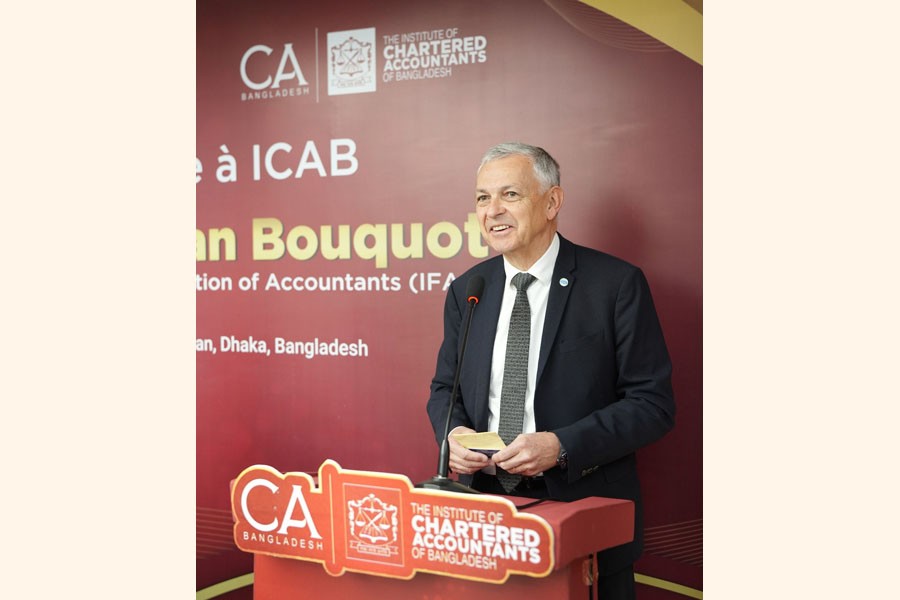
 Jean Bouquot, President, IFAC
 In an era of rapid technological change, rising sustainability demands, and persistent weaknesses in corporate governance, public trust in financial reporting has become more critical than before while transparency, ethics, and continuous professional upskilling are the main three pillars on which that trust must rest, particularly in emerging economies like Bangladesh, said International Federation of Accountants (IFAC) President Jean Bouquot.
In an interview, he, who visited Bangladesh to join the SAFA International Conference held in Dhaka recently, stressed that global accounting challenges are no longer defined by income levels, but by how effectively professions adapt standards, technology, and ethical responsibility to local realities.
In reply to a question, Bouquot said the challenges surrounding international standards adoption, transparency, and audit quality faced by small and medium enterprises (SMEs) are not unique to Bangladesh, but are shared by economies across the world.
He stressed that SMEs constitute a dominant share of global economic activity, yet international accounting and auditing standards have historically been designed with large, listed corporations in mind, resulting in smaller entities often struggling with compliance, interpretation, and implementation.
“It’s not a question of being a high-level economy or a lower level-economy. It’s really an issue for the whole profession,” he said, adding that standards-setters have increasingly recognised the need for simplified frameworks for less complex entities.
Bouquot pointed out that the International Financial Reporting Standards (IFRS) for Small and Medium-sized Entities and the development of less complex auditing standards reflect attempts to bridge this gap. However, implementation remains a challenge, requiring local adaptation and professional judgment, he said.
Role of accountants and auditors: According to the IFAC president, professional accountants specialising in SMEs have a crucial responsibility to help businesses understand what is expected of them, particularly in terms of transparency and consistency.
“What is expected is transparency first. Transparency in the way you answer the requirements, transparency also being from one year to another, respecting the same rules, not playing with the rules,” he said.
Such consistency, the IFAC president noted, is vital for stakeholders including banks, investors, suppliers, and business partners, all of whom rely on financial information to make informed decisions. In an increasingly interconnected economy, corporate reporting can no longer be viewed as an isolated exercise, he added.
Bouquot emphasised that auditors provide assurance based on sampling, not full examination of every transaction, a reality that is often misunderstood by the public. “Audit reports are based on sample testing… It is not possible to check 100 percent [of transactions],” he said.
This, he argued, makes the role of preparers of financial statements equally critical. Without proper record-keeping and compliance by corporates, auditors cannot deliver clean and reliable opinions, he added.
IS AI A threat or opportunity: Addressing concerns over artificial intelligence (AI), the IFAC president rejected the notion that technology would render accountants obsolete. “This is total nonsense,” he said, noting that AI can generate unreliable or misleading information, whether intentionally or unintentionally.
Rather than replacing accountants, AI increases the need for professional judgment, ethics, and verification. He argued that the profession must adapt by developing the knowledge and skills required to understand both the potential and the risks of AI.
“Who are in the profession have to upskill and reskill on a permanent basis,” he said, describing AI as part of a “revolutionary evolution” in accounting and assurance.
IFAC, he added, is encouraging millions of professional accountants worldwide to remain alert to AI-related risks while also using technology to analyse data more deeply and effectively than before.
Expanding scope: Bouquot highlighted the growing importance of non-financial information, including sustainability and environmental, social, and governance (ESG) reporting. Increasingly, stakeholders are demanding more than traditional financial statements to assess corporate performance and risk, he noted.
“So, we also have a role which is expanding,” he said, noting that IFAC has spent the past several years preparing accountants to operate in this evolving reporting environment.
Ethics as the foundation of trust: Bouquot repeatedly returned to the theme of ethics, describing it as the foundation of public trust in financial reporting. “Trust does not go without ethics,” he said. “Without ethics, we are losing everything, not only in one country, but all over the world.”
The IFAC president stressed that ethics differentiates the accountancy profession from technological tools such as AI and from other professions. Ethical conduct, he said, is what regulators, investors, and the public ultimately expect from accountants.
IFAC’s mandate: Clarifying IFAC’s role, Bouquot said the global body does not act as a regulator or enforcement authority. “IFAC is a specific body. We are not making sure things are happening the way they should. This is the role of the regulators,” he said.
Instead, he noted, IFAC serves as the global voice of the accountancy profession, working to ensure that the profession is trusted worldwide. This trust, according to him, benefits national professional bodies and individual accountants by enhancing credibility at both global and local levels.
Bouquot said IFAC supports its members through international education standards, ethical frameworks, and guidance on emerging issues, but implementation and enforcement rest with national regulators and professional organisations.
Looking ahead: Bouquot concluded that while challenges around transparency, technology, and sustainability are significant, they also present an opportunity for the profession to add greater value than ever before.
“What we are dealing with is information that supports the economy,” he said, underscoring the importance of trustworthy professionals who can help organisations of all sizes navigate complexity and change.
Bouquot’s visit marked his first trip to Bangladesh, with local professionals expressing hope for continued engagement between IFAC and the country’s accounting community as it adapts to global standards and emerging risks.
rahmansrdk@gmail.com
© 2026 - All Rights with The Financial Express

