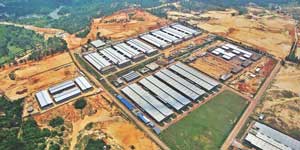
 A partial view of the Korean Export Processing Zone
 Korea has been a valuable partner for Bangladesh for more than four decades. This country has been the guide as to how Bangladeshi entrepreneurs can open new frontiers, promote cooperation, consolidate meaningful friendship and put in place wider economic connectivity through constructive engagement.
We are today focusing on the Republic of Korea because of the latent potential that exists in that country for Bangladesh. Korea is the 13th largest economy in the world with a GDP of 1.3 trillion US dollars in 2013, the 8th largest trading country with more than 1 trillion US dollars of trade, first in the world market in 112 items such as cell phones, shipbuilding, and semiconductors. It is also among the top five in the production of automobiles, steel and petrochemicals.
In addition, Korea is also one of the major investors in the world with a total of $ 371 billion, which includes investment in China of US$ 62 billon and US$ 31 billion in Vietnam. This investment in Vietnam, in particular, has tremendously helped that country's economic and trade perspectives. Over 3,300 Korean companies in Vietnam generate over $ 40 billion annual export which is about 30% of Vietnamese total export- US$ 132 billion. It may be mentioned here that in 2013, only one factory of Samsung Electronics exported US$ 21 billion mobile phones from Vietnam. It is now that country's number one export item superseding garments worth US$ 17.8 billion.
A WORLD OF ECONOMIC INTEGRATION: Korea today has become a linchpin of economic integration and global value chains. It has, in this regard already concluded FTA deals with the US, EU, ASEAN and recently China- in other words, with almost all the principal actors of the global economy. Korea is the only Asian country with the US, EU, China and the ASEAN as FTA partners. From the perspective of global economy, Korea, hub of FTA, can, therefore, best serve as a gateway to larger markets for Bangladesh in this era of economic integration.
Korea could consequently be a significant partner for Bangladesh and be the gateway to larger markets in the short term and also provide a good opportunity to reinforce Bangladesh's overall economic fundamentals in the longer term. Currently Bangladesh's annual export to Korea is only about US$ 300 million (0.05 per cent of Korea's total import) and the investment from Korea to Bangladesh is only US$ 0.6 billion (0.2 per cent compared to Vietnam). In view of the above, our authorities need to engage more seriously with Korea and associate with that country as an ideal partner for our 'Look-East Policy', especially with respect to acquiring state-of-the art technology, learning from their experience of FTA policy, attracting potentially big investors from that country- all these, without any pitfalls of possible political ambition hidden behind areas of growing cooperation.
It would be worthwhile to recall here that it was the Republic of Korea that introduced us to the realm of the ready-made garment (RMG) sector. It opened the pathway which has resulted today in that sector being our principal source of export and employment for over 4 million workers. Korea has also been offering duty-free and quota-free scheme for Bangladesh since 2008. This now covers nearly 95 per cent of all items exported to Korea. This has been particularly useful for RMG exports to that country. This has grown by almost 69 per cent annually for the last 5 years.
MANPOWER RECRUITMENT: In the area of manpower cooperation, the principle of EPS (Employment Permit) has been in place since 2007 in the context of recruitment of Bangladeshi workers for Korea. Through the government-to-government system, about 10,500 qualified Bangladeshi workers have found jobs in Korea. In 2014, 2,700 workers were recruited without brokers being allowed to intervene.
There have been complaints that Bangladeshi unskilled or semi-skilled expatriates working abroad do not always get equality in treatment despite having to work in harsh surroundings. This largely does not appear to be so in the case of Bangladeshis in Korea. Korean employers, it has been reported, in general, try to apply equal and non-discriminatory treatment to foreign workers with respect to wage and healthcare. Expatriate workers get higher salaries than their compatriots in the Middle East, particularly in the construction industry. Korean companies, associated with the construction of Burj Khalifa in Dubai, the tallest building in the world, hired Bangladeshi workers. So did another Korean company when it was building the Marina Bay Sands Resort in Singapore.
The fact that Korea or Korean companies working abroad are popular destinations is evident from the numerous advertisements one sees on walls all over the bigger Bangladeshi cities urging passers-by to learn the Korean language to enhance their chance of employment in a Korean firm. The potential for further cooperation in this sector remains immense.
DEVELOPMENT ASSISTANCE: It would also be fitting to note here that Bangladesh is the second largest recipient of Korean Official Development Assistance. This has been brought to bear in 49 projects of which 11 projects are in the form of grants (implemented through the cooperation of KOICA) and the others on the basis of soft loan (EDCF). This includes support for the Bangladesh-Korea Technical Training Centre, Chittagong, the National Institute of Advanced Practice Nurses, efforts pertaining to eye health promotion and prevention of blindness, the Bibiyana-Kaliakoir Transmission Line Project and the Wireless Broadband Network for Digital Bangladesh.
It may be recalled that Korean companies have been in the forefront with regard to serious investment not only in the RMG sector but also in several other areas. There are nearly 220 Korean companies in Bangladesh today. They employ about 160,000 local workers and export of products worth about US$ 1.3 billion -around 5 per cent of Bangladesh's total export.
The foremost among them since the 1970s has been the Youngone Group, which was also at a particular time, given permission to set up the Korean Export Processing Zone (KEPZ) located in the eastern bank of the River Karnaphuli in the upazila of Anwara in Chittagong district. This was done consistent with the Bangladesh Private Export Processing Zones Act, 1996 (Act Number XX of 1996). It is now time to turn towards some of the challenges that are continuing to create difficulties for the KEPZ authorities. This needs to be seen against the present government's commitment to encourage foreign direct investment in Bangladesh through the creation of the necessary regulatory regimes to facilitate this process. This has been done to enable foreign institutions to function meaningfully within the paradigm of both government-sponsored export processing zones as well as private initiatives. Coordination in some areas in this regard among government agencies has led to constructive inter-active engagement. We have moved forward- but not entirely as expected.
YOUNGONE'S ROLE: The Korean company, Youngone- while waiting for land registration formalities, initiated its comprehensive environment-related plan for KEPZ- planting of 1.7 million trees, digging of 17 lakes, creation of sweet water reservoirs from rainfall runoff and construction of 21 km of paved roads within the KEPZ to facilitate movement of goods. However, despite the passage of more than a decade since the issue of the Deputy Commissioner's Demand Note, and full payment for the entire acquired property, the problem of execution of the Deed of Transfer (DOT) for the entire land is till awaited. In its absence, no lease agreement can be concluded. This complication has made the question of investors investing in KEPZ legally difficult. Another factor has been added to the complexity of the KEPZ process.
Section 14 of the Bangladesh Private EPZ Act, 1996 stipulated that the authority of the Sponsor Company (in this case- Korean EPZ Corporation, BD, Limited) would have the authority to approve the industries to be set up in that zone (in this case the KEPZ). Sub-section 2 of the same Section also laid down that the sponsor company shall, on receipt of an application under Section 14 (1), process it, and if satisfied that the applicant fulfills the requirement for setting up the industry, grant the applicant a permission letter in the form prescribed for this purpose. This legal principle has, however, been changed to the detriment of the sponsor company. Now, according to guidelines in the Bangladesh Gazette dated 15 November, 2009, the sponsor company can issue the letter of permission to set up industries in the zone only with prior approval from the Executive Cell, Private EPZ, PMO.
RESOLVING KEPZ ISSUE: Treating the KEPZ issue with urgency and resolving the existing problems have acquired particular importance after the conclusion of the Dhaka Apparel Summit 2014. Despite the on-going challenges, Youngone Corporation has disclosed that it has decided to expand its operations in this country and intend to raise the number of local employees to more than 65,000 by 2018 from the current 52,000. This will take place because their portfolio of operations will be diversified and also intensified in Bangladesh. It may be added that they are currently exporting products worth about US$ 600 million but intend to cross the US$ 1 billion mark as soon as possible.
The relevant government agencies need to understand that unless we promote our credibility by sticking to our promises or assertions made to investors, we will eventually lose in this game of chess.
We are in need of investment not only to promote economic development but also to ensure greater employment opportunities. We must not look only at the short-term advantages but view the scenario from a wider spectrum. We have other competing emerging countries in our region encouraging foreign investors to re-locate in their territories. We need not help them by changing principles that have received earlier state assurances.
The writer, a former Ambassador, is an analyst specialised in foreign affairs, rights to information and good governance.
mzamir@dhaka.net
© 2026 - All Rights with The Financial Express

