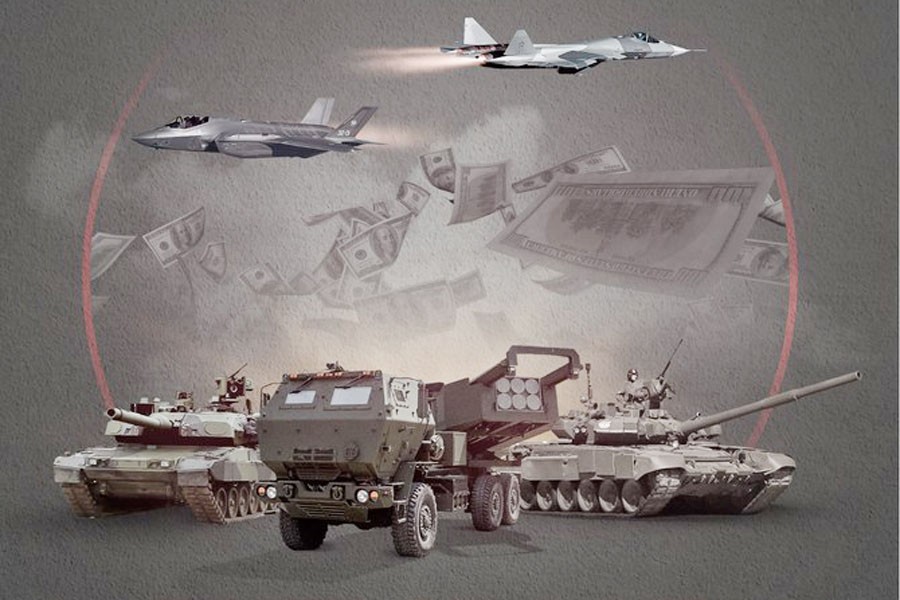
War is as old as human beings life on earth. The main cause of war between territorial entities has been land and occasionally water. The first remains the pre-eminent reason why wars - local, regional or global - have taken place throughout human history. Land is at the heart of the recent devastating war in Gaza and the one that is continuing in Ukraine. Future wars may have other reasons as additional factors but natural resources, particularly land, is destined to be at the centre stage. One difference between wars fought in the past and the ones waged after the second world war is the purchases and sales of weapons, equipment, warships and planes that have been made across borders. These transactions have taken place even in times of peace after the second world war. The reasons given have been building defence against future armed attacks by enemy countries. For a country like Israel an additional reason has been the policy of carrying out so called pre-emptive strikes against hostile countries. For America, regime change in countries deemed unfriendly has been a motive behind military invasions in recent years. The continuation of the last policy, unilaterally pursued, may see America launch a land invasion in Venezuela in the near future. The perceived need to be militarily equipped to engage in war for countries on any or all of the grounds mentioned above inevitably leads to sales and purchases of arms, weapons and equipments. This provides the demand side of the arms market.
On the supply side, the capacity of defence industries may exceed the need of the producer countries and create dependence on exports. This in turn leads to several policies on the part of producer countries to create demand by prospective buyer - countries through (a) pressures and (b) incentives like deferred payments, loans etc. The importance of (a) has recently been highlighted by the high profile visit by president Trump to Saudi Arabia and the Gulf countries that resulted in sales of American produced arms and equipments worth trillions of US dollars. Incentives under (a), on the other hand, are given as a matter of routine through security agreements, membership of regional alliances and even commercial deals.
The end of second world war paved the way to sales of military hardware by America, Russia and West European countries because it left them with sunk investment in defence industries. Winding these down or putting them in mothball was not chosen because of (a) sunk investment; (b) employment of white collar workers, scientists and researchers; and (c) pressure from defence establishment. It is presumed that in the course of time, factor (c) became powerful through lobbying in the corridors of power (i.e. government, legislature, media). This has been described as the working of the 'military-industrial complex' in defence-equipment producing countries like America. To reflect the reality and apportion ownership of the concerned policy ( defence industries production, subsidies and exports) along with military establishment, political leaders should also be included in the group involved in policy decisions regarding defence production, sales, including exports. Though documentary evidence is not available, it has long been contended that defence industries regularly placate the political elites and civilian and military establishments through hefty kickbacks. In return they are assured of fiscal incentives (subsidy and tax exemption) and export guarantees.
Beginning from second world war to date, the supply side of defence industries has become increasingly powerful dictating demand for their products. As a result, the large defence industrial base in a few major arms producing countries have created structural incentives for continuous or expanding demand abroad. These incentives can influence foreign policy, bilateral arms deal, alliance structure and military aid.
High costs of production and research and design have from the beginning created an oligopoly in defence production which has shown little sign of change. As a result, the countries that were major producers of military products during second world war have continued their dominance on the market. According to Stockholm International Peace Research Institute (SIPRI) about 75 per cent major weapons systems are produced by five countries whose shares in total exports of the same are : (1) America 43 per cent; (2) France 9.6 per cent; (3) Russia 7.8 per cent; (4) Italy 4.8 per cent; and (5) United Kingdom 3.6 per cent. The share of these major producers in total production and exports has shown little change over the years indicating built-in advantage of existing industries.
On the demand side, it is seen from SIPRI data that most of the countries that accounted for bulk of imports of weapons systems during 2020- 2024 period are developing countries involved in security arrangements with major defence producing countries or are in current military conflicts : (1) Ukraine 8.8 per cent; (2) Qatar 6.8 per cent; (3) Saudi Arabia 6.8 per cent; (4) Egypt 3.2 per cent; and (5) Kuwait 2.9 per cent.
According to SIPRI, the world's 100 leading arms producers earned over $ 670 billion in exports to other countries in 2024, registering an increase of 5.9 per cent. Majority of these companies are based in America and West Europe.
The worry about the growing volume of production in defence industries stems from the following grounds: (a) it continues the allocation of resources to a non-development and welfare-reducing sector; and (b) increasing production and sales, including exports sustain armed conflicts in various parts of the world. It may even be argued that propelled by profit motive, countries with major defence industries may be interested in a continuous cycle of conflicts and geo-political tensions so that the demand for their products remain high.
hasnat.hye5@gmail.com
© 2026 - All Rights with The Financial Express

