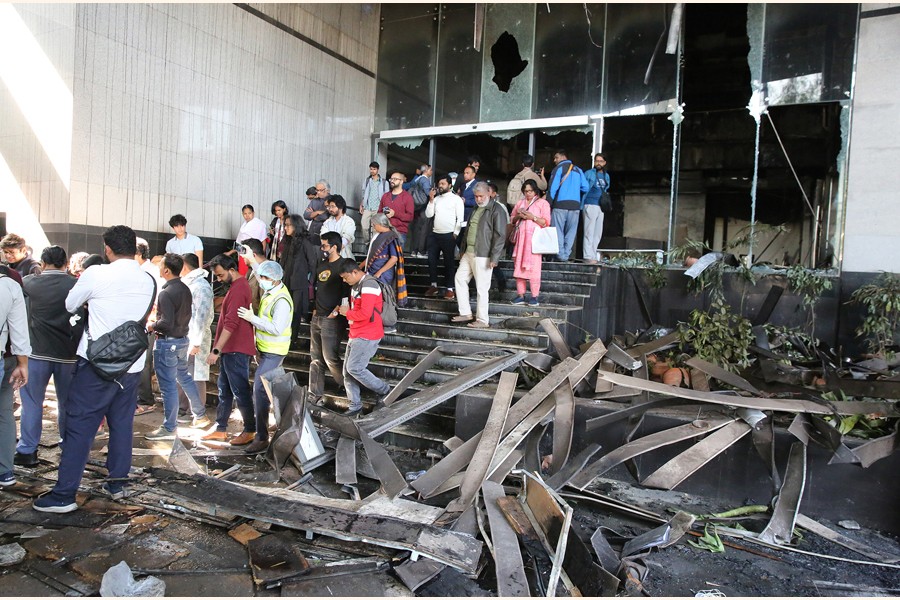
 Journalists and staffers in front of burnt building of The Daily Star in Dhaka —FE Photo
 The country has plunged into another upheaval again– suspected by many as an ominous sign of conspiratorial machinations. The countrywide unified protests did not begin with attacks on newspaper offices or assaults on journalists. It began with the shooting and killing of the young political leader Osman Hadi, an incident that shocked the country and ignited widespread anger. That killing brought people into the streets in grief and outrage. These emotions were real, legitimate, and deserved to be reported, documented, and scrutinised—not drowned in chaos.
Osman Hadi was widely regarded as a promising young political leader whose rise reflected a generation seeking principled engagement rather than inherited power. Known among peers and supporters for his organisational energy, accessibility, and commitment to political participation through lawful means, he had begun to emerge as a recognisable voice in local political circles. His killing was therefore not only the loss of a life, but the silencing of a future—one that carried the aspirations of many young supporters who believed change was still possible through politics rather than violence. The grief that followed was not abstract or manufactured; it was personal, generational, and deeply felt.
Political history shows that moments of collective grief often become moments of moral reckoning. They force societies to confront power, accountability, and justice. But history also warns that such moments are fragile. When grief is allowed to harden into rage and rage slips into violence, the original moral claim begins to erode. What was once a demand for justice risks being transformed into a spectacle of disorder—one that benefits the very forces responsible for repression.
As demonstrations spread, some protests crossed a dangerous line. Rallies meant to express political anger began to turn violent. In that transition—from protest to destruction—journalists and newspaper offices became targets. This was the moment the crisis took a more perilous turn, not only politically but institutionally. When institutions that preserve truth are attacked, the crisis ceases to be only about a single killing; it becomes a crisis of public memory itself.
It is important to state clearly what has already happened. Law enforcement agencies have arrested the suspected perpetrators involved in the killing, and the case is now within the legal process. The suspects will be prosecuted. Justice is not absent; it is underway. In this context, further disruption of law and order does not advance accountability. Instead, it risks undermining the very process through which justice is meant to be delivered.
In functioning democracies—and even in fragile transitions—the legitimacy of justice depends not only on arrests, but on due process, evidence, and sustained scrutiny. That scrutiny comes from journalists who follow cases beyond headlines, who track investigations when public attention wanes, and who ask uncomfortable questions long after slogans have faded. When protests turn violent after arrests have been made, they weaken this chain of accountability rather than strengthening it.
Sustained disorder carries a larger consequence. It weakens the country’s ability to move toward a democratic election. Lawlessness erodes public confidence, strains institutions, and creates conditions in which elections can be delayed, manipulated, or rendered meaningless. This outcome does not weaken authoritarian politics; it serves it.
This is precisely the environment the Awami League seeks. Disorder allows an authoritarian structure to argue that stability matters more than accountability, that control matters more than consent. When attention shifts from justice to chaos, from investigation to street violence, the narrative moves away from democratic transition and toward “law and order.” In this sense, protests that turn violent—especially those that attack independent institutions—end up serving Sheikh Hasina’s fascist objective of unsettling the country and justifying repression.
Authoritarian politics does not fear protest as much as it fears documentation. Street anger can be dispersed, manipulated, or exhausted. Records cannot. Journalism transforms fleeting outrage into lasting evidence. Destroying newspapers and intimidating reporters is therefore not accidental collateral damage; it is a strategic gain for any regime that thrives on confusion and fear.
Many protesters claim they are fighting for democracy and people’s rights. Yet a profound misunderstanding is evident. People’s voice does not survive on the streets alone. It survives because there are journalists and newspapers that record events, verify claims, question power, and preserve public memory. When protesters attack journalists or burn newspaper offices, they are not strengthening people’s voice; they are crippling the very instruments through which that voice exists beyond the moment.
This is not an abstract concern. Bangladesh’s news media sector employs a substantial number of people across newspapers, television channels, online portals, printing presses, distribution networks, advertising, and technical services. Conservative estimates suggest that around 150,000 to 200,000 people depend directly or indirectly on news media for their livelihoods. These include reporters, editors, sub-editors, photographers, press workers, technicians, office staff, freelancers, and digital workers. When newspaper offices are attacked, it is not only freedom of expression that is harmed. Jobs are threatened, families are pushed toward insecurity, and institutions built over decades are weakened overnight.
Beyond employment, there is a deeper loss that numbers cannot capture. News organisations are accumulations of institutional memory. They hold archives, expertise, editorial judgment, and professional norms shaped over generations. When such institutions are attacked, a society loses not only jobs but continuity—its ability to remember, compare, and learn.
Violence against media houses produces immediate and lasting effects. Fear enters newsrooms. Editors begin to calculate personal safety before public responsibility. Investigative reporting slows. Critical voices retreat. This is how silencing works in practice—not always through formal censorship, but through intimidation that makes journalism unsafe. The silence that follows is rarely total, but it is enough to blur truth, delay exposure, and weaken accountability.
Protests turning violent do not weaken authoritarian rule; they reinforce it. Peaceful, disciplined protest exposes abuse of power. Violent protest obscures it. When journalists are attacked, scrutiny diminishes rather than intensifies. Evidence disappears. Witnesses are intimidated. Rumor replaces reporting. In that environment, authoritarian narratives face less resistance, not more.
Journalists—particularly those engaged in intellectual journalism rather than yellow sensationalism—are especially vulnerable at such moments. They do not chant slogans. They do not align neatly with street politics or state narratives. They document, analyze, and question. That makes them inconvenient to both authoritarian power and angry crowds. Yet without them, public debate collapses into accusation and counteraccusation, where influence belongs to whoever can shout loudest or strike hardest.
In heated moments, many protesters do not read articles carefully. They do not distinguish between factual reporting and political allegiance. Newspapers become symbols rather than institutions, and symbols are easy to attack. But once those institutions are damaged, the country loses its witnesses. What follows is not liberation but silence—filled by fear, rumor, and manipulation.
The killing that triggered this crisis demanded accountability. That accountability can only come through documentation, investigation, and sustained public scrutiny. Attacking journalists undermines all three. It also hands authoritarian power exactly what it seeks: weakened institutions, frightened voices, and a society too distracted by disorder to demand justice or prepare for a credible election.
There is no contradiction between protesting authoritarianism and protecting journalists. The contradiction lies in attacking the press while claiming to defend people’s rights. Journalism is not the enemy of protest; it is what allows protest to matter beyond the streets and beyond the day. Without newspapers and journalists, today’s outrage fades into tomorrow’s silence.
Bangladesh is at a critical juncture. Anger is understandable. Grief is justified. But when protests turn violent and journalists and newspaper offices become targets, the country moves further away from justice, not closer to it. Disrupting law and order after suspects have been arrested does not pressure power—it protects it. It drowns legitimate demands in chaos and undermines the path to a democratic election.
A society cannot demand justice while destroying its own witnesses. If people’s voice is to survive this crisis, journalists and newspaper offices must be protected, especially now, when truth is most vulnerable and fear is most easily weaponised.
Dr Abdullah A Dewan is professor emeritus of economics at Eastern Michigan University, USA and former physicist and nuclear engineer at BAEC. aadeone@gmail.com
© 2026 - All Rights with The Financial Express

