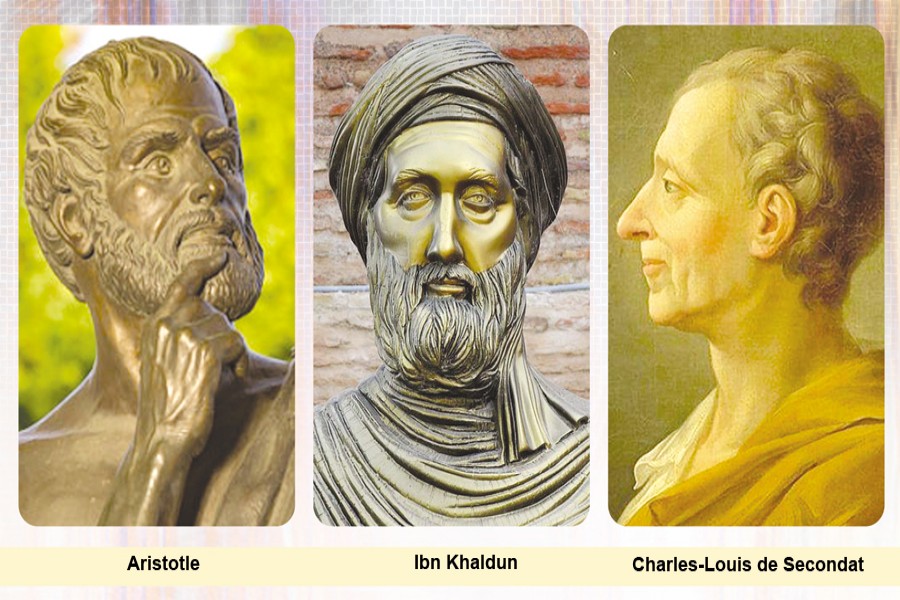
 Three thinkers, from different ages and worlds, reached the same conclusion: government begins to lose legitimacy the moment those who make the rules also begin to profit from them
 Power and profit are a dangerous mix. That was true in the age of kings. It remains true in the republics. The old rule of good governance is simple: those who make the rules should not also be in a position to benefit from them.
Charles-Louis de Secondat, Baron de Montesquieu (1689–1755) understood this clearly. He is best known as the French thinker who helped shape modern constitutional government, especially the idea that power must be divided so that no single person or institution controls everything. But his deeper concern was even more fundamental: how to stop those in power from turning public office into private advantage.
That is why one of his sharpest warnings was not about courts or elections, but about commerce. In The Spirit of the Laws, Montesquieu posed a devastating question about rulers who enter trade: who shall restrain them if they monopolise everything themselves? Who shall oblige them to honour their engagements? His meaning was plain. The moment a ruler enters the marketplace, he ceases to be a neutral referee. He becomes a player — and, worse, a player who writes the rules and profits from them at the same time.
Montesquieu was not alone in seeing this. Aristotle warned that people grow angry when they believe rulers are enriching themselves through office. Ibn Khaldun, the fourteenth-century North African historian and philosopher whose Muqaddimah remains one of the great works of political and economic thought, made the same point with sharper economic force. When rulers enter commerce, he argued, they do not compete like ordinary merchants — they carry the hidden weight of the state into every transaction. Three thinkers, from different ages and worlds, reached the same conclusion: government begins to lose legitimacy the moment those who make the rules also begin to profit from them.
The reason is not difficult to see. When a senior public official has a strong personal or institutional stake in an enterprise, everyone around him knows it. Regulators know it. Tax authorities know it. Banks know it. Suppliers know it. Competitors know it. No direct order is needed. The market quietly starts adjusting itself around power. Investment flows not to the best idea, but to the best connection. Ordinary entrepreneurs are crowded out. Commerce becomes less a matter of merit than of proximity.
That is why modern democracies try to keep public authority and private gain apart. In the United States (US), officials must disclose financial interests and recuse themselves from decisions that could benefit them. In the United Kingdom (UK), ministers must declare relevant interests and avoid conflicts between public duty and private advantage. These systems are imperfect — sometimes so. But the principle is clear: those who govern must be seen to govern for everyone, not for themselves.
Recent weeks have brought considerable reporting that has raised questions about the record of the leader of Bangladesh’s interim government — a record that should be judged against precisely that standard.
Muhammad Yunus came to office in August 2024 at a moment of genuine national crisis. His appointment, following the fall of Sheikh Hasina, was widely welcomed. He was trusted not simply as an economist or a Nobel Peace laureate, but as a figure presumed to stand above the grubby calculations of ordinary politics. That presumption made his role possible. It also made scrutiny of his conduct necessary — not as an act of hostility, but as a basic requirement of democratic life.
The problem is not any one isolated decision. It is the pattern they form together.
Reports indicate that during Yunus’s tenure, the interim government restored Grameen Bank’s tax exemption for five years, extending it to December 2029. It later reduced the government’s ownership stake in Grameen Bank from 25 per cent to 10 per cent, and trimmed state representation on the bank’s board through ordinance. These were not routine administrative adjustments. They were significant policy decisions directly affecting the institution Yunus founded and with which he remains inseparably identified.
At roughly the same time, legal pressures surrounding Yunus and Grameen-linked entities also eased. His labour-law conviction was overturned. Proceedings in a corruption case against him and six others were dismissed. A High Court verdict in the Grameen Kalyan tax reassessment dispute was withdrawn. Any one of these developments, taken alone, admits of explanation. Courts do correct errors. Politically motivated cases do sometimes collapse. That much is true.
But conflict of interest is not assessed event by event, as though each decision arrives sealed off from every other. It is assessed by direction, by accumulation, by whether state action appears over time to move toward the personal and institutional world of the ruler. That is what makes this record troubling. Tax policy moved one way. Institutional restructuring moved the same way. Legal outcomes appeared to move in the same general direction. Separately, each step may be defensible. Together, they form a picture that no serious ethics regime would dismiss lightly.
This is the point most often overlooked. Conflict of interest does not mean proven corruption. It does not require a bribe, a payoff, or a smoking gun. It arises whenever a public officeholder has a personal stake in the outcome of a decision that he is in a position to influence. At that point, the burden shifts to the officeholder: disclose, recuse, create distance, and remove doubt. On the public record, there is little evidence that such distance was consistently maintained.
There is a larger lesson here, which goes beyond Bangladesh. Countries emerging from authoritarian rule are often tempted to place their faith in exceptional individuals rather than in strong institutions. The temptation is understandable. In times of breakdown, a respected figure can steady a fractured country in ways that rules alone cannot. But reputation is not accountability. A Nobel Prize is not an ethics code. A distinguished life is not a substitute for institutional restraint. If anything, the more admired the leader, the stricter the standard ought to be.
Bangladesh has now passed through the transition that Yunus said he wanted to deliver. Elections were held. Power was handed over. That is a real achievement. But that achievement does not erase the ethical questions of the interim period. Democracies are not strengthened by politely looking away from apparent conflicts because the individual involved is globally admired or domestically revered. They are strengthened when the same rule is applied to the celebrated and the ordinary alike.
That is where Montesquieu still speaks with unsettling force. His warning was never really about kings and merchants alone. It was about a permanent temptation in politics: to use public power for private or institutional advantage while continuing to speak in the language of the public good. When that happens, the damage is not confined to one tax waiver, one ordinance, or one courtroom outcome. The deeper damage is moral and institutional. Citizens begin to suspect that the state is no longer standing above contending interests — but leaning toward one of its own.
And once that suspicion takes hold, trust drains away. Commerce loses its fairness. Institutions lose their credibility. Public life becomes just another arena in which influence protects itself.
That is the real cost of letting the prince trade.
Dr M G Quibria is an economist and public affairs commentator. mgquibria.morgan@gmail.com
[The author wishes to thank Professor Salim Rashid for the invitation, many years ago, to a colloquium of American university scholars devoted to the works of the great political philosophers — an occasion from which much of the grounding for this essay was drawn, including a deeper acquaintance with Montesquieu and his enduring relevance.
The opinions expressed in this article are the author’s alone.]
© 2026 - All Rights with The Financial Express

