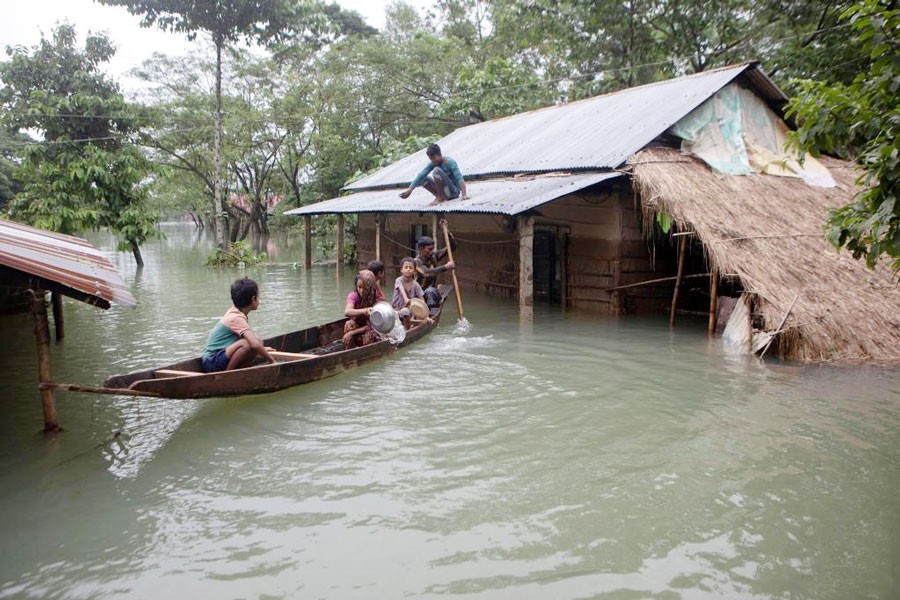
 People move by boat from a flood-affected area to a safe place in Sylhet, Bangladesh, on June 19, 2022 —Xinhua Photo
 Floods are nothing new to Bangladesh. Rivers, monsoons and seasonal deluge are woven into the country's geography and history. But the July 2026 flood revealed something beyond the usual script: in the age of climate change, flooding is no longer just about submerged homes and stranded families - it is a structural stress test for the national economy itself.
The familiar images returned this year too: people wading through waist-deep water, families queuing for relief, children huddled in shelters. According to the Ministry of Disaster Management and Relief's report of mid-July, the death toll from floods, flash floods and landslides since 5 July has climbed to 54, with over six lakh people affected and more than 1.55 lakh families still marooned across 59 upazilas in seven districts. Cox's Bazar has recorded the highest toll - 31 dead, including Rohingya refugees killed when a landslide struck the camps on July 8, among them seven children and a teacher. Chattogram, Bandarban, Rangamati, Khagrachhari, Moulvibazar and Habiganj account for the rest.
The government has deployed army, navy, and air force personnel alongside local NGOs to provide relief and conduct boat evacuations in the worst-hit districts. Tourist spots in Bandarban remain shut, board exams have been postponed, and forecasters warned as recently as Saturday that 10 more districts - Feni, Sylhet, Netrokona, Sherpur, Mymensingh, Lalmonirhat, Kurigram, Gaibandha, and adjoining areas - face fresh short-term flood risk, as several rivers still run above the danger level.
But one thing stood apart this year - the capital itself came to a standstill. An overnight downpour of 76 millimetres overwhelmed Dhaka's drainage network in the second week of July, submerging large stretches of Dhanmondi, Mirpur, Malibagh, Mouchak, Motijheel, Karwan Bazar and Old Dhaka within hours. Commuters were stranded, transport collapsed, businesses shut, and schools closed, and waterlogging and traffic chaos have recurred with each fresh spell of rain since. Those hours exposed an uncomfortable truth: climate impact is no longer confined to a haor or a border hill town - it now reaches the country's economic nerve centre directly.
That is the real significance of this year's flood. In the same fortnight, we saw upstream surges in Sylhet, landslides in the hill tracts, flash floods across Chattogram division, and repeated waterlogging in Dhaka - simultaneously. Disasters that once seemed distinct are now different faces of a single climatic crisis.
It would be unfair to blame nature alone. Decades of unplanned development have filled in rivers, canals, and wetlands; natural reservoirs in cities have disappeared; settlements have crept onto hillsides; and drainage systems have expanded without regard for natural water flow. When nature tries to release its excess, there is no space left to absorb it - so the water moves through homes, markets and factories instead.
The Kushiyara, Manu, Khowai, Sangu and Matamuhuri rivers all breached their banks this month, and forecasters warn heavier rain across Meghalaya, Tripura and Assam could push upstream flows even higher. Bangladesh's floods, in other words, are no longer purely a domestic weather event - they are the product of a transboundary river system colliding with global climate change.
Our biggest failure lies in how we measure flood damage. We typically count the number of affected people, damaged roads, flooded homes, and destroyed crops. But beneath these figures lies a deeper, less visible wound.
When a farmer sows a field, he is not merely growing rice - he is investing savings, credit, labour and hope. A shopkeeper borrows to stock goods; a fish farmer sinks capital into ponds and feed; a rickshaw puller depends entirely on that day's earnings. When floodwater rises, it is the future income that goes under it, not just land and buildings.
This is why the true cost of a flood can never be fully captured in monetary terms. It erodes productivity, drains savings and deepens debt - a cost rarely reflected in national income data, yet one that lingers for years.
Bangladesh has posted remarkable growth over two decades. But this flood forces a harder question: is that growth actually climate-resilient? If agriculture, tourism, logistics and ordinary livelihoods can all be disrupted within days, isn't it time to rethink the development framework itself?
One of Bangladesh's great economic strengths is the interconnectedness of its sectors. Agriculture, industry, transport, ports, tourism and urban commerce sit within a single supply chain - so a disaster in a Sylhet haor or on a Bandarban hill road ripples quickly into Dhaka's markets, Gazipur's factories, or Chittagong port. This flood should be understood not as a localised disaster but as a macroeconomic shock to the national economy.
Agriculture absorbs the first blow. The real damage isn't just lost tonnage - it's lost investment. Seeds, fertiliser, irrigation and labour costs are already spent, often financed through banks, NGOs or informal lenders. When the crop is destroyed, the loan instalment remains, and the crisis cascades through the rural economy: reduced spending in local markets, slower machinery sales, disrupted transport, and knock-on effects on education and health - the multiplier effect.
This is especially acute in the haor districts, central to national food security; two or three consecutive bad seasons there can shake the national food market. Fisheries and livestock suffer similarly, with recovery taking months rather than weeks, ultimately pushing up consumer prices.
The southeast faces a different threat: landslides. A single collapsed mountain road cuts villages off from markets, halts tourism, and stalls local business. Days of severe weather in Cox's Bazar can badly hurt hundreds of hotels, restaurants and transport operators dependent on the beach economy - losses rarely captured in official statistics.
The Rohingya camps add further complexity: heavy rain and landslides there endanger lives and strain water, sanitation and shelter systems, raising costs for government and international partners alike - turning a natural disaster into a humanitarian, financial and diplomatic challenge at once.
Perhaps the most consequential impact is on the supply chain. Roads are the backbone of domestic goods movement. When a highway floods or a regional road is damaged, the flow of agricultural produce, industrial inputs, and consumer goods is disrupted, transport costs rise, and delays impose additional costs on consumers.
This is where the Dhaka-Chittagong corridor matters most. The bulk of the country's trade moves through Chittagong port, so even minor disruptions hit industrial production and foreign trade. The ready-made garment sector - Bangladesh's largest export earner - suffers when raw materials arrive late, or shipments miss deadlines; in global markets, on-time delivery matters as much as price.
These disruptions feed straight into inflation. As output falls and transport costs climb, prices of rice, vegetables, fish and eggs rise. This is the economic signature of climate risk, and controlling inflation now requires a supply system built to withstand disaster, not just price management after the fact.
This flood exposes a hard truth: Bangladesh's economy has grown, but its foundations are not yet climate-resilient enough. Growth has outpaced resilience - and left unaddressed, that gap will keep setting back not just households but the country's development trajectory.
Disaster management and development planning can no longer be treated as separate domains. Floods, landslides, river erosion, and urban waterlogging are now central issues in development economics - in roads, ports, industry, housing, or agriculture. Ignoring climate risk means building something that won't last.
Bangladesh has made real strides in infrastructure, but how much of it is built for the climate reality ahead? Dhaka's flooding proved that more drains alone won't solve the problem - restoring natural reservoirs, canals and rainwater retention systems is essential, since roads built without regard for natural watercourses often become the very cause of waterlogging.
This is where "climate-resilient infrastructure" becomes essential - valued not by construction cost, but by how much future damage it prevents. Spending on climate adaptation today is a preventive investment against far larger future losses.
Bangladesh also urgently needs to extend financial protection to farmers and small businesses, who currently absorb nearly all disaster-related risk alone. When a flood destroys a crop or a shop's stock, savings vanish, and debt deepens for years. State-backed crop insurance, weather-indexed compensation, and disaster recovery funds for small entrepreneurs are overdue.
Other countries offer models: the Netherlands has made room for rivers instead of walling them in, while Kenya and the Philippines use weather-indexed agricultural insurance. Bangladesh has its own long-term framework in the Delta Plan 2100 - but it remains unclear how firmly the plan is tied to actual budgets and on-the-ground implementation.
What is needed most is a shift in mindset. We still treat floods primarily as emergencies - relief, rescue, rehabilitation. But in the climate era, floods are a recurring economic risk, and until that risk sits at the centre of development planning, the same damage will repeat every monsoon.
This flood will fade from the headlines soon enough. Waters will recede, roads will be repaired, markets will reopen. The real question is whether we learn from this, or wait for the next spell of rain to replay the same story.
The challenge before Bangladesh is not to stop the floods - that isn't possible. It is to build an economy that can absorb the shock and bounce back quickly: where farmers aren't wiped out, small businesses aren't shuttered, highways don't collapse, and a few hours of rain don't paralyse the capital.
Growth will only mean what we want it to mean once it can withstand the shocks climate change keeps sending our way. This flood was a difficult but necessary reminder of that truth.
Dr Matiur Rahman is a researcher and development professional.
matiurrahman588@gmail.com
© 2026 - All Rights with The Financial Express

