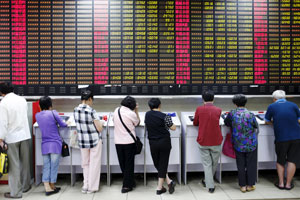
 China\'s stock market crash is now being felt beyond the millions of mom and pop investors who have poured their savings into the market. — Reuters photo
In mid-August, 2015, stock markets all over the world witnessed an upheaval taking all investors and analysts aback. During the period from August 11 to August 24, all major stock exchanges, including New York Stock Exchange, Toronto Stock Exchange, US S&P 500, and DowJones Index, experienced drastic fall in the markets. Most of the shares, including blue chips, plunged and the world financial market suffered a loss of US$ 5 trillion from the turmoil in the share markets. Although tumble in share market did not last long and stock exchanges went through correction, yet this sudden plunge caused great shocks to the world economy. The economists and policy-makers are now sceptical about the recovery from the depression the world economy had been experiencing since 2008. Whether the world economy fully recovers or the economies of developed countries, especially G-8 countries are in real expansion stage, have become a subject of discussion. The US Fed was contemplating to increase its benchmark rate but is now probably going to put it on hold following this sudden shake-up in the stock exchanges.
Recent bubble burst in the Chinese stock market is mostly blamed for drastic fall in the world capital market. At first, share prices went down in the Shanghai Stock Exchange followed by other exchanges in the Asia-Pacific region which then contaminated Europe and North America causing nightmares for the CEOs of all financial institutions. This writer was carefully listening to the commentary and analysis of experts and was trying to understand whether there is any comment on siphoning of trillions of dollars from the share markets, but could not find any such comment except estimated loss of five trillion dollars and holding China responsible. Stock market bubble in China was not unexpected at all. Rather the whole world was predicting the correction or fall in the share markets of China because Chinese stocks gained 150 per cent during the period from July 2014 to June 12, 2015. How the fall in Chinese share market instantly affected the stock markets of the whole world, especially those of the developed countries, was not comprehensible for many analysts and think-tanks. If large investors, particularly international investors, uploaded their holding in the Chinese stock exchange out of panic, this realised cash must have been invested somewhere else preferably in the developed market where the price was supposed to go up, but the reverse had happened.
In fact, the nature and structure of stock market is so complex that its depth cannot be assessed. Since Great Depression in 1930, the recession has come in cyclic order after some time making some rich people richer and poor people poorer. Every time some issues are blamed as catalysts for creating recession. Dotcom bubble, Y2K, Subprime Mortgage and now China's bubble were held responsible for periodic recession experienced by the world economy since 1990. In order to prevent the recession, the SEC and regulatory bodies across the world are tired of formulating rules and regulations one after another. Professional bodies are fed up with introducing designations one after another like CFA, CMA, CPA etc and IT companies are engaged in developing various modules one after another. But recession cannot be prevented; instead recurrence with periodic interval has become a regular phenomenon.
Bangladesh's stock market is not exempted from this trend as stock market crashes in 1996 and 2010 show. To speak the truth, stock market is not the place for common people and more precisely for the general investors. This is not the investment opportunity for injecting borrowed money and not even hard-earned savings. Although clever affluent segment of society can benefit investing in the capital market, historical data reveals that ordinary investors have mostly suffered from their investment in capital market. Besides, this is not the market for making wealth overnight; instead, careful investment can at best be considered as an alternative source of income. This opportunity, however, has very limited scope in a developing economy like Bangladesh, because risk-free return, which is very high in this economy, can hardly be expected through investment in the capital market.
In the developed world, the opportunity of a risk-free return is very limited and even the rate is negligible too. Therefore, people have no other alternative but to invest in the capital market. Since the nature of capital market is very volatile and unpredictable, general investors have been protected through introduction of mutual fund. Although there are some loopholes in calculating income from mutual fund, yet this instrument is very popular among general investors. Mutual fund not only provides some sort of protection to the investors but also generates some steady income. For some mysterious reasons, this instrument could not receive acceptability in our country's stock market. It was expected that banks and other financial institutions would play their proactive roles in establishing this instrument among the general investors.
While serving in SEC (Securities and Exchange Commission), this writer was always in favour of bringing banks and financial institutions to the country's capital market. They have been given that opportunity too, but their role in the capital market was not found praiseworthy as was expected. As a result, the condition of general investors remains at stake. After share market crashes in 1996 and 2010, it was learnt that innumerable people who did not possess minimum knowledge about share market had jumped into it. Not only hard-earned savings but also money borrowed from relatives or sale proceeds of tangible assets, were invested in the country's capital market. This kind of investment in extremely sensitive places of capital market is suicidal for the investors and their families and the country as a whole. Care must be taken to prevent this type of fund from being invested in the volatile capital market. We understand that after the crash, the capital market has been strengthened, regulatory body has been reconstituted empowering more authority and demutualisation has been effective. All of these are really very praiseworthy steps which will undoubtedly ensure fairness of the market. At the same time, financial advisers' role should be given more importance because their appropriate role can only protect investors' interests by suggesting suitable investment advice. The qualified investment adviser knows well what kind of investment is suitable for a particular investable fund. They are conversant with the function of balanced growth portfolio, high growth portfolio, risky portfolio etc. and can accordingly match with the risk attitude of the investors.
Moreover, the constitution of portfolio for each investor based on the nature of investable fund as well as investor's risk-taking capability is another important function. Ratio of investment in risk-free, low-risk, medium-risk and high-risk returns is the most crucial factor in determining the portfolio of the investors. This will of course vary depending on the nature and size of investible fund and risk appetite of the investors. But there must be some benchmark parameters which will be followed while forming portfolio. We are not sure whether financial advisor's appropriate role has been established in the investment houses of our country's capital market. Last year, there was an opportunity to visit investment houses of some banks but this type of service being rendered by the financial advisors of investment houses could not be found. We hope, the concerned authorities will look into this area and take due measures to establish standard role of investment advisers. In addition, in-depth research and analysis have to be undertaken to unearth the reasons of mutual fund's failure and based on findings, corrective measures should be taken. Because, mutual fund is still now the widely accepted financial instrument which gives protection to the investors and fetch some income.
Foreign investment is another crucial factor in the country's economic development and therefore, all countries including both developed and developing ones, always welcome foreign investment. The need for foreign investment in the developing world is relatively high because there is always a paucity of capital in those countries. Our country also welcomes foreign investment and provides various concessional facilities to attract foreign investment, which may take place in two forms, of which one is portfolio investment and the other is direct investment. Although neither form of investment is risk free, yet direct investment is less risky than portfolio investment. Utmost care must be taken while wooing foreign investors to the country's portfolio investment, and some stringent restrictions should be exercised on their investment activities so that the market does not turn volatile. Free role of foreign portfolio investment may make the market vulnerable to their investment whims. China is realising in a hard way the effect of allowing free presence of foreign portfolio investment. Since it is now the second largest economy in the world and has enormous foreign exchange reserve, it has been able to tackle this free fall in its capital market at least for the time-being. But it remains to be seen how long this fall can be prevented. During mid-90s, the Asian emerging tigers, which include South Korea, Singapore, Thailand and Indonesia, suffered severe recession because of indiscriminately encouraging foreign direct investment.
Malaysia, however, escaped the wave of that recession because of bold leadership role of Dr Mahathir Mohammad who stopped outflow of foreign currency from his country without valid reasons. Now globalisation and free flow of goods and services have changed the nature and scope of direct foreign investment.
Although the recent stock market plunge all over the world has no apparent direct impact on our economy because there is no such investment from our country in the world stock market, yet it provides opportunities to learn some good lessons from it. The Bangladesh Securities and Exchange Commission, Dhaka and Chittagong Stock Exchanges and capital market specialists may analyse the pros and cons of the recent upheaval in the world capital market, the reasons behind this fall and its aftermath and based on their findings, if appropriate measures are taken, the investors' interests will be well protected and thereby the country will be able to avoid further crashes in capital market in near future.
The writer is a banker working in Toronto, Canada.
nironjankumar_roy@yahoo.com
© 2026 - All Rights with The Financial Express

