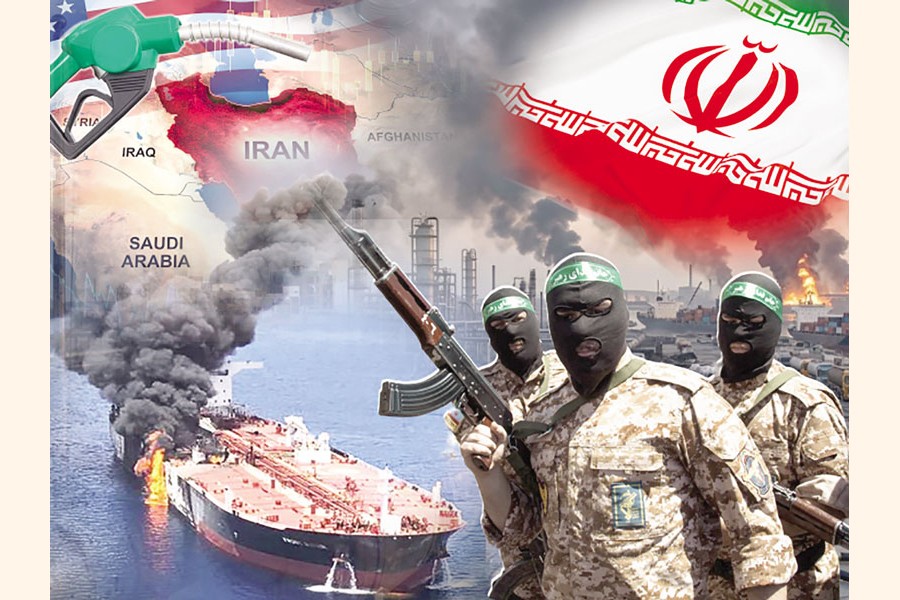
Wars fought thousands of kilometres away rarely remain distant for long. The escalating tensions in the Gulf following the recent US-Israel-Iran confrontation are a stark reminder that geopolitical conflicts can quickly send economic shockwaves far beyond the battlefield. For South Asia, the Gulf is not just another region-it is a vital economic lifeline for energy supplies, migrant employment, and trade. When instability grips the Gulf, the consequences are felt across South Asian economies already grappling with inflation, fiscal pressures, and fragile external balances.
The region's dependence on the Gulf runs deep. Nearly 20-25 million South Asian migrant workers live and work across Gulf Cooperation Council (GCC) countries. Their remittances sustain households and stabilize national economies. For several South Asian countries, these inflows are among the most important sources of foreign exchange. India receives over $120 billion annually in remittances, a large share of which originates in the Gulf. Bangladesh receives around $22-23 billion, Pakistan about $30 billion, while Nepal's remittances exceed $11 billion, equivalent to roughly 26-27 per cent of its gross domestic procut (GDP), one of the highest ratios in the world.
These flows represent the livelihoods of millions of families. Any disruption to Gulf economies-whether through economic slowdown, security risks, or labour market contraction-can therefore have immediate and far-reaching consequences across South Asia.
Perhaps the most immediate economic transmission channel from the Gulf conflict is energy prices. The Middle East accounts for roughly one-third of global oil production, and a significant share of global oil shipments passes through the Strait of Hormuz, one of the world's most critical energy chokepoints.
South Asia's economies are heavily dependent on imported oil. India imports nearly 85 per cent of its crude oil requirements, Pakistan around 80 per cent, and Bangladesh more than 90 per cent of its petroleum products. Even Nepal, though smaller, relies entirely on imported petroleum.
When geopolitical tensions threaten oil supply routes, global energy prices rise sharply. Higher oil prices quickly translate into increased transport costs, electricity tariffs, and food prices across South Asia. For households already facing elevated inflation, this becomes an immediate and visible burden.
Governments are often forced to absorb part of the shock through fuel subsidies or tax adjustments. Yet doing so strains public finances at a time when many South Asian economies are already grappling with limited fiscal space.
The second-and potentially more profound-channel of impact lies in labour migration. Gulf economies depend heavily on foreign workers, many of whom originate from South Asia. Construction, infrastructure, hospitality, and service sectors across the Gulf rely extensively on this labour force.
A prolonged regional conflict could slow economic activity in Gulf countries, reduce construction and infrastructure projects, and ultimately affect employment opportunities for migrant workers. In extreme scenarios, geopolitical instability could even force large numbers of workers to return home.
Such a development would create serious economic pressures. Remittances help finance imports, stabilise foreign exchange reserves, and support consumption across South Asia. A significant decline in these flows would quickly weaken external balances and strain domestic labour markets already struggling to generate sufficient employment.
Beyond energy and remittances, the Gulf conflict also threatens global trade routes. The Gulf region sits astride some of the world's busiest shipping lanes connecting Asia, Europe, and Africa. Escalating tensions raise insurance premiums for shipping companies, increase freight costs, and disrupt supply chains.
For South Asian exporters-particularly in sectors such as textiles, garments, agriculture, and light manufacturing-higher shipping costs erode competitiveness in global markets. Import costs also rise, further feeding domestic inflation. The combined effect is a tightening of economic conditions across the region.
Geopolitical crises also trigger volatility in global financial markets. Investors tend to shift capital toward safer assets during periods of uncertainty. Emerging economies-including many in South Asia-may face currency pressures and higher borrowing costs as a result.
For countries already managing debt vulnerabilities and fiscal constraints, tighter financial conditions complicate economic management. Maintaining investor confidence therefore becomes even more important.
While governments in South Asian countries cannot control geopolitical conflicts, they must strengthen resilience against external shocks.
First, energy diversification must become a strategic priority. Expanding renewable energy sources, investing in regional electricity trade, and building strategic petroleum reserves can help reduce exposure to global oil price volatility.
Second, protecting migrant workers must remain a diplomatic priority. Governments should maintain close engagement with Gulf partners to safeguard employment opportunities and labour protections for their citizens abroad. At the same time, accelerating domestic job creation through industrial development and skills programmes can gradually reduce excessive dependence on overseas employment.
Third, targeted social protection programmes will be essential to cushion vulnerable households from rising energy and food prices. Well-designed cash transfers and food support schemes can help mitigate the immediate impact of inflation.
Finally, maintaining macroeconomic stability remains crucial. Strengthening foreign exchange reserves, managing fiscal deficits prudently, and communicating clear economic policies can help sustain investor confidence during periods of geopolitical turbulence.
The Gulf conflict serves as a powerful reminder of economic interdependence. A war in one region can quickly manifest as inflation, job losses, and fiscal strain in another.
For South Asia, building economic resilience must become a central policy priority. Reducing dependence on external shocks-through diversified energy sources, stronger domestic industries, and greater regional cooperation-will be essential in navigating an increasingly uncertain global landscape.
For millions of South Asian households whose livelihoods depend on stable energy markets and overseas employment, the consequences of distant conflicts are already being felt. Preparing for these shocks today may determine how effectively the region overcomes the storms of tomorrow.
Manmohan Parkash is a former Senior Advisor in the Office of the President and former Deputy Director General for South Asia at the Asian Development Bank (ADB).
manmohanparkash@gmail.com
© 2026 - All Rights with The Financial Express

