Many people often ask: Who is an actuary, and why is an actuary important in the insurance industry?
The term 'Actuary' originates from the Latin word Actuarius, which means a record keeper or accountant. Actuarial science is essentially the mathematics of insurance. It is a discipline that applies mathematical and statistical methods to systematically observed natural phenomena to assess risk and uncertainty. Through these principles and methodologies, the financial impact on both companies and policyholders is significantly reduced.
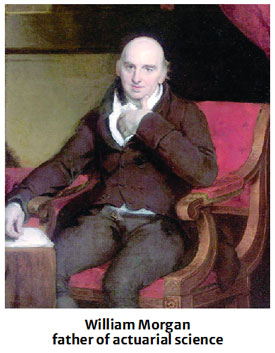 William Morgan, FRS, a British citizen born on May 23, 1750, was a physician, physicist, and statistician. He is considered the modern father of actuarial science. In 1774, he became the world's first actuary at the Equitable Life Assurance Society, the first life insurance company. He served for 56 years. During his tenure, he prepared detailed annual reports based on insurance fund calculations, risk analysis, mortality rates, and premium determination. These reports became the first actuarial reports in history.
At that time, the concept of life insurance was comparatively new. People had only a limited understanding of its importance for future financial security. However, through his wisdom, expertise, and foresight, Morgan brought revolutionary changes to insurance practices. He developed models based on age, mortality rates, interest earnings and financial risk, which helped determine appropriate insurance premiums. These methodologies laid the foundation of modern actuarial science.
An actuary is a qualified professional in insurance, pensions, and finance. Actuaries blend expertise as business executives, mathematicians, economists, social scientists, and investment managers. Simply put, actuaries solve problems using actuarial science to analyse and address the financial, economic, and business impact of future events.
Actuarial science is a highly respected profession that offers prestige and substantial financial rewards. In many cases, actuaries earn more than chartered accountants. Unfortunately, the actuarial profession in Bangladesh has not yet developed adequately. At present, there are only two practising actuaries in the country, an extremely low number relative to its 82 life and non-life insurance companies. By comparison, India has approximately 600 actuaries for its market, Malaysia has 164, and Pakistan has 88. However, in recent years, the expansion of the insurance sector, increased economic awareness, and support from the Insurance Development and Regulatory Authority (IDRA) have gradually increased interest in actuarial science among Bangladeshi insurance professionals.
Bangladesh is facing a severe shortage of actuaries, primarily because the profession is not properly valued and adequate career opportunities are not provided. As a result, many talented students leave the country. The insurance industry cannot function effectively without actuaries. If each insurance company employed at least one actuary, the foundation of the sector would become much stronger. In developed countries, actuarial qualifications are regarded as highly prestigious and well-paid, which is why their insurance industries are globally recognised as sustainable and well-structured. The scope of work for actuaries is extensive, including life insurance, general insurance, pensions, gratuity schemes, provident funds, scheme valuation, banking and financial services, information technology, and education and training.
ADDRESSING THE SHORTAGE OF ACTUARIES: To address the shortage of actuaries in Bangladesh's insurance sector, the following measures are recommended:
1. Recruit skilled and competent manpower in the insurance sector;
2. Encourage the children of existing insurance professionals to pursue careers in insurance.
3. Raise public awareness through seminars, workshops, and conferences on actuarial science;
4. Maintain endless communication with Bangladeshi actuaries currently residing abroad;
5. Include actuarial science in school, college, and university curricula alongside insurance studies;
6. Introduce actuarial science training programs in public and private institutions that offer insurance-related training;
7. Create at least two Actuarial Trainee Officer positions in each insurance company;
8. Provide government patronage to the "Diploma in Actuarial Science" course offered by the Bangladesh Insurance Association (BIA);
9. Establish a Bangladesh Insurance Institute of Actuaries.
10. Form a steering committee comprising officials from BIA, IDRA, professional actuaries, and experienced insurance practitioners.
END NOTE: Insurance is vital to the country's economic development. For the insurance industry to grow and for all stakeholders to be protected, actuaries are essential. Insurance cannot function without them. The principles and ideals of William Morgan, father of actuarial science and architect of future financial security, should guide us. His influence appears in every chapter of actuarial science. Through his work, humanity learned that mathematics is not just numbers; it secures society's financial future.
Muhammad Nurul Alam Chowdhury is Managing Director South Asia Insurance Company Limited.
© 2026 - All Rights with The Financial Express

