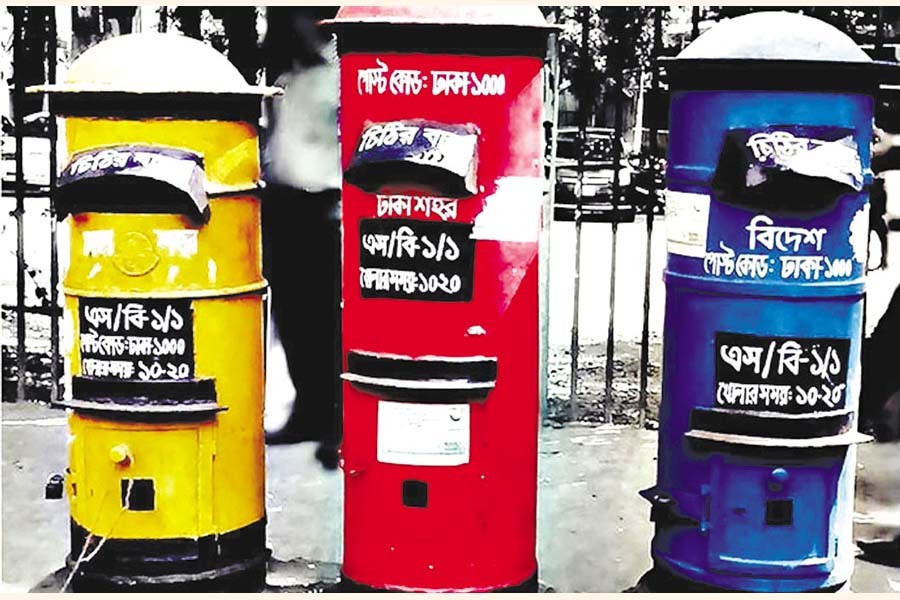
 Letter boxes are disappearing gradually - Collected Photo
 Few have noticed that the post boxes standing at street corners are fast disappearing. Except at the gate of the Dhaka General Post Office (GPO), post boxes standing in an array are not seen any longer. Inside the mid-level post offices, the brisk activities of the postal officials and clerks are replaced with a leisurely atmosphere. The only crowd could be seen at the queues for delivery of parcels or sending registered letters. At a corner of the vast hall of GPO, there is the relatively busy section of the postal savings certificates. On the other side there are the counters for Postal Life Insurance (PLI) and Electronic Money Transfer Service (EMTS). Ironically, the products which have traditionally been synonymous with a post office --- envelopes, post cards and stamps, do not have much demand these days.
Like all other sectors, the postal service has also entered the digital age. Not long ago, postal letter and parcel deliveries were mostly taken over by the private courier services. Against this backdrop the fading of the earlier dominant role of postal service in the people's life can be called a sign of the times. The pragmatic segments of society can read the message between the lines: many of the yesteryears' postal features are on the way out.
In the layman's view, a post office stands for letters. Its function of dealing with money orders and telegram messages has long been over in Bangladesh. Amazingly, letters are being taken over by the fast rising courier operators. In the digital age, emails have posed the greatest threat to letter writing. Email communication doesn't require a pen or a piece of paper. What it needs are the email addresses of the sender and the receiver. This, however, applies to the day-to-day letters, in which the message is the objective. But when it comes to leisurely letters requiring much space, hand-written letters have no alternative. For a couple of centuries, missives narrating varied types of personal experiences dominated letter-writing. Emotion-charged love letters include them. Scores of such letters and their facsimile now occupy an immortal place in history. These romance-filled letters, especially in the East, didn't become the trend until the invention of envelopes. In the not-too-distant a past males and females in romantic love used to write their letters on special paper, using special pen and ink. Many would soak the paper with perfume. In contrast, the tales of short letters throwing a brutal challenge to an adversary are also not uncommon. There are also instances of letters hand-written by kings inviting their hostile counterparts to a negotiation meet. Before the age of postal exchange of letters, it was the royal messengers who would carry these messages. Long before even the early modern era, it was the 16th century Pashtun ruler Sher Shah Suri who introduced the horse-borne courier mail service in the Indian sub-continent. Many credit the ruler with the honour of being the pioneer of long-distance mail service in the then India.
Few write an analogue letter these days, unless pressed by necessity. These necessities are prompted by official and formal requirements. These are being replaced by the needs for online correspondence. On the other hand, sending a digitally composed letter online has endless benefits. The process doesn't need time. Both the mail's senders and receivers remain satisfied. It's true with the formal correspondence only. In spite of the dominant trend of the time to write personal and official letters online, many prefer longer handwritten letters. But the facilities of speedy compose and the fast pace at which the letters are sent and received draw the online literate people to the digital medium. In this transitional time of switching over to the online device, literate persons find themselves in a dilemma. It's especially those in the rural areas with irregular online connections or no reliable electricity who suffer the most. Moreover, there are no set-ups like post offices which can help them out. Many foresee the small and mid-size post offices in the rural areas close to the urban swathes serving as e-centres (electronic centres). Their clients will comprise the new generations hooked on the electronic world. The e-centres will have arrangements of desk-tops, which can be rented out to the interested clients. The functional monitors can be accessed with personal passwords.
A fully operational e-centre, could, thus, resemble a new generation mail centre or an 'outdated post office'. In the city neighbourhoods, e-centres are a common spectacle. But the service of them cannot be availed at will. Their operation as commercial e-centres can serve people not having any digital device.
The analogue era was free of technological complexities. In those days many were passionate letter writers. A lot of authors, academics el al included them. The very mention of them brings to the mind the names of Rabindranath Tagore, Kazi Nazrul Islam, Dr Muhammad Shaheedullah, Poet Buddhadev Bose and many others. Besides, most of the great novelists of the decades of the thirties and forties were skilled letter writers. Of them, the names of Sharatchandra, Tarashankar, Manik and their contemporaries stand out. 'Chhinnapatra' by Rabindranath Tagore is a collection of letters the poet wrote to his niece Indira from the then East Bengal. The poet spent a few years in the eastern Bengal villages of Shilaidaha, Sajadpur and Potishor. He visited those villages extensively and mixed with the areas' poor farmers as a young 'zamindar' of the vast area. In his letters to Indira, the poet intimately portrayed the areas' natural beauty including that of Padma. His keen observation didn't leave out the struggling life of the poor farmers living on the banks of the Padma. According to critics, hadn't the poet written any other prose pieces, the 'Chhinnapatra' letters alone would have brought him the indisputable fame as a gifted prose artist.
Had those times been digital ones, the later-day readers would have been deprived of these literary treasures. It's because the letters written by the authors in those days used to be long, at times attaining the height of literary pieces. Those were beyond the capacity of the envelopes to hold even the squeezed essence of the letters. They needed two to three pages studded into an envelope. Handwritten letters comprise a golden era of the 19th-20th century Bengal. Today's Bangladesh and the then East Pakistan have also passed over seven decades in the era of the traditional postal system. The smooth entry of the tradition of the three postal eras --- British Indian, Pakistani and Bangladeshi ---into the digital age is, indeed, amazing.
Shihabskr@ymail.com
© 2026 - All Rights with The Financial Express

