"Welcome to Riyadh!" said the young immigration officer after stamping my passport with a smile. Before stamping, he wanted to know about my profession. Learning that I am a journalist and writer, he also wished to see if I am accustomed to travelling frequently and writing about my trips. His question stemmed from the perspective of his country's various efforts to attract more tourists worldwide. There is no doubt that a young officer is well-trained to allure tourists.
It was a soothing February evening in Riyadh, the capital of the Kingdom of Saudi Arabia (KSA), and we were greeted by our hosts as soon as we emerged from the arrival hall of King Khalid International Airport. Saudi Tourism Authority (STA) hosted the familiarisation tour in Saudi Arabia for a group of media representatives from Bangladesh and Pakistan during the last week of February last year. And the whole event was organised by Hamza Camel Tours, headed by Emad Muhammad Abdul Rahman Kashmiri.
Emad offered us a welcome meal, and that was obviously Albaik's famous chicken meal. More than 50 years ago, a Palestinian-Saudi entrepreneur, Shakour Abu Ghazalah, launched Saudi Arabia's first fried chicken restaurant. In later years, the outlet has been expanded into different parts of the country. Today, it is the best fried chicken meal brand in KSA, and some believe that Albaik's fried chicken is one of the best in the world.
Following the tour plan, Emad guided us to Riyadh's King Abdullah Financial District (KAFD). This iconic business and lifestyle destination, with its 95 towers, has redefined the city's skyline. Spanning over 1.6M sqm, KAFD is not just a business hub, but also an environmentally friendly area. We had the opportunity to offer our evening prayers at the KAFD Grand Mosque, a stunning architectural marvel inspired by the native desert rose of the Arabian Peninsula.
"The design of the masque is inspired by the desert rose native to the Arabian Peninsula," said Emad. "It features a unique geometric structure built without a single pillar."
Riyadh has already emerged as a key global financial and investment hub, competing with Dubai.
"The KSA government has offered a set of incentives to relocate the regional headquarters of multinational corporations to the capital city of Saudi Arabia, mostly from Dubai," said Emad.
Without a regional headquarters, it is now difficult for MNEs to do business in the KSA and take advantage of various opportunities.
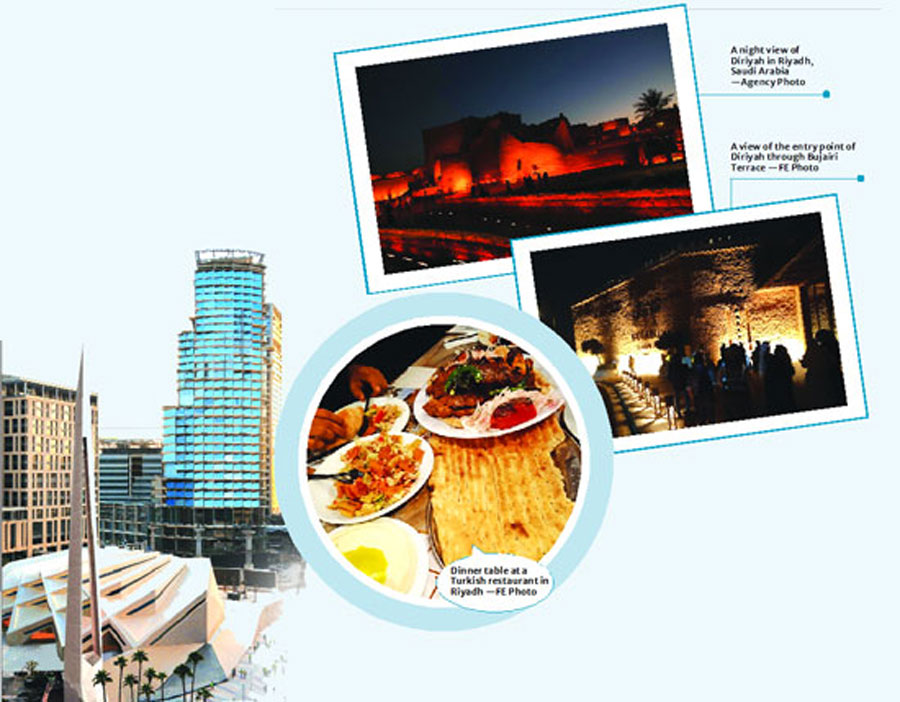
After we explored the business district, Emad led us to Diriyah, the home of the At-Turaif UNESCO World Heritage Site. Established in 1446 AD, this beautifully preserved mud-brick city is not just a historical site, but also the birthplace of the KSA and the original home of House Al Saud. Stepping into Diriyah felt like stepping back in time, experiencing the ancient history of the Kingdom of Saudi Arabia.
As we entered the area, the old streets and heritage landmarks, illuminated by night, virtually took us back to the ancient history of the Kingdom of Saudi Arabia. "At-Turaif stands over Wadi Hanifah and the verdant Diriyah oasis," said Emad. "The regal citadel once thrived as the heart of the Emirate of Diriyah or the First Saudi State." Exploring Diriyah means experiencing over 600 years of authentic Najdi culture and history.
At the Visitor Center, we learned about the history behind the migration of Banu Hanifah that started the settlement in the area, followed by the foundation of Diriyah and The First Saudi State ((1727-1818). We also visit the Arabian Horse Gallery that showcases the vital role of the Arabian horse in Saudi culture.
We spent around three hours in Diriyah, although we did not cover many other spots there. Nevertheless, it is a unique experience. Later, we went to a Turkish restaurant for dinner and enjoyed a wonderful gastronomic experience there. One year later, my mouth still watered for the wonderful gastronomic experience I had there.
asjadulk@gmail.com
© 2026 - All Rights with The Financial Express

