The world is moving fast. Services are going online, classrooms are becoming digital, banks are moving into mobile apps, and artificial intelligence is beginning to influence how people learn, work, communicate, and access public services. Bangladesh is part of this transformation. Over the past decade, the country has expanded digital public services, built thousands of government websites, promoted mobile financial services, and invested in platforms for education, employment, governance, and citizen support. But speed alone is not progress. The more important question is whether we are moving forward together.
For persons with disabilities in Bangladesh, the answer is still uncertain. A service may be online, but unreadable by a screen reader. A classroom may be open, but inaccessible to a wheelchair user. A banking app may exist, but may not allow a visually impaired person to complete a transaction privately. A government form may be digital, but may still require printing, scanning, signing, and physical submission. A mobile SIM registration process may appear simple for most people, yet become impossible for someone whose fingerprint cannot be captured.
Bangladesh has made important legal and policy commitments. The Rights and Protection of Persons with Disabilities Act of 2013 recognises the rights of persons with disabilities. Bangladesh has ratified the United Nations Convention on the Rights of Persons with Disabilities. The country has also joined the Marrakesh Treaty, creating new possibilities for accessible books and learning materials for persons who are blind, visually impaired, or otherwise print disabled. In the digital sector, accessibility guidelines and inclusion-focused initiatives have also begun to emerge.
Yet the distance between policy and daily experience remains wide. A recent public debate over a wheelchair user being denied entry to a commercial showroom in Dhaka showed how quickly dignity can be denied when institutions are unprepared. The incident was not only about one security guard or one company. It reflected a larger problem: many organisations still do not have clear accessibility policies, trained staff, or basic procedures to ensure that persons with disabilities can enter, move, communicate, and receive services with dignity.
The same problem exists online. Bangladesh's digital ecosystem is expanding, but many platforms are still not designed with persons with disabilities in mind. People with visual disabilities face unreadable PDFs, inaccessible CAPTCHA systems, confusing website navigation, and forms that do not work with screen readers. People with hearing disabilities encounter voice-only helplines and videos without captions or sign language support. People with physical disabilities may be blocked by biometric verification systems that offer no alternative. People with intellectual or neurodevelopmental disabilities may struggle with complex language, crowded interfaces, and unclear instructions.
Now AI adds both promise and risk to this landscape. Used well, AI can make life easier for persons with disabilities. It can improve Bangla text-to-speech, convert printed documents into readable formats, generate captions, support sign language interpretation, simplify complex government information, help students with personalised learning, and make public services easier to navigate. For a student with visual impairment, a good AI-supported reading tool can open up books that were previously inaccessible. For a person with hearing impairment, real-time captions can turn a meeting or class into something they can actually follow. For someone with limited mobility, AI-enabled service support could reduce the need to travel repeatedly to offices.
But AI will not automatically make society inclusive. If AI systems are trained without disability-sensitive data, tested without persons with disabilities, or deployed without accountability, they may reproduce old exclusions in new ways. A chatbot that cannot understand speech differences, an automated identity system that rejects non-standard facial or fingerprint data, or a learning platform that assumes all users read, hear, see, and move in the same way can deepen inequality instead of reducing it. This is why accessibility must be built into Bangladesh's digital and AI future from the start.
Digital exclusion carries a real cost. When a blind person must ask someone to complete a banking transaction, privacy is lost. When a person with a disability cannot register a SIM card independently, autonomy is lost. When a student cannot access university-level reading materials in a usable format, opportunity is lost. When a woman with a disability faces online harassment and lacks digital safety support, participation is lost.
The challenge is especially serious for women with disabilities, rural citizens, and people with multiple or severe disabilities. Many face not only inaccessible technology, but also poverty, family restrictions, low digital literacy, weak connectivity, and social stigma. A digital service that assumes every user has a smartphone, stable internet, literacy, privacy, confidence, and physical mobility will fail many of the people who need it most.
Education shows the stakes clearly. Bangladesh has made progress in bringing children with disabilities into schools, but enrollment is poor. A child must be able to enter the school, use the toilet, sit in class, understand the lesson, access textbooks, take exams, and continue to the next level. For children with severe or multiple disabilities, the journey may need to begin at home, with family support, basic communication, assistive devices, and gradual preparation for school.
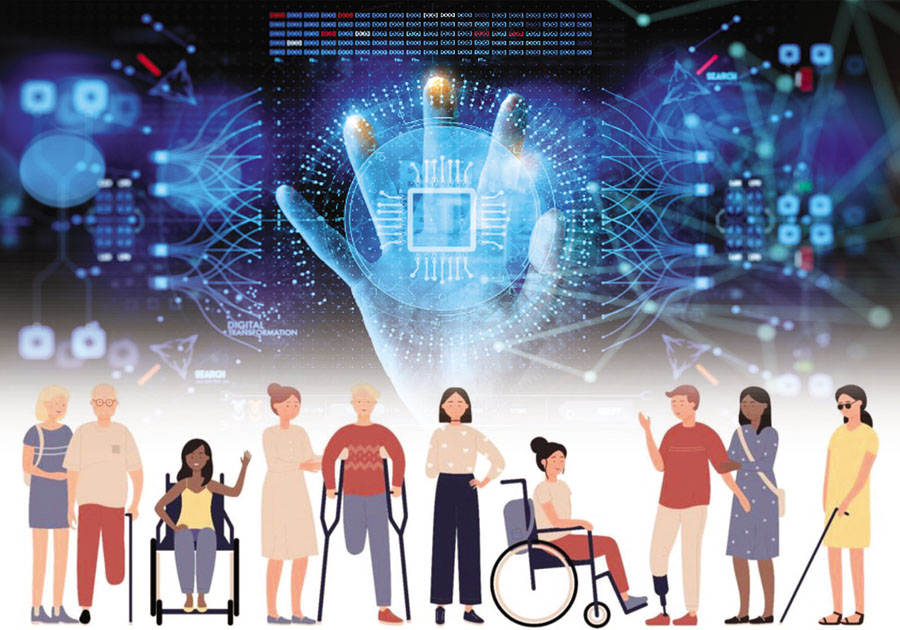
Now AI can support inclusive education, if used carefully. It can help create accessible learning materials, convert textbooks into audio, support teachers in adapting lessons, and provide individualised learning support. But it cannot replace trained teachers, accessible infrastructure, family engagement, or human care. Technology can support inclusion; it cannot substitute responsibility.
Bangladesh now needs to move from scattered initiatives to enforceable accessibility governance. First, accessibility should be mandatory in public procurement. No government website, mobile app, digital payment system, school infrastructure, e-learning platform, or AI-supported public service should be approved unless it meets accessibility standards.
Second, essential public and private services should undergo regular accessibility audits. Government portals, banking apps, telecom systems, education platforms, social protection services, hospitals, emergency communication channels, and public buildings should be tested by persons with different disabilities. Accessibility cannot be judged only by developers or officials. It must be tested by the people who actually use the services.
Third, Bangladesh needs alternatives to rigid biometric verification. Fingerprint failure, inaccessible facial recognition, or short OTP windows should not prevent people from getting SIM cards, passports, bank accounts, allowances, or government services. Identity systems must recognize human diversity.
Fourth, Bangla-language accessible technology must become a national priority. Bangladesh needs stronger investment in Bangla text-to-speech, speech-to-text, OCR, screen reader compatibility, captioning, sign language tools, and accessible publishing. AI can help accelerate this work, but it must be developed with local language, culture, and disability needs in mind.
Fifth, inclusive education must be planned as a full pathway, not a one-time enrollment drive. Early identification, family counseling, home-based preparation, accessible schools, trained teachers, flexible assessment, assistive devices, and transition to secondary and higher education must be connected.
Finally, organisations of persons with disabilities must be treated as policy partners, not ceremonial participants. Persons with disabilities should be involved in designing, testing, monitoring, and improving digital and AI systems. Nothing about accessibility should be decided without those who experience exclusion directly.
The private sector also has a major role to play. Banks, telecom companies, shopping centers, hospitals, universities, employers, media platforms, and technology firms shape everyday life. Accessibility should not be treated as charity or public relations. It is part of serving the public. Persons with disabilities are customers, workers, students, entrepreneurs, voters, and leaders. Excluding them is unjust, and it is also economically shortsighted.
There is a wider lesson for South Asia. Governments across the region are racing to digitise services and adopt AI. But if accessibility is not built into this transformation, digital progress will repeat old inequalities in newer, faster, and less visible forms.
Bangladesh has an opportunity to choose a better path. It already has laws, policy commitments, disability rights advocates, digital infrastructure, promising education models, and a growing technology sector. What is needed now is disciplined implementation.
The future should not require persons with disabilities to keep adjusting to systems that were not designed for them. The systems must change.
A country's progress cannot be measured only by how many services it digitises, how many platforms it launches, or how quickly it adopts AI. It must also be measured by whether a blind student can read, whether a wheelchair user can enter, whether a deaf citizen can communicate, whether a woman with a disability can use technology safely, and whether every person can access public life without pleading for dignity.
Rifat Islam works with Aspire to Innovate (a2i), Government of Bangladesh's programme for public service innovation and digital transformation. rifat.islam@a2i.gov.bd
© 2026 - All Rights with The Financial Express

