Cancer rarely announces its arrival. It enters silently and resides in our bodies for a considerable period before turning ordinary lives upside down. It is no longer a rare disease but a growing public health challenge, affecting millions of people worldwide, including Bangladesh. Early detection and timely treatment can save countless lives.
In Bangladesh, the cancer burden is rising steadily, with hundreds of new cases and deaths recorded annually. According to extensive research on the cancer situation in Bangladesh conducted by BSMMU, the prevalence of cancer patients per 100,000 people in the country stands at 106, with 53 new cases diagnosed every year. The study identified 38 different types of cancer prevalent across the nation. The gender-disaggregated data reveals a rate of 118 per 100,000 amongst men and 96 per 100,000 amongst women. The five most common cancers overall are breast, oral cavity (mouth), stomach, oesophagus, and cervical cancer. In men, the five most prevalent cancers are throat (laryngeal), stomach, lung, oral cavity, and oesophageal cancer. In women, the five most common are breast, cervical, oral cavity, thyroid, and ovarian cancer. Associate Professor Dr Md Khalekuzzaman, the principal investigator from the Department of Public Health and Informatics, reported that cancer accounts for 12% of total deaths in the country.
Anyone can develop cancer, but the incidence can differ by ethnicity, sex, and lifestyle factors. Symptoms of cancer may vary from person to person, depending on which type of cancer cells are developing in the body. Different types of cancers present with different symptoms. Regular screening is essential; otherwise, symptoms might deteriorate very quickly. It is possible to have cancer for years without being aware of it. Some symptoms can be detected early, helping to identify whether cancer cells are present in the body or whether medical attention is required.
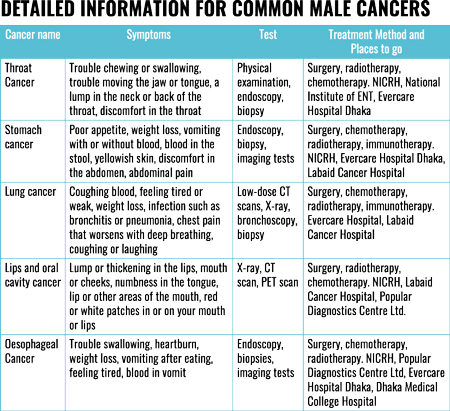
Common symptoms that may be caused by cancer:
• Swelling or lumps anywhere in the body
• Any lumps in the breast area or under the arms, colour changes around the breast area, or any itchiness or redness
• Fatigue or extreme tiredness that does not improve with rest
• Bleeding or bruising for unknown reasons
• Changes in bowel movements such as blood in stools, constipation, or diarrhoea
• Changes in bladder function such as pain when urinating, blood in the urine, or difficulty urinating
• Fever or night sweats
• Sores, bleeding, pain, or numbness around the mouth area
• Unexplained weight loss or weight gain
• Eating problems such as pain after eating, trouble swallowing, nausea, vomiting, or changes in appetite
These symptoms might not necessarily be caused by cancer but could be attributed to other conditions. It is always advisable to consult a doctor to determine the actual cause.
There is no need to be overly concerned about the symptoms. We can monitor symptoms ourselves at home through regular observation of our lifestyle. Whilst any of these symptoms could be an early sign of cancer, it is better to seek medical evaluation for a verified diagnosis. Following a doctor's assessment and appropriate medical testing, early detection of cancer cells in the body can be achieved. Early detection can help reduce the severity of cancer cell proliferation, making it less difficult to treat or prevent in the future. It can significantly improve treatment success rates.
According to the World Health Organisation, early detection consists of two components: early diagnosis and screening. Early diagnosis focuses on detecting symptoms in a patient's body as soon as possible, whilst screening refers to various tests for individuals to identify the specific type of cancer developing within the body.
Early diagnosis aims to raise awareness of cancer symptoms and the importance of seeking medical services when necessary. Through symptom awareness, it will help improve the accessibility and affordability of treatment and services needed at the initial stage.
Screening helps identify specific types of cancer before they have developed on a large scale. Screening procedures must be undertaken when their effectiveness is justified, the prevalence of the disease is sufficiently high, and the diagnostic criteria are up to standard. After abnormalities are identified through screening, further tests are assigned for thorough diagnosis. For example: mammography for breast cancer, HPV and Pap testing for cervical cancer, colonoscopy, sigmoidoscopy, and stool-based tests for colorectal cancer, and low-dose CT scanning for lung cancer.
Breaking through fear and stigma
Fear and taboo may exist in people's minds regarding cancer. Some may fear that cancer is synonymous with death, which can lead to extreme anxiety about developing or having cancer. The taboo surrounding cancer is widespread, often transforming a cancer diagnosis into a source of shame or social isolation. People who develop cancer, even without any family history, often face criticism and unnecessary blame. Victims might be characterisedas facing punishment or being the product of generational wrongdoing. This psychological distress can act as a major barrier to early detection and care.
People may also fear the financial burden on their families, as cancer treatments are costly. Additionally, many families conceal their medical history of cancer patients and keep them as secrets to avoid damaging relationships within society and to uphold dignity.
spurba2003@gmail.com