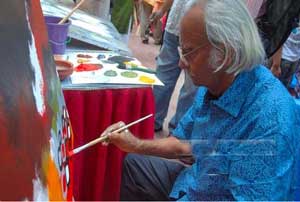
 Qayyum Chowdhury at work at the Liberation War Museum on Mar 26, 2008.
 Since his emergence as an artist, Qayyum Chowdhury's creative self all along remained attuned to the lavishly colourful rural Bangladesh. At intervals his focus shifted to other subjects; yet the age-old village and its inhabitants had a dominant place in his paintings. The eventful and bustling urban life, in spite of his six decades' residence in Dhaka, failed to find a remarkable place in his ever-alive and vibrant canvas.
Unlike the dramatic situation in which the artist left this world on November 30, throughout his painting career he carefully avoided suspense and surprise. He grew quietly. Qayyum Chowdhury's was a serene life in which myriad forms of beauty unfolded on being tuned to a unique musical notation dedicated to nature. We find in this music a preternatural tranquillity that transcends everything mundane. The artist excelled in the composition of this notation with paintbrush and colours.
The sudden collapse of Qayyum Chowdhury on the stage of Bengal Classical Music Festival on Sunday night (November 30), and his death after some time from cardiac arrest came as a great shock to art lovers, artists, and the cultural activists in general. True, he was in his ripe old age; yet at 82 many artists remain active in their creativity. Until his abrupt exit from this world, Qayyum Chowdhury was directly involved with a lot of activities related to painting. As a highly revered and senior artist of the country, he would regularly be on the judge-panels of different painting competitions, lead art camps in the country and abroad, and work as adviser to national-level painting exhibitions. At the same time, he could hardly keep himself detached from his chief mission of life -- painting. Over the last six decades, Qayyum Chowdhury had continuously been passing through creative bursts of painting and designing book covers -- the area where he singled himself out as a gifted artist.
Before the arrival of computer technology in this country, the artists were indispensable for book covers. It is in their manual works where the human imagination used to play its creative role, unlike in the machine-made designs. Qayyum Chowdhury developed a strong passion for doing book covers since his early days as artist in the mid-fifties. Apart from being admired as a major artist of the country, he was also regarded as an innovative and much-sought-after book-cover designer. He pioneered some new trends in this genre in Bangladesh. The artist veritably brought about a revolution in the country's cover drawings and book illustration. After his emergence as a book-cover artist, our publications sector had witnessed a break with many conventional trends in book designing, typography and mast head-making of weeklies and dailies. The artist was deeply associated with a number of monthly and weekly journals and magazines, as well as dailies. At one time of his career he worked for the Bangladesh Observer.
His artistic genius notwithstanding, Qayyum Chowdhury loved to keep himself involved with the socio-cultural events of the country. Unlike many of his contemporaries, mass upsurges always had an appeal to him. He never kept himself aloof and actively participated in all the popular upheavals in the then East Pakistan. Many would like to call him a pro-people artist. A number of Qayyum Chowdhury's paintings revolve round the country's turbulent period in the 60s and the early 70s. Those include '7th March, 1971', 'Bangladesh '71' 'Protest' etc.
In fact, as could be seen in his paintings, the artist was gifted with an inborn penchant for exploring the pure form of the Bengalee ethos. In line with this, we find in his works the rural Bengalees' centuries-old culture, with focus on their day-to-day activities and various rituals. The recurrence of peasants, boatmen, fishers and village professionals, alongside bashful housewives and young women, speaks eloquently of the dream the artist spun centring Bangladesh. These pastoral views are interspersed with the dominant collage of the 1971 Liberation War, Freedom Fighters and the other mass movements. Reminding us of the unique character of the artist, Qayyum Chowdhury's village sagas are found to be set against the backdrop of a still-unspoiled nature -- which occupies a considerable expanse in the artist's canvas.
A master of neatness in drawing and in the use of bright red, green, yellow and, at times blue, Qayyum Chowdhury believed in the clarity of expression. Perhaps this temperament contributed to his shift from the fondness for cubism in his early phase to the plain, but stylised, form of viewing man and nature. While his contemporaries tirelessly kept themselves busy experimenting with forms, Qayyum Chowdhury invented a language of his own: poetry-laden, unambiguous and free of pretensions. It is this simplicity in form and content that explains his activism for a cultural regeneration. An in-depth look at the artist's works shows how amazingly the romantic lyricism in his works coexists with roars and fire. The artist felt comfortable with all the major mediums including oil, watercolour and pen & ink.
It is now a part of our art history that Qayyum Chowdhury, Debdas Chakraborty, Murtaza Basheer et al sowed the seed of an art movement in the 1950s. Those were hostile times for art and the artists. Painting was still far from being accepted by the middle-class society. Qayyum Chowdhury played the doyen's role in this movement. The avant-garde group was greatly inspired by Zainul Abedin, who founded the first art college in Dhaka -- the Government Institute of Fine Arts, now the Faculty of Fine Arts, University of Dhaka. Qayyum Chowdhury graduated from this college in 1954. He joined the institute as a teacher. At one stage he teamed up with artist Quamrul Hassan at his Design Centre but later returned to the Arts Institute.
As his death at a musical event shows it symbolically, Qayyum Chowdhury drew significantly on music to explore his subjects and messages for his works. He was a connoisseur of music, both classical and Bangla folk. Classical music shaped his taste and the way how to notice man and other living beings. It appears to have taken him to the very essence of life. Bengali folk music opened for him the window on a marvellous world of the hidden treasures of our fading heritage. At times, it seems Qayyum Chowdhury was one of the few Bengalee artists who with their full passion and by employing an impressive style observed nature and the common village people. In this respect, the artist can be likened to Zainul Abedin, Quamrul Hassan, and, a little remotely, Jamini Roy.
Shihabskr@ymail.com
© 2026 - All Rights with The Financial Express

