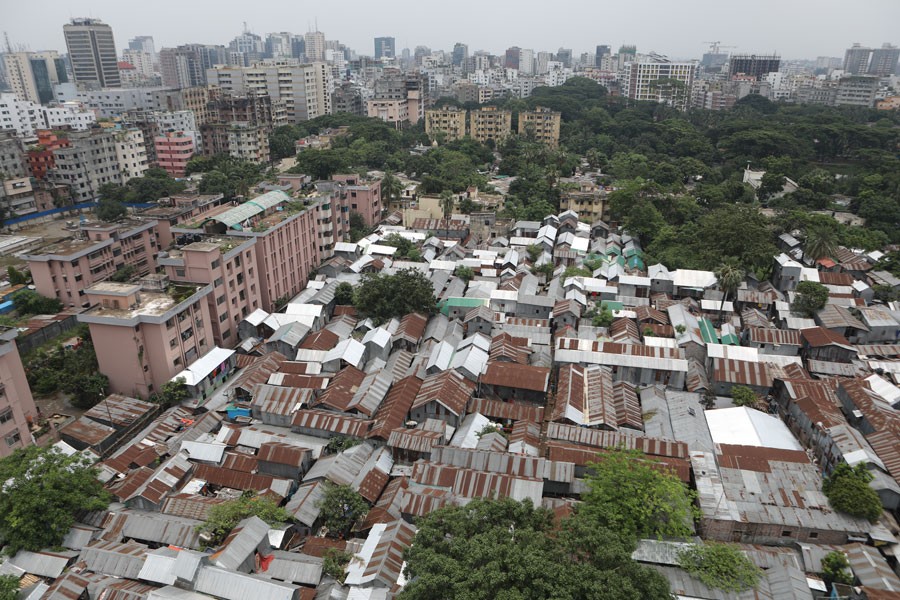
 High-rise buildings and tin -shaded slums coexist in Dhaka —FE Photo
 What will be the look of the city of Dhaka one hundred years from now? Given the stunningly fast change in the look and character of Dhaka in the 1940s and, later, in the 1970s --- especially after the independence of Bangladesh, many found in the city's features clear prospects for change. These seeds of change can be identified in the two views of Dhaka just over a hundred years apart from each other. The earlier scene, a photograph taken in the first decade of the 20th century, shows Dhaka's Shahbagh area as an idyllically quiet expanse. The area belonged to the then Nawab family of the then town. Many Dhaka experts call it an extension of the Bhawal Forests which lay in today's vast swathe of Joydebpur-Gazipur area. In just one century, the scenario of this part of Dhaka underwent lots of external changes. With fast urbanisation extending up to the fringes of today's Old Dhaka, many were able to foresee its future transformation into a bustling trade and administrative centre.
On the southern bank of the Buriganga River, on which the largest city of East Bengal stood, vast croplands interspersed by villages of farmers constituted the usual spectacle. Pressed between the pristine woodlands to the north and the hustle and bustle of a sprawling settlement and a riverside trade centre and port in the south, people settled in the mid-part later came to be known as the neo-rich comprising government officials and the city's elite. This demographic distribution began in earnest in the late 1940s. In the following decades, the urban population in this part of Dhaka comprised mainly the growing city's middle class population. In the later years, they were fast joined by the educated and career-conscious people arriving in Dhaka from all parts of East Bengal. In a general visual, these new arrivals of the mid-level educated classes and higher education-seeking students added to the fast-growing population of Dhaka. Already a vast number of century-old Dhaka dwellers had been settled in this historic city, famed for its muslin fabric.
During the Mughal period, Dhaka's joining the urban pace of life was slow. It was not until the arrival of the city's British colonial administrators, that the modernisation of the 400-year-old city began gaining speed. By the 1930s, Dhaka had already emerged as one of the neatly built sophisticated cities in the South and Southeast Asia. The sprawling city could then take enormous pride in achievements covering all major areas of urban life. The city had already got its first full-fledged university, a handful of undergraduate colleges, secondary schools. These institutions earned the ability to vie for a place besides those being established in the neighbouring city of Kolkata in the western part of Bengal. Despite the feeling of pride distinguishing the emerging city of Dhaka, it had still been lagging behind Kolkata in many urban amenities. Dhaka's identity as a capital of the provincial Mughal Subeh Bangla, was of a not too long duration. In comparison, Kolkata stood, with reasonable pride, as the capital of the British India for 139 years (1772-1911). Later, it enjoyed the fame of being the capital of whole Bengal for 35 years from 1912 to 1947.
Compared to Kolkata, Dhaka's progress in its urban look has been slow since its early days in the mid-20th century. Dhaka continued to develop in jet-speed after the country's independence in 1971. During the tenures of successive governments, they have followed their own development strategies. The most striking area of mega-level development was seen taking place in the communication sector. In the last 15-20 years, the roads and railway communication sector had undergone phenomenal phases of development. High-rises modelled on avant-garde architectural model continue to add to the capital's cityscape. Besides long-distance national highways, elevated expressways and the overhead, viaduct-based metro rail, Bangladesh has lately discovered itself among the countries showcasing their bridges across mighty rivers. After the Bangabandhu Multi-purpose Bridge was built in 1996 across the Jamuna, the country waits eagerly to see its longest road-rail bridge open in June connecting the two sides of the Padma River.
The country has a long development agenda. It includes a nuclear power plant, deep-sea ports, the underground Karnafuli tunnel, breakthroughs in the digital sector and mid-length bridge across rivers throughout the country. The massive project which has taken Bangladesh aloft among the countries with space-based communication satellites is its Bangabandhu Satellite Programme. The satellite was put to its specific orbit in the year of 2018.
In the sector of socio-economic uplift, the country's progress has been striking. If it is not for the Covid-19 pandemic and the Russo-Ukrainian war's fallout-related disruptions, the country in most likelihood would meet its SDGs. All this augurs well for Bangladesh, a small country having a critical role to play in global strategies, be they inter-regional economic cooperation, ensuring peace or saving the planet from environmental and climate disasters. In spite of these lofty thoughts, getting stuck in the blind alleys of sloppily carried out development plans might invite trouble for the country.
Given the miserable density of concrete residential and commercial structures pointing to the increasing dearth of space in every sphere of life, Dhaka's inability to bear further human pressure becomes evident as days go by. Dhaka was once confined to the settlements starting from the Buriganga's northern bank to the Nawabpur rail crossing. To the south, i.e. on the opposite bank of Jinjira stretching further to Keraniganj villages, vast areas were covered by different types of croplands. All these sprawling areas filled with unblemished solitude have for a few decades been filled with urban noise and squalor emitted by sporadically located satellite towns. These urban lands were procured by the neo-rich from the capital at almost throwaway prices. Many of them were traders and businessmen fresh from the nearby villages. Finding the land prices in the central parts of Dhaka like even greater Dhanmondi, Kalyanpur, Shyamoli or Mohammadpur too high they had opted for the rural areas lying across the Buriganga River. Many of the people from Dhaka who visited Keraniganj in the 1970s and the 80s now become speechless upon watching the metamorphosed Keraniganj neighbourhoods. The tin-shed residential houses, shops and other commercial centres have been replaced by multi-storey buildings; roads filled with various modes of transport including buses, deluxe private cars. Urbanisation experts attribute this makeover of the greater Keraniganj to the Buriganga Bridges connecting the two banks of the river.
Many call the sudden urbanisation of the vast areas on the opposite banks of the Buriganga an extension of capital Dhaka's frenzied turning into an unwieldy metropolis. Dhaka also continues to broaden on all sides. Many fear the city's northward extension will continue unabated until it touches the borders of Gazipur City Corporation. Barring the government's reserved zone of the vast residential complex, the whole Uttara Model Town is fast turning into another unplanned and congested urban centre in the greater Dhaka. A similar condition prevails in the extended areas of Dhaka to the east. Though still less populated, the capital's western flank braces for accommodating new residential and commercial plot seekers.
Kolkata, the neighbouring Indian state of West Bengal's capital, also faces a space crunch. But due to its sheer length and breadth, coupled with its planned growth, discipline in traffic movement, strict surveillance of industrial emission --- and, most notably, the popular tendency to abide by law, the cosmopolitan city still remains quite livable. Compared to it, the national capital of Dhaka continues to emerge as a metonymy for chaos, and also for primitive violence. Many can somehow visualise Dhaka's disorderly look after 100 years. Beyond that time, their thoughts start getting clouded.
shihabskr@ymail.com
© 2026 - All Rights with The Financial Express

