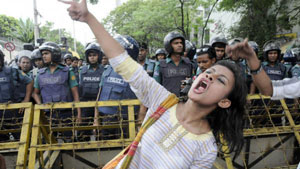
 An activist raises slogans demanding action against the sex offenders when the police stopped a protest procession against the harassment of women near the TSC, Dhaka University during the Pahela Baishakh celebrations on April 14.
 There is not an iota of doubt about the remarkable achievements made by Bangladeshi women in the last three decades. Ranging from socio-economic and academic sectors to even politics they have made their presence felt, quite distinctively at that.
Unlike in many developing countries, women in Bangladesh have increasingly been contributing to the nation's march forward. In fact, hardly any area could be found where some sorts of leadership role have not been taken by our competent women. The political arena comes first, with the country's prime ministerial role going to two women leaders since the fall of a dictatorial regime in the early days of the nineties. The Prime Minister, the Speaker of Parliament, the Leader of the Opposition in Parliament, the biggest opposition party leader --- all are women.
In commerce and the business sector, too, women are not lagging behind their male counterparts. Small, medium and large women entrepreneurs have fast been entering the economic scene. Young female entrepreneurs are found in considerable numbers in the rural areas. In many outlying areas far from the capital, self-reliant women with their innovative projects have been attracting the focus of national policymakers. International forums and agencies, including the UN, nowadays lay much stress on keeping the momentum of female empowerment in the country alive.
With 53.4 per cent literacy, against male 62 per cent (2011), our women clearly show the potential for emerging as a social force in the country. Girls and young women comprise an impressive segment in secondary, higher secondary, tertiary and higher education.
In short, young women in Bangladesh have already proved themselves to be a national phenomenon. But there is a flipside too, which is utterly depressing and bitter. The encouraging picture, with women at the centre, turns grey as we take a hard look at the stark reality in which our women are stuck. In fact, the view of the untiringly struggling new-generation women of Bangladesh stands in sharp contrast with another. That has millions of them being haunted by an ugly syndrome, one that has lately begun robbing them of their hard-earned freedom.
To speak without mincing words, our women are no longer safe outside their homes. In cases, they feel insecure even when lodged indoors. Male sex maniacs are after them. They begin stalking women the moment they come out of the confines of 'socio-economic dungeons'. The scenes are similar in both the cities and villages. When it comes to present-day Bangladesh, a deserted path across a paddy field is no different from a crowded festival venue in the city. In both the places, women are equally vulnerable to sexual assaults.
Hardly a day passes in the country that is not witness to the dishonouring of women. Many sadistic males do not stop at satiating their lust; they complete their orgiastic exercise by killing the victims. Of late, sexual persecution of women has emerged as a national scourge. In the cities and urban centres, it is carnal advances that afflict vulnerable women. They are relatively well protected compared to those in villages. But those in the poorer segments of urban society, garment factory workers in particular, walk into the path of sex-starved monsters unwittingly. The crimes like violating a lonely young woman in a running bus by its crew members have already entered Bangladesh. Although the frequency of sexual violence in Dhaka is lower than that in the capital of a neighbouring country, there is no point feeling relieved. Given the sudden spurt in the incidence of women's violation and the mostly unreported cases of sexual harassment, Dhaka might soon find itself alongside the said capital.
Communities in all parts of the world are used to seeing saintly people live alongside sex psychopaths. We are no exception. But due to the Bengalee nation's roots being stuck in a past laced with mysticism, it has been able to remain free of many behavioural aberrations. The men here have traditionally been respectful of women, with dishonouring of females coming to be regarded as a great offence.
Respect to women used to be held high until recently. Even the post-Liberation War confused times were relatively free of this nightmare. A young woman then could take a rickshaw ride alone in the evening in unknown neighbourhoods; or a young mother and her teenage daughter had no reasons to feel nervous while aboard a ferry-boat propelled by male youths. The scenario changed almost overnight in the decade of the eighties. A section of researchers point the finger at the 'video craze' that reached a feverish pitch at that time. The country's big and small cities, and even village markets, became flooded with video shows screening porno films. The gullible youths were the major clientele of these shows. Commercial screening of the films through video cassette recorders (VCRs) in clandestine ghettos wrought havoc of sorts on the age-old values related to women's dignity. With the phase-out of VCRs and the arrival of the invincible Internet years later, the whole educated young generation of the country jumped on the electronic bandwagon. The Internet set off a revolution in the world of knowledge and communication. The young generation had no reason to turn away from it. But along with its amazing benefits and services, the electronic communication medium also sparked myriads of vices. Ironically, it is the womenfolk once again, who became their victims. The online world or the Internet is unrestricted. People not much careful of the pitfalls in this medium get entangled in lots of embarrassment. In the electronic communication world, young women are easy targets of cyber-crimes.
As newer social networking sites are coming up, so are the mischievous ways of harassing women. Lately, hacking others' accounts, photo-tailoring, uploading highly objectionable doctored photos with indecent comments have become widespread crimes online. Lives of hundreds of young women have been devastated by these practices. The most disturbing aspect of online culture is anybody can download an x-rated film any time. After all, it's a free world up there.
Many blame the wantonly warped use of computers by a section of pervert males for the rising incidents of sexual harassment. The menace has deteriorated to such an extent that even many middle-aged women have dissociated themselves from online use. Parents have restrained their teenage girls' presence in the virtual world. Despite all this, our urban women stray into sexual hazards quite often --- be they on public transports, while walking along roads, at workplaces, or even at educational centres. In many areas of life in Bangladesh, it is mostly the lower and lower middle-class women who fall prey to sex maniacs. The upper and middle-class women are more or less secure and safe. They have social and formal protections owing to their being part of the privileged segment of society. In spite of this lopsided picture, sexual harassment takes a heavy toll on the overall uplift of women. It slows down all kinds of economic activities of the womenfolk. Their social life, as well as freedom, also gets choked.
What alarms a number of social scientists is the spectre of an orchestrated campaign against women. Misogynists are found in every society. It is an alien aberration. Regardless of its presumed strength in Bangladesh, misogyny, nonetheless, adds to the miseries and traumas of women.
However, the scourge of sexual harassment has yet to raise its ugly head in the manner in which it has in many countries. The genie is still in the bottle. Even then, the assaults have long been leaving a debilitating impact on younger women in general. As a result, they may start feeling less confident and assertive in many sectors. The government ought to be fully proactive in coping with the dreadful vice.
shihabskr@ymail.com
© 2026 - All Rights with The Financial Express

