School textbooks play little role in prompting teenage students to go for pleasure-reading. At school, few Bangla teachers are found going beyond the confines of the syllabus contents fixed in a textbook. Even the students in the higher classes aren't normally given clues to 'out books' --- books of stories. The scenario was different in the past. A few of teachers would be seen referring to famous juvenile books in between their class lessons. Amazingly, they were able to pick a handful of book lovers. A number of these students remained attached to creative books throughout their life. In spite of the many temptations of successful careers, they couldn't dissociate themselves from the appeal of books.
Authors, painters, singers and many other creative persons cannot be 'created'. And readers are also born. Although they cannot acquire the flair for creative activities, they make good connoisseurs. Passionate readers belong to this class. In course of time, they earn the capability to call themselves book lovers. Not all readers are book lovers. Workshops, special lessons and guidebooks can teach new readers the methods of reading fruitfully. Few know the fact that reading in a haphazard manner results in the growth of mere amateur readers. These readers in one phase of their life become disillusioned with pleasure-reading. And they, finally, dissociate themselves from books.
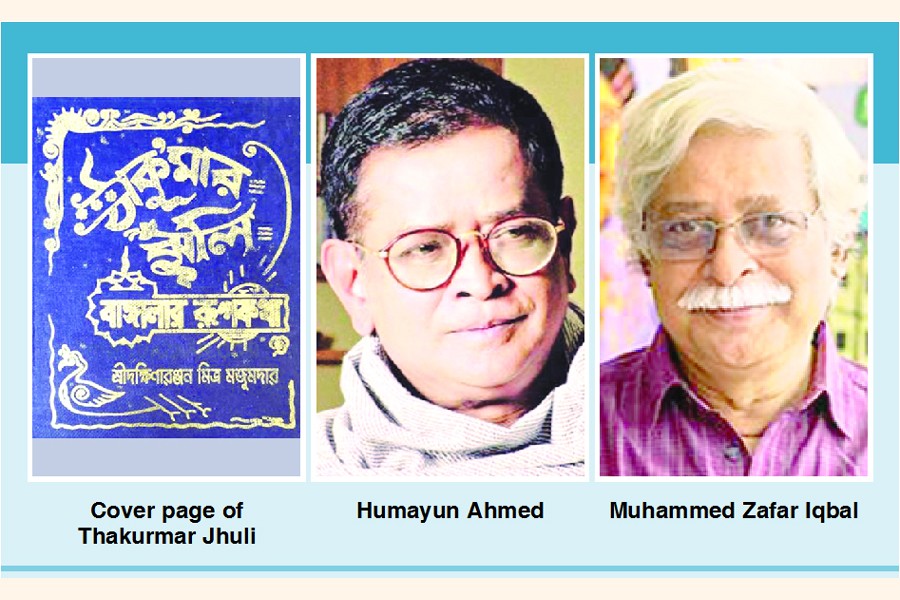
Picking books at an early age is the key to the process of making one an ideal reader. This is the stage where most of the children's guardians are found erring. According to many of them, all-time great juvenile books are no longer available to the young readers. The reality speaks of a different picture. Reprint editions children's Bangla classics continue to be published in the greater Bangla-speaking world. Apart from them, folk or fantasy tales written by a section of new-generation writers keep being published in both Kolkata and Dhaka. However, there is a chance of misunderstanding. The non-availability of the 100-year-old fairy tale collections, like the one by Dakshinaranjan Mitra Majumdar --- 'Thakurmar Jhuli', leads many in Bangladesh to go for books by the new-era authors. Unfortunately, many adults fail to differentiate between the old and the new classics. They accept the new books as the original ones. The irony is the new-edition juvenile books, despite their glossy outer look, remain filled with printing errors. A few of them use low-quality paper, instead of the costly art paper. An atrocious part of the new-age fairy-tale books comprises a section of unscrupulous authors. Many of them are found altering the story-lines, adding their own versions to the original plot, or rewriting the story altogether. Fortunately enough, the number of these writers and publishers is few and far between.
Apart from fairy tales, many adapted to the taste of the new-era teenagers, varieties of new subjects have entered the 21st century domain of juvenile literature of Bangladesh. In the history of Bangla juvenile books, the fairy tales have been followed by innocuous ghost and mystery tales, adventures and science fictions. Books of humour are conspicuous by their absence, though. It's sad to note that the tradition of humour stories has veritably been put to an end with the death of Shibram Chakraborty. Poet and story-teller Tarapada Roy, however, had picked the tradition in his unique way. But he couldn't go ahead with the trend thanks to his spending of time on the other lighter subjects. Finally, the responsibility of keeping alive the vital branch of humour in juvenile literature had to be taken by Humayun Ahmed. It's this prolific Bangladeshi writer, who seemingly shouldered the task of keeping the vein of humour alive in Bangla juvenile literature. Although the contribution to the area of the tales of humour is meagre, the august presence of Shibram, Tarapada, Humayun and a few others was able to make it a vital area in undivided Bangla literature.
When it comes to variety, Bangla juvenile literature is no less vital in the context of world literature. After its fairy tales, one might feel tempted to turn to the publications of assorted nature. They include almost all the subjects related to the contemporary popular science, robotics etc --- not to speak of the fantasies about space adventures, aliens, inter-galactic wars etc. There are lots of younger writers interested in these subjects. But they lack the command of a lucid Bangla, which produced the successful science fiction writers in Kolkata in the 1950s. Basically short story writers and novelists, these authors included Premendra Mitra, Hemendra Kumar Roy et al. In the 21st century, Zafar Iqbal, a prolific science fiction author, reigns supreme in the genre of Bangla science fictions. In the past glory days of books, detective fictions remained popular with many teenage and post-teen readers. In those days scores of youths would be found being glued to Bangla detective novels. Only a handful of Dhaka publishers had outlets for these novels; the chief source of detective books or crime thrillers thus, finally, turned out to be Kolkata.
Apart from the two series with Sharadindu Banerjee's Byomkesh Baksi and Satyajit Roy's Feluda as the detectives, the decade of the 1930s to 1960s saw a few of other sleuths. They were Mr Blake, Deepak Chatterjee, and Kiriti Roy. Their creators were Deenendra Kumar Roy, Swapan Kumar and Neeharranjan Gupta. Thanks to their movie versions, the books by Shradindu and Ray have been enjoying immense popularity among young readers for decades. Most of the recent movie versions of Byomkesh stories, after a long pause, have proved box office-hits. Books under the two series with Dosyu Bahram and Dosyu Bonhur as the unbeatable pro-poor heroes sold thousands of copies in Dhaka in the 1960s and the 1970s. The heroic exploits of these two nearly irresistible teenage idols were created in the style of those linked to Dosyu Mohon, the first Bengalee social hero based in Kolkata. Meanwhile, today's younger generation in Bangladesh can claim itself to be fortunate to have the genre of mystery-thrillers created by Humayun Ahmed. This series also has a detective-like protagonist. Called Misir Ali, his job is psycho-analysis of characters suffering from different forms of psychosis. Misir Ali is a unique creation in the world of Bangla mystery thrillers which deal with psychoanalysis of troubled persons.
Humayun Ahmed has written a couple of horror novels, too. They became popular with both teenage and adult readers. It's difficult to wean readers, who are drawn to detective, mystery and horror fictions, off these books. Same is the case with the espionage novels, especially those written under the Masud Rana series. Based on the daring espionage missions of the Bangladeshi spy, the espionage thriller series had been favourite with the country's teenage generation and the general youths until recently since the 1960s.
Out-of-syllabus books spark different types of worries among the caring parents. A few of them believe these books have little role in the intellectual maturity of young students. Many oppose the view. They cite the examples of great people who remain glued to the so-called 'out books', besides being engrossed in textbooks. These students do not fail to perform brilliantly in their professional careers. The young learners who fail to come out of the spell of their favourite book worlds find their own paths open before them. They stand out with their above-average intellect. Many even emerge as authors themselves.
shihabskr@ymail.com
© 2026 - All Rights with The Financial Express

