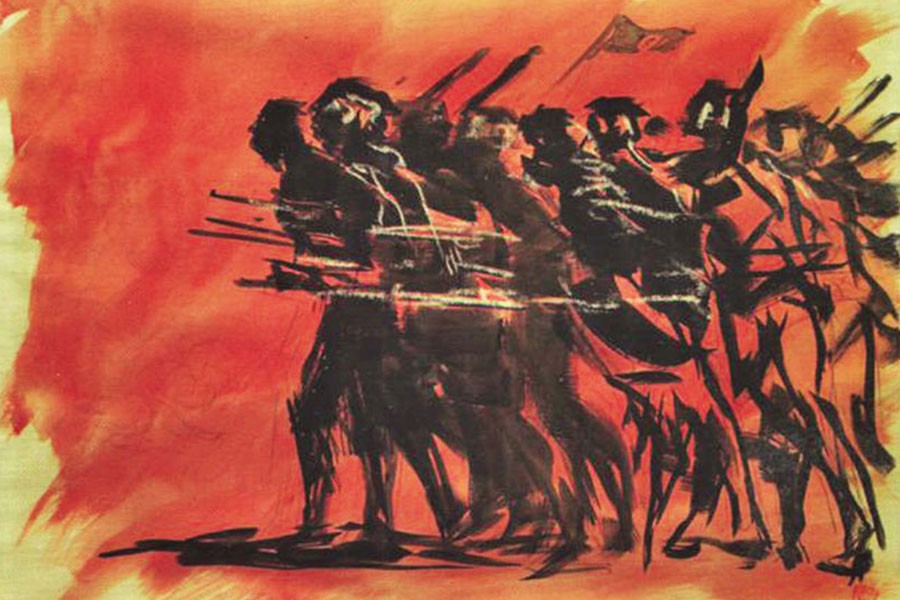
 Bangladesh Liberation War, 1971: a painting by Zainul Abedin
 Bangladesh did not suddenly appear in 1971. It was not created in a moment of crisis, nor born out of a single political decision. Rather, it emerged through a long and continuous historical process-shaped by geography, culture, power, resistance, and the enduring will of its people.
To understand Bangladesh, one must look beyond the immediate events of March 1971 and recognise a deeper truth: this was the culmination of a civilisational trajectory, not an accident of history.
Ancient Bengal existed as a distinct ecological and cultural space, defined by its riverine geography. The Ganges-Brahmaputra-Meghna basin provided fertile land that enabled early settlement and agricultural development. From around 4000-1500 BCE, Austroasiatic-speaking communities established the foundations of a structured society through agriculture, fishing, and river-based livelihoods. This early society, though shaped by nature, gradually evolved into an organised and adaptive human landscape.
Archaeological evidence from sites such as Wari-Bateshwar and Mahasthangarh reveals that Bengal was not an isolated agrarian region but part of an early network of urbanisation, trade, and exchange. These sites demonstrate the presence of planned settlements, commercial activity, and monetary systems-clear indicators of an integrated and outward-looking civilisation.
Placed within the broader global timeline, this development aligns with major shifts elsewhere.
Around 2000 BCE, during the era traditionally associated with Abraham (Hazrat Ibrahim in Islamic tradition), religious and social structures were taking shape in the Middle East, while agrarian civilisations were consolidating across South Asia. Bengal's early society evolved in parallel with these transformations, firmly embedded within the wider arc of human civilisation.
By the 4th century BCE, the Gangaridai state represented Bengal's first visible political consolidation. Greek historians such as Megasthenes and Diodorus described its formidable military strength, particularly its war elephants. This was not a peripheral region-it was a recognised power.
Under Chandragupta Maurya, Bengal became part of the Mauryan Empire, entering a centralised imperial structure for the first time. Emperor Ashoka (r. 268-232 BCE), following his conversion to Buddhism, advanced a model of governance rooted in ethics, tolerance, and moral responsibility. These ideas left a lasting imprint across the region.
The Gupta period (320-550 CE), often described as a "golden age," saw remarkable developments in science, literature, and the arts. Bengal participated in this intellectual flourishing while maintaining religious pluralism. Following the decline of Gupta authority, King Shashanka in the 7th century established an independent political centre in Gauda-marking the emergence of a distinct regional political identity.
The Pala Empire (750-1174 CE) elevated Bengal into a global centre of Buddhist learning. Institutions such as Nalanda University and Somapura Mahavihara at Paharpur attracted scholars from across Asia. Bengal, during this period, was not merely governed-it was intellectually influential.
This trajectory shifted under the Sena dynasty (1097-1204 CE). Ballal Sena institutionalised the kulin system, formalising rigid social hierarchies and restricting mobility. While literary culture continued to develop under Lakshman Sena, society itself became increasingly stratified and inward-looking.
It was within this convergence of social rigidity and political vulnerability that Bakhtiyar Khilji's conquest in 1204 took place-restructuring Bengal's power dynamics and linking it to a wider Islamic political world.
At the same time, Bengal remained deeply connected to global trade networks. Through riverine and maritime routes, it engaged with Southeast Asia, China, the Arab world, and even the Roman Empire. Roman coins, Chinese ceramics, and Arab merchant accounts testify to Bengal's place within the Indian Ocean trading system.
In essence, Bengal was a globally connected civilisation long before the modern idea of globalisation emerged.
MEDIEVAL BENGAL: Between the 13th and 18th centuries, Bengal became one of the most prosperous and cosmopolitan regions in the world. Islam spread gradually-through Arab traders, political expansion, and the influence of Sufi saints. Figures such as Shah Jalal (early 14th century) played a critical role in embedding Islam within society, not through coercion but through spiritual and social engagement.
The Bengal Sultanate, established under Shamsuddin Ilyas Shah in 1342, unified the region politically. Under Alauddin Hussain Shah (r. 1494-1519), Bengal witnessed a flourishing of language, administration, and culture.
In 1576, Mughal expansion under Emperor Akbar reached Bengal. His general Raja Man Singh defeated Daud Khan Karrani, ending the independent Sultanate and incorporating Bengal into a centralised imperial structure. Islam Khan later established Dhaka as the provincial capital.
Bengal's economy thrived under Mughal rule, with Dhaka muslin becoming one of the most coveted textiles in the world. Bengal was not merely surviving-it was shaping global trade and culture.
COLONIAL BENGAL: The Battle of Plashey in 1757 marked a decisive rupture. With the defeat of Nawab Siraj ud Daulah, Bengal fell under British control, and a new system of economic extraction began. Indigenous industries declined, agrarian pressure intensified, and wealth flowed outward.
Resistance emerged in multiple forms. Titu Mir (1831) led an armed peasant uprising; Haji Shariatullah mobilised agrarian society through the Faraizi movement. Even the 1857 rebellion, though limited in Bengal, reflected broader unrest.
The Bengal Famine of 1943 exposed the catastrophic consequences of colonial policy-millions perished, not solely due to nature, but due to systemic failure. Yet this period also witnessed a profound intellectual awakening. The Indigo Revolt mobilised peasants, while thinkers and writers reshaped identity. Figures such as Rabindranath Tagore and Kazi Nazrul Islam articulated a cultural consciousness that would later underpin political nationalism.
Bengal learned that rights are not granted-they are claimed.
PAKISTAN PERIOD: The creation of Pakistan in 1947 raised hopes for a just political order among many Bengali Muslims, including leaders such as A K Fazlul Huq and Huseyn Shaheed Suhrawardy. However, the state quickly became centralised around West Pakistan.
The imposition of Urdu by Muhammad Ali Jinnah triggered resistance. Economic disparity deepened as East Pakistan's resources-especially jute-were used to benefit the western wing.
Movements unfolded in sequence-from the Language Movement of 1952 for identity, to the Six-Point Movement of 1966 for autonomy, the Mass Uprising of 1969, and the elections of 1970 for a democratic mandate-together transforming a political demand into a national movement.
MARCH 1971: By March 1971, the crisis reached its peak. Despite the Awami League's electoral victory, power was not transferred. At its core, this was a conflict between democratic legitimacy and centralised authority. The suspension of the National Assembly on March 1 triggered a non-cooperation movement, effectively transferring administrative control to Bengalis. On March 7, Sheikh Mujibur Rahman's speech unified the population while maintaining strategic restraint.
March 7 was not the end-it was the decisive turn.
The balance collapsed on March 25, when the Pakistani military launched Operation Searchlight, transforming political crisis into war.
MARCH 25-26 - THE BIRTH OF A NATION: Units of the East Bengal Regiment-including the 1st, 2nd, 4th, and 8th battalions-rebelled.
Students, workers, peasants, women, and the diaspora joined the struggle.
In Chittagong, Major Ziaur Rahman -- second-in-command of the 8th East Bengal Regiment declared independence firstly on his own behalf and later on behalf of Bangabandhu Sheikh Mujibur Rahman, risking his life and career. Both the declarations were broadcast from Kalurghat Radio Station at Chittagong 26th March 1971.
The movement became a war. The people became a nation.
Bangladesh was not created in a moment. It was shaped over centuries. March 26, 1971 was not the beginning-it was the culmination. Bangladesh was not made-it was realised, through history, struggle, and the unyielding will of its people.
Maj (Retd.) Mohd Akhtaruzzaman is a Former Member of Parliament (1991-1996, 1996-2001). rtlbddhaka@yahoo.com
© 2026 - All Rights with The Financial Express

