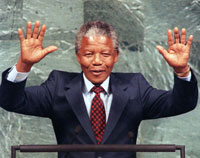
 Nelson Mandela smiles at the United Nations in New York on June 22, 1990: There were many liberators in history, and Nelson Mandela is the tallest of all.
 It is ordinarily said that "end justifies the means." But what end? In Jean Paul Sartre's opinion, means is not justified if end is not justified. Bertrand Russell was more categorical and dismissed any means if it is not for a good end. Rabindranath Thakur took it further by saying that human being can not participate in human destruction. He put more emphasis on Human as he thought Humans have a responsibility toward each other and to the environment around him. Mahatma Gandhi wrote, "The means may be likened to a seed and end to a tree; and there is just the same inviolable connection between the means and the end as between the seed and the tree."
It was natural that after being occupied by the invaders for hundreds of years, the people of the sub-continent of India would want to be free and be ruled by their own kind, preferably chosen by a process of electing the rulers. The end was clear and means - both passive and active resistance - were accepted by all including the occupiers. Adolf Hitler's forcible annexation of other nations was not acceptable and almost the whole world rose against him. At the cost of millions of life, destruction of cities after cities and displacement of several million people, the nations in Europe were made free and it is now argued that end justified the means of such catastrophic destruction. In South Africa, humanity was subjugated and humiliated, and means of both violent and non-violent campaign were accepted and supported by the rest of the World.
In 1971, the people of Bangladesh rose against occupation and oppression. A violent conflict ensued. The brutal war cost about three million lives and millions of families fled to the neighbouring country. Bridges and infrastructure were destroyed. People around the world supported the violent resistance for freedom. This violent "means" would not have been necessary, had the Pakistani occupiers exercised reason and rational appreciation of the situation.
All these 'ends' and 'means' were acceptable and justifiable to pundits and philosophers. But when a few leaders who are still unwittingly revered by the nation, decided to make personal gain and satisfy personal ego, caused slaughtering of six million people and made tens of millions displaced as it happened during the 1947 partitioning the sub-continent, can the 'end' or 'means' be justifiable ? This atrocity was not perpetuated by the colonial occupiers, but by their own people.
When in Congo, thousands of people were butchered after the colonial French were long gone, can it be justified and blamed on the colonial overlords? What happens when a nation is freed? Is it to be taken over by some groups or gangs or is it to be decided by the free people how to freely live and prosper? Why freedom is so misunderstood?
There were many liberators in history who had sacrificed their lives, comforts and material possessions to live in freedom, to liberate the enslaved and free a land from the occupiers. Some of them stood taller than others. Of many such liberators, Nelson Mandela is the tallest of all.
From the dawn of civilisation, human struggle mostly focused, first, on achieving freedom and then an environment where humanity will prevail over prejudices, hate and exploitation. Human beings excelled in creative expressions, building social cohesion, cultural traditions and preserving fraternity which perhaps God originally had intended. This imbued campaigners to reach to the remotest corner of the earth and propagate knowledge and technology to protect human beings from the greed of rulers and natural calamity and disasters.
But more poignantly, as expressed by D. H. Lawrence: "Consciousness is an end in itself. We torture ourselves getting somewhere, and when we get there it is nowhere, for there is nowhere to get to." Today's Bangladesh tragically confirms D.H. Lawrence's apprehension. At the birth of this nation "hope" was the only capital while many pundits dismissed it as "unachievable state". Bangladeshis struggled hard to come out of the poverty trap and achieved the status of one of the promising nations. Saddled with the heavy burden of 150 million people, nature's destructive onslaughts and hostility in political arena, the nation has struggled and marched to attain recognition in the economic world.
Unfortunately, politics and political parties stand on the way of national progress. They are still debating on the ideology and purpose of liberation as they are gradually becoming irrelevant to national life. Bangladesh is one of the few nations among the LDCs (least developed countries) that have made a mark on the international scene without being politically led or having any working institutions of governance. Every gain, prize and award was achieved by relentless and enduring efforts of individual Bangladeshis whom the local leadership might not have recognised but the community of nations appreciated and rewarded them.
Other nations may suffer tragedy once, but in Bangladesh tragedies happen consecutively and frequently. First, millions of people were slaughtered by the occupation army of Pakistan and their collaborators, then in '75, the national leaders and their family members were assassinated, and in addition, cyclones and floods periodically batter the nation ever since.
In all these, one would expect a leadership would emerge to unite the nation and bear the pain of these tragic occurrences. But the politicians, motivated only by self-interest, burdened the nation with extra pain and created obstacles to progress.
Philosophically, one may always accept "any means to achieve an end" but, "any means" has historically created more conflicts, more destruction and more human tragedy. It is difficult to understand and, at times, to appreciate, why a few men will want and can resort to "any means" to amass wealth, gain power and hold on to control and manipulate to cause human destruction. It is, however, something that had happened and will recur in human history. It is what is known as megalomaniac aspiration that will blind a person or group to perpetrate torture, panic and terrorise society.
This is done in many ways. We have just gone past the Cold War. The bipolar system is no longer there. We have entered into a mono-polar arrangement and have become victims of the single dimension of security, social and economic management.
Charlemagne in an attempt to unite Europe had campaigned against other nations and subjugated them. But separate identity and culture did not vanish. They had, instead, flourished more defiantly. Adolf Hitler on piggy ride on the Socialists captured power in Bavaria and then slaughtered 16 million people, including the Socialists, to establish his personal stamp on humanity. Joseph Stalin apparently had a listening device at every one's bedroom and whoever said a word against him or his "state" was summarily executed or sent to Siberia next morning.
Humans are very resilient creatures. If they evolved by selection, they had overcome all the limitations of nature or God has given them immense ability to withstand nature's worst brunt and humans' own predation.
The writer is an economist, business consultant and President of Bangladesh-Myanmar Chamber of Commerce & Industry (BMCCI).
kbahmed1@gmail.com
© 2026 - All Rights with The Financial Express

