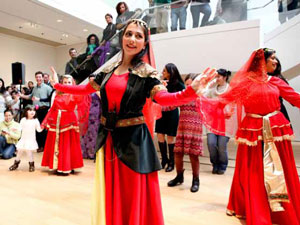
 Nowruz 2015: The Persian New Year Festival.
 Newspapers around the world, including those in Bangladesh, published a report on March 22, 2015. Its content centres on a centuries-old celebration, Nowruz, the gaieties and festive air of which annually sweep through over a dozen of countries in western and central Asia. The celebration this year marked welcoming the 1394 Persian solar calendar year Nowruz. Like many other annual jubilations around the world on different days, March 21 witnesses the beginning of the Persian New Year, which coincides with the first day of spring. Nowruz is also called the 'new day'. Despite the fact that the celebration has its roots mainly in Iran -- the erstwhile Persia -- Afghanistan and the Iranian-Turkic people-dominated areas in Iraqi Kurdistan, Syria and Lebanon, it also enjoys a strong presence in the vast regions nearby. Those include large swaths of Central Asia, part of the Middle East, north-western China, the Caucasus and the Balkans. The ancient Persian people living in the Indian sub-continent also observe the day in great festive mood.
Given the Persian New Year Day's message of peace and harmony, and the accompanying pageantry, its spontaneous celebration in many of the world's present violence-torn areas seems a little unusual. Over the last few months, many Kurd-majority areas in Iraq, Syria and Turkey have been overrun by extremist forces opposed to socio-ethnic traditions. They disapprove of them as they view these rituals as stemming from the pagan past. After all, the history of the ancient festival of Nowruz is traced back to the Zoroastrian past of Persia. But the obscurantist forces did not prevent the nations and communities in the region from observing the day amid traditional fervour.
In Iran, Nowruz is a national holiday. It is a public holiday in Afghanistan, Azerbaijan, Uzbekistan and many other Central Asian countries. The celebration of Nowruz resembles almost the similar festival of Pahela Baishakh in Bangladesh, albeit in an uncanny way these days. Although the Bangla New Year's festival had been smoothly observed in Dhaka for the last four decades, the grisly terror bomb attack on the 2001 open-air musical celebration in the capital dealt a big blow to the popular tradition. Despite being a conservative Islamic society now, Iran has not rejected its past.
The New Year's Day used to be observed in the country in great jubilation in its Persian era, and also in the modern-day Iran ruled by emperors. After the Islamic Revolution, the cleric-dominated government has not stood in the way of the celebration of Nowruz. Following the end to the 60-year iron-fisted socialistic rule, the newly-independent nations in Central Asia have not lost time in going back to their colourful past. From among many traditions, some of them warmly embraced Nowruz.
To speak acerbically, as an ethnic entity we appear to have been miserably failing to meet a number of basic requirements that constitute an ideal nation. In the New Millennium, intolerance and fierce parochialism are fast overpowering the age-old Bengali virtues of assimilation and amity. Many sections of the people in the country have long been caught in the tentacles of orthodoxy and obscurantism. At times, zealotry seems to be ruling the roost in the land. Keeping this grim Bangladesh reality in view, the unfettered celebration of Nowruz in Iran, where religion plays an official role in moulding society, appears before us in a garb of incredulity. The Iranian people can rightfully boast of their heritage which is thousands of years old. So do the Afghans, the Uzbeks or the Kurds.
As a well-defined nation in all its ethno-traditional totality, the Bengalees do not lag behind. Islam has added beauty to its multi-splendoured social strength. During the centuries past, the religion embraced by the majority of the people in Bangladesh was not in any conflict with the other prevailing socio-cultural matrixes.
Something went wrong in the later part of the last century. Deviational hues began overshadowing the common people's world of long-nurtured beliefs and thoughts. Hatred and violence raised their ugly heads. The gullible sections of society turned out to be hapless victims. To the horror of the sensible and conscientious people, a hitherto-strange form of terror began sending out its root in many sections of society. All this had helped the seeds of hate and destabilisation to grow. The Ramna Batamool bomb attack in 2001 was the inevitable corollary to the deliberately made wrong and lethal interpretations of our socio-cultural ethos. The ground had been in the making for quite some time, with the cabal spinning their dark web in various disguises.
In the meantime, stenches of socio-cultural baggage have kept thickening the air. Iran, Afghanistan and other Muslim countries are celebrating their New Year with aplomb and élan. And we think twice before arranging ours, thanks to the spectre of the 2001 carnage, which we so lovingly welcome by singing, "Esho Hey Baishakh …"
No nation or community in today's world having the faintest trace of pride and love for their heritage will oppose the celebration of their New Years. The Mayans and the Aztecs are long gone. But peoples in Guatemala, Mexico and other Latin American countries still observe their ancient New Year days -- alongside that marking the Gregorian calendar. All ancient civilisations had their own styles of New Year celebration. That's what history tells us about the Babylonians, the early Egyptians living on the Nile Valley and a lot of other races and civilisations. Thanks to their zeal for life and the ingenious ways to fight hostilities, many of the early peoples survive still today. The Iranians and the Chinese stand out among them. The Chinese New Year celebration is one of the most spectacular of these events. So is ours these days. The Bangla calendar was introduced in 1584 AD, during the reign of Mughal emperor Akbar. Although its invention was prompted by the necessity to devise an annual schedule to facilitate harvest in Bengal, the mainly 'agriculture year' eventually became interspersed with scores of Bengali folk rituals. Opening fresh accounts for clients by businessmen and organising fairs have for centuries been two essential parts of Pahela Baishakh in the village. Upon entering the urban areas, the event has kept absorbing the broader features of our culture such as music, dance, carnival, entertaining guests at home with sweetmeats and special dishes, and other innovative forms of merrymaking.
Like all national festivals, welcoming the traditional New Year amid festivities speaks of a people's inherent love for its rich past. That's what applies to today's Iranians, the Afghans, the Kurds, the Chinese --- and many others. Bengalees in Bangladesh feel proud that they have their own Nobo-borsho.
shihabskr@ymail.com
© 2026 - All Rights with The Financial Express

