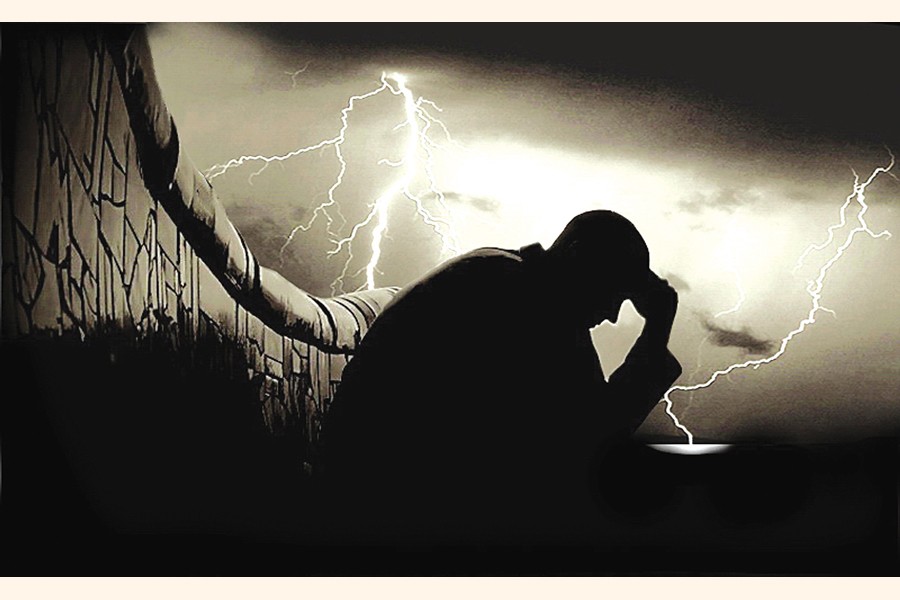
Amid the dozens of indexes and surveys conducted annually by globally known non-government organisations, news magazines etc the mundane issues are found to be dominant. These surveys prove helpful in determining the extent of help the badly performing nations need in both long and short-term stretches. Conventionally, these surveys remain focused on assorted issues belonging to areas like economy, social condition, air pollution and, lately, climate-hostile or environment-friendly activities. All of them are tangible areas. On occasions, unusual sectors related to modern lifestyle are also brought into focus.
Determining the scores in the Negative Experience Index is apparently one of the least known surveys. It tries to elicit the causes of the negative psychological conditions in 122 countries in the current year like in the past. These areas include physical pain, worry, sadness, stress, anger and panic. In short, the global survey has found the world is passing through a war, inflation and a protracted pandemic which visits mankind at long intervals. Wars and internal conflicts breed panic, feeling of insecurity, worries prompted by the threat of becoming refugees --- all this leading to a broad area of psychological trauma, finally ending in unhappiness. Under the Global Emotions Report, the state of unhappiness index with all its distressing aspects has placed Afghanistan at the top of the list --- giving it a score of 59. As the most uncertainty- and stress-filled country, Afghanistan has earned the negative index score of 32. It is the lowest score since the Gallup poll started in 2006.
Placed at seventh, Bangladesh has scored 45 among the present times' angriest, saddest, and the most stressed of the 122 countries under the survey. The poll surveyed 127,000 adults spanning the globe and found that 2021 was more stressful than 2020.
According to the report, the world is a slightly sadder, more worried and more stressed-out than it was the year before --- even if people are less angry. In its bid to get to the causes of unhappiness, the survey observes that five reasons stand out as contributors to the increase in the times' unhappiness. They are poverty, 'bad' communities, hunger, loneliness and the dearth of 'good work'. Under a broad overview, the Latin American countries in general, nestled amid sylvan environs with little political fracas have emerged relatively happy and content nations. With their average scores under the Positive Emotions Index in the domain of 80, four such countries stand out in the vast area. Panama tops the list with a score of 85. Besides the largely indigenous people-dominated continent of Latin America, the countries Iceland, the Philippines, Senegal, Denmark and South Africa have occupied their distinctive places in the positive index.
Readers seeking to remain updated about the ups and downs in human conditions will show keen interest in the nations' outward looks. All this normally points to the black-and-white realities they presently take pride in or which they try to avoid discussing. Ironically both the moods represent intransient realities. In accordance with a thematic similarity, the mood of sadness and its behavioural offshoots can claim to be in wide focus. The survey examined sadness in the context of the grim realities like wars, human displacement and various uncertainties that continue to beset man in the recent times. Above all these crises, there hovers the global pandemic of Covid-19. Yet many think, they are almost nothing compared to the insidious and deep-seated sadness which has been plaguing mankind since the early phases of civilisation.
Sadness in extreme forms saps out all vitalities and positive thoughts from a person who fall victim to this veritably incurable illness. Many call it genetic. Some inherit it as an atavistic feature. Some call it an aberration moulded by negative pressure of the happenings around a person. It has many forms with distinctive names. One common malady is depression. Although a section of people would like to bracket depression along with psychological disorders, many would not prefer to call it a depression at all. It's because unlike the cases of manic depression or bipolar disorder, a depressed person doesn't show features of loud eccentricities. In society, lots of depressed people continue to exist without being singled out. Outwardly, many lead their lives like the average people. Problems crop up with their occasional outbursts of anger or revolt. Many confuse this state with the now widely prevalent autism or the mentally challenged condition. Depression is a completely different psychological disorder. Most of the victims have their roots in social and community strains. Personal disorders remain mostly unnoticed and overlooked. Patients of depression cut across national borders leading to a firm belief that it is the developed West which has the greater number depressed people compared to the poorer countries. It may be an overstatement. But it's true that highly developed and ultramodern lifestyle robs humans of many of their natural attributes. The poorer countries are also not spared this malady.
In line with the above surveys, sadness in the literal sense is one of the negative aspects that determine a nation's place in the list of the countries covered by the survey. There is a school of philosophy which extols sadness. Dozens of thinkers have emerged from their coexistence and assimilation with sadness. According to the said school, there are some forms of sadness, the seizures of which remain lurked in mysterious roots. The affected persons do not know why they are sad. Many, however, have hints at the possible root causes. But they themselves realise that those causes alone are not responsible for their lack of ability to lead normal lives. Hamlet knew that his pervasive melancholy hadn't stemmed from his mother's infidelity only. In course of time, the Shakespearean hero found himself in the midst of a maze of political and familial hostilities. He discovered hostile situations had begun surrounding him.
In such a desperate situation, it's only a person like Hamlet, the prince of Denmark, who can confess that he doesn't know why he is so sad. Hamlet is the most luckless yet reflective hero in the British Elizabethan literature. However, there are a few older protagonists confined to different circumstances altogether. They are not only sad. They continue to be harried by hostilities inflicted on them. It's their offspring who bruise them emotionally, insult them and leave them alone in raging storms, shoving them onto the verge of lunacy. King Lear represents them.
Being one of the greatest playwrights of his era, and also the later times, Shakespeare was able to touch upon all the natural traits of man, sadness being one of them. In the latter ages, especially in the European pre-modernist and modernist eras the characters nurturing sadness are found in poems, paintings, novels, stories --- and, of course, plays. Lord Byron celebrated it in his poetry. The painters ranging from Van Gogh, Guglielmi to Picasso, novelist Thomas Mann and Joseph Conrad, Herman Hesse --- all have extolled the virtues of loneliness --- and thus sadness. This gloom belongs to a group of moods known in general as subjective. By its very nature, it stands apart from the feelings of loneliness, panic and worries. Sadness in the conventional sense along with its different forms of fallout is being increasingly encountered during the war-time savageries, the pandemic horrors or the consequent economic crises. The subjective or, to speak sarcastically, romantic sadness, apart from being different in nature, is rarely understood by society. Yet the war-displaced refugees' experience of sadness itself and the sufferings it inflicts on their minds have continued to pervade nations and communities since the First World War and the scores of regional conflicts and civil wars. A school of Oriental philosophy believes that man is destined to be sad. It's also true Eastern sadness abhors barbarity and cruelty considered offshoots of deep-seated 'modern' sadness. Sadness at times coalesces into spiritual quests.
shihabskr@ymail.com
© 2026 - All Rights with The Financial Express

