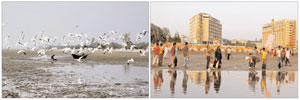
 (Left) The idyllic setting of Kuakata; (Right) The flurry of constructing multi-storey hotels, motels, etc. have completely changed the landscape and skyline of the earlier quiet beach-town of Cox\'s Bazar.
 Lands suitable for hotels and guesthouses are on sale in Kuakata at attractive prices. Contact immediately -- that's what an advertisement on the backside of a number of Dhaka auto-rickshaws says. The publicity notice may have drawn the attention of a lot of residents in the metropolis. Those interested have perhaps already communicated with the plot sellers. After all, Kuakata is now a fast-growing beach resort in the country's southernmost periphery along the shore of the Bay of Bengal.
URBANISATION FEVER: This brings to mind the present state of Cox's Bazar. The flurry of constructing multi-storey hotels, motels, etc. have completely changed the landscape and skyline of the earlier quiet beach-town in the country's south-eastern part.
Thanks to the hyperactive real estate entrepreneurs, the areas near the beach have been witnessing a construction boom over the last 15-20 years. Of late, a number of high-rise hotels came up right on the beach. Intervention by the authorities concerned, however, stood in the way, with many such projects later put on hold.
The town has witnessed an abrupt increase in the onrush of domestic tourists. They have apparently been lured to the beach by both the luxury and budget accommodations. Meanwhile, the district-town and the very beach have had to bear the brunt of an urbanisation fever. On vast swathes of the beach area, it will now be quite difficult to even visualise the small-town idyllic charm of Cox's Bazar.
The lush green hills and hillocks have been levelled by the developers to construct glitzy hotels and apartment buildings, roads are choke-a-block with motorised vehicles, and shopping outlets have replaced the small arrays of cosy boutiques.
Cox's Bazar is virtually a bustling city now, with a number of polluting agents spoiling its natural ambience. Nowadays, many find the Cox's Bazar town and the beach itself not worth re-visiting. In spite of the visible presence of law enforcers, security of tourists on the beach often sees lapses.
CRASS BUSINESS INTERESTS: Given the Cox's Bazar scenario, there are reasons to feel wary of the open-arm invitations to developers to join the construction spree in Kuakata in the southern Patuakhali district. As a nation we love to imitate things, be it lifestyle or social practices. We have a pathological anathema for innovation. Bringing developers from Dhaka and other places with a view to strengthening infrastructure around the Kuakata beach is not unusual.
The problem lies with jumping on the bandwagon of giving a facelift to a new-found tourist site. We remain oblivious to the reality that over-zeal in the facelift job robs a place of its innate beauty.
To speak bluntly, like the unpleasant result of excessive facial make-up of a woman, an otherwise wonderful site too loses its beauty after being burdened with mindless beautification projects.
Moreover, everything gets an ugly turn when crass business interests make inroads here.
It will not surprise us if we find Kuakata in the future metamorphosed into another Cox's Bazar, as we see it today --- filled with crowds of tourists, jostling with one another on the beach to have Chatpoti and other snacks, rushing from one shopping outlet to another to buy souvenirs or clothes.
KUAKATA'S ATTRACTIONS: Serendipitously discovered by the print media in the eighties, Kuakata has yet to make any remarkable progress in its infrastructure. A large portion of its natural beauty remains untapped.
But it holds enormous tourism prospects. Taking cue from it, intrepid domestic tourists have started visiting the place braving the ordeals of a tiring journey.
The present attractions at Kuakata include, among others, enjoying both sunrise and sunset on the beach, the indigenous Rakhine villages, the century-old Buddhist temple, and the massive ancient boat dug out recently. That the Kuakata neighbourhood in the near future will turn into a beach-town is no fantasy.
Given the country's steady infrastructural progress along with its economy, the sea-laced tourist site is in for a radical transformation. Keeping this potential in mind, local land owners and brokers are busy hooking entrepreneurs in tourism and hotel sectors. It could not be otherwise.
LAND GRABBING: In the setting up of new urban pockets in the country's outlying areas, the unlettered rural people are generally shortchanged. Many of them fall victim to land-related rackets of cheats. Some have to undergo the ordeal of repeated coercions, and even threats, before they sell out their plots, including farmland.
Upon failing to purchase lands at throw-away prices, local influential quarters resort to their most potent tool -- land grabbing. However, the small and large syndicates generally target the government or abandoned landed properties.
They act in cahoots with a section of people working at the relevant government offices. Although the government does not drag its foot in paying the prices of lands acquired for large installations, the process eventually gets convoluted.
The middlemen are often seen chipping in unwarrantedly, blocking quick payment to poor land-owners - only to make a quick buck. The forceful occupation of lands has long been a common practice in the country's rural areas, especially in the suburbs. It goes on simultaneously with the formal buy-and-sale activities centring on lands.
When it comes to infrastructural constructions, a plethora of malpractices begin dogging the projects concerned. The decades-old Cox's Bazar tourist heartland is now free of disputes and legal battles over landed plots, barring the main beach area.
Yet, as large portions of the sea-shore have allegedly been encroached upon or grabbed through dubious means, the largest tourist site in the country is still vulnerable to skullduggeries.
URBANISATION DEVOID OF PROPER PLANNING: Kuakata's attractions comprise a lot of natural features not found in Cox's Bazar. In the context of mundane gains, the hidden opportunities for windfall money-making and other material gains remain dormant in the area. As the present picture shows, untapped commercial and residential plots in Kuakata now hold a bonanza of sorts for both the honest investors and swindlers.
Pragmatically speaking, things as they stand now in Kuakata are not unique to the place. The early days of any large venture in this country are traditionally fraught with acute teething problems.
The stakeholders include those shouldering the responsibility to set up costly and imposing infrastructural units on time. On many occasions they fail. Then there are the authorities directly involved with the ventures.
They have to assess the realities that prevail at a given time in order to stave off any adverse developments in and around the site in the future. Kuakata is passing through that critical phase.
The distressing aspect of the Kuakata episode is the orgy of an urbanisation devoid of proper planning. To give the beach-town a smart look, it's most likely that a lot of centuries-old coconut groves and Jhau gardens will be cleared.
Besides, many Rakhine and other communities in the area may not be able to resist the temptation of selling residential plots to developers at 'unexpected' prices.
With the journey to and from the capital and other cities becoming comfortable, and roads being made suitable for high-speed long-haul coaches, tourists will rush in droves to Kuakata.
With a messy launch in place there, we may have to brace for the fate that has befallen Cox's Bazar lately. Developing a tourist spot without taking into consideration the basic prerequisites eventually spells doom for it.
The world's longest unbroken (120 kilometres, 75 miles) beach at Cox's Bazar has scopes to open tourist facilities at some other points nearby. To avert the urban din and chaos, it may extend further its present area of focus on the beach. The 30-mile Kuakata beach does not have this blessing of nature. Planned development is thus critical to its existence and growth.
shihabskr@ymail.com
© 2026 - All Rights with The Financial Express

