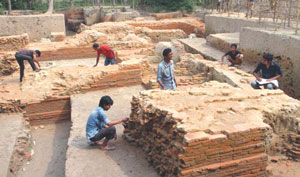
 Excavation at Wari-Bateshwar in Narsingdi
 Contrary to the long-held notion, Bangladesh is emerging as a land filled with amazing archaeological sites. Over the last 10-15 years, archaeologists ran into a number of hitherto unknown ruins.
Thanks to the increasing interest in antiquity, youthful students in droves are coming out of universities completing higher studies in the subject of archaeology. The scene was completely different in the past. Whatever handful discoveries had been made in the bygone days, those were carried out by professional archaeologists. Young archaeology graduates and teachers play the most dominant role in the country's excavation scene these days. Ranging from the excavation of the Wari-Bateshwar ruins to the discoveries of Dinajpur and Chapainawabganj spots in recent times, all these missions have been accomplished by undaunted youths.
Many believe that it is these inquisitive youths who might radically change the archaeological map of Bangladesh. Rejecting the earlier notion that Bangladesh was essentially a rural society in the past the new-generation archaeologists throw focus on the land's urban heritage. Alongside the vast rural-life expanses, Bangladesh is now believed to be holding the vestiges of a rich urban culture. According to some, these city-centred communities date back to pre-Christ times. The 2,500-year-old Wari-Bateshwar in Narsingdi is one of them.
Bangladesh, in general, used to be dubbed by a section of archaeologists a land devoid of much ruins from the distant past. In geological context, the land is composed of a soil which is marshy in nature and sand-mixed. Yet strikingly, much of the country's land was formed 1 to 6.5 million years ago. Geologists have described the land as ancient. The region has been mentioned in Ptolemy's map. In contrast to myths, the history of human habitation in the area is quite old, with evidence of the Paleolithic civilisation dating back to 100,000 years. In terms of climate, the landmass has had to survive through a corrosive ambience since its formation. It has continued even in the later years. Unlike in many other parts of the Indian sub-continent, it was quite difficult for monumental concrete structures to remain erect for long due to the corrosions caused by the elements. But, surprisingly, this phenomenon has not stood in the way of the isolated urban or semi-urban pockets sending out roots.
However, through the passage of time, innumerable historical relics have been wiped out from Bangladesh. Ranging from religious installations, palaces to educational institutions, the ruins excavated so far date back as early as the 4th century BC. The oldest archaeological site of Bangladesh, Mahasthangarh, has been calculated to be over two thousand years old. Identified by experts as Pundravardhana, it was an ancient city and the capital of Pundra dynasty during the Gupta era. Spread on a vast tract of land, the site is situated in Bogra district. Another site of historical significance is Somapura Vihara (monastery) in Paharpur in the greater Rajshahi region. The installation is actually a Buddhist monastery, constructed in 770-810 AD. At its peak of glory, the monastery once ranked among the most widely known Buddhist viharas in South Asia.
Barring a handful of great archaeological sites, such as Mahasthan and Paharpur, scores of ruins in Bangladesh are believed to have completely disappeared into the abyss of time. In the process, these sites have taken with them many eventful chapters of history that unfolded in this land ruled by local and foreign kings, emperors and conquerors.
Yet, many ruins are still being dug out in the land, reminding us of the fact that Bangladesh is, in fact, not that poor in terms of archaeological sites. Thanks to the youthful vigour and enthusiasm of young archaeologists, nearly a dozen stunning discoveries were made in the country in the early part of the 21st century. Although previously limited to the northern and northwestern parts of the country, the recent archaeological finds surfaced in unlikely places such as Narsingdi, greater Sonargaon, Munshiganj and Bikrampur, Savar, and greater Faridpur.
The discovery of Wari-Bateshwar ruins, however, was initially made in 1933 by local school teacher Hanif Pathan. He had sought logistic and financial support from the authorities concerned. But his appeal remained unheeded until a young university teacher, Sufi Mostafizur Rahman, embarked on re-excavation of the site in 2,000. After launching the project, the teacher at Jahangirnagar University in Savar teamed up with a number of his enthusiastic students. They belonged to the university's Archaeology Department where the professor taught.
After the start of excavation in Mahasthan in 1928-29 under the guidance of KN Dikshit of the then Archaeological Survey of India, the work continued until the 1990s. The large site is now maintained by the Department of Archaeology. The full-length excavation of Wari-Bateshwar began 70 years after Mahasthangarh. In no time Wari-Bateshwar started to be considered as the most significant find in the country's archaeological history. Apart from its 2,500-year-old history, it is rich in some unique features. Although the sprawling ancient settlement flourished on the bank of the Karatoa, Mahasthangarh was not fully dependent on the river. But Wari-Bateshwar in its days of glory literally survived on a mighty river, the Old Brahmaputra, that flowed by it. As further excavations have revealed, the site and its vast neighbourhood was part of a kingdom. International trade was the chief means of its impressive survival. Besides, the excavated roads, alleyways, esplanades, building plinths and scores of artefacts point to the site's urban past. Highly optimistic experts even look to the days when Wari-Bateswar will be placed alongside Mohenjodaro and Harappa. The two sites in today's Pakistan were built in the period between 2600 BC and 2600-1900 BC. Both were once vibrant city-centres. The scientific and urban planning of the two cities' civic facilities has been widely viewed as being quite developed by even modern standards.
Although in its sixteenth year, a full-scale excavation of Wari-Bateshwar has yet to begin. Owing to financial constraints, the work of the excavation project remains suspended periodically. Being a nation busy coping with pressing socio-economic and political problems, archaeological discoveries take a backseat to more urgent issues. But in view of the premier national goal of all-out development, bringing the nation's past under spotlight is equally important. It is also because our archaeological history is replete with the signs of magnificent cultural yields. In many areas of the world, ambitious excavations end up in heartbreaks. We are fortunate in this respect, as whenever we have gleaned even the faint signs of archaeological resources, we were not disheartened. Good news is that despite intermittent suspensions, the excavation of Wari-Bateshwar has been set to go ahead until it comes up with a full view of the long-lost settlement.
In the context of locations of the ruins from the past, the newly discovered sites point to the fact that Bangladesh is yet to be fully exposed, archaeologically. Field-level experts and academics these days do not hesitate to call the country one of the richest sites in the South Asian region that preserves precious records of the past. Archaeologists recently came across an early settlement in greater Dinajpur. The partly excavated site is believed to be holding the relics of an old settlement. Some time ago, a few archaeological sites were dug out in the Chapai Nawabganj area in greater Rajshahi. The zone belongs to the Varind region, which geologically extends up to Bihar in India. The region is part of one of the most archaeologically blessed areas in the sub-continent. In the Indian part, among other sites, the area has witnessed the emergence of Bodhgaya, Patuliputra and Nalanda, some of the present world's most famous archaeological spots. In Bangladesh part, the majority of the collections at Varendra Museum in Rajshahi speak of the rich past of the area.
Keeping the country's salinity-prone southern region aside, its whole northern and north-western regions hold a number of archaeological treasures. The south-eastern Chittagong region has also occasionally shown potent signs of antiquity. In between, the Comilla tract has emerged as an ancient centre of Buddhist scholarship.
Given the continued discovery and exploration of timeworn installations and sites, the younger archaeologists find it unwise to sit idle. True, they have financial drawbacks. Many look to foreign funding. But, finally, the youths get down to brass tacks. Archaeological pursuits are not rewarding financially. But they, undeniably, speak of a distinctive passion.
shihabskr@ymail.com
© 2026 - All Rights with The Financial Express

