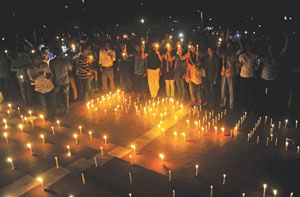
 A multi-ethnic crowd of Bangladeshis hold a vigil of thousand candles at Central Shaheed Minar in the capital on the occasion of the International Day of the World\'s Indigenous Peoples on February 11, 2015, demanding that the indigenous communities of th
 The nation is being torn by one of the intractable crises it has ever seen since its independence in 1971. With the people's main focus riveted on the grim developments in the politico-economic arena, disasters in the other sectors keep going unnoticed. Had those occurred in normal times, many in the country would have found themselves in the midst of those otherwise upsetting happenings.
As part of its duty, the media has picked the events. As is natural, the civil society and human rights organisations came up with protests. But, unfortunately, those were buried by the more urgent and significant issues relating to the current political deadlock.
The savagery let loose on the Khasis, Monipuris and Garos in the greater Sylhet region has once again brought to the fore the plight of the indigenous communities in the country. According to media reports, a Garo young woman was found dead in Maulvibazar on January 31. Her throat was slit. Besides, 72 Khasi families have been passing their days in panic as a tea estate owner decided to fell 2,000 trees which the indigenous community had been using to grow betel leaf. The reports added a Monipuri village in Sylhet inhabited by 90 families was attacked on December 29. Not long ago, villages inhabited by Oraon people in greater Dinajpur for ages were attacked by local influential quarters.
Although some over-enthusiastic circles would like to blame Bengalee ethno-centrism for the trouble, the reality speaks otherwise. According to experts working on the indigenous people in the country, it is mainly land grabbing which leads to the anti-Adivasi brutalities. Those include murder, rape, ostracising and other forms of oppression. The tribal peoples, the term now regarded as offensive --- and replaced by the politically correct definition 'indigenous', have been living in this land for over thousand years. Many smaller ethnic groups have disappeared, or are on the verge of being wiped out. At present broadly two types of indigenous peoples live in Bangladesh. Numbering around two million, they include the Mongoloid (Tibetan-Burman and Sino-Tibetan) stocks and those of Austroloid lineage --- viewed by anthropologists as the ancient settlers in the country. The Mongoloid ethnic groups populate the Chittagong Hill Tracts (CHT) in the country's south-eastern region, the eastern part of the greater Sylhet region and a few pockets in the greater Barisal zone. The so-called ancient settlers such as the Santals, Oraons, Mundas, Mahalis, etc. are concentrated in the country's western and northern regions. A few of those under the Mongoloid category also live in the northern greater Mymensingh and Tangail, and Patuakhali in Barisal. The prominent communities in the CHT include the Chakmas, Marmas, Tripuras, Tanchaingyas, and Rakhines, the later having a concentration in Patuakhali in Barisal. The Garos and Hajongs mainly live in the grater Mymensingh. Many indigenous people belonging to the relatively advanced communities these days have converted to Christianity and serve for local and city-based NGOs. A few in the Chakma and other communities hold responsible positions in the government administration. To the dismay of many, it is but one side of the coin. The other side offers a gloomy picture of oppression on the smaller indigenous communities living in the country.
Around the globe, irrespective of societies and countries, the indigenous ethnic communities have been subject to various forms of oppression by the 'civilised' mainlanders since the 15th century. The European settlers in the Americas mercilessly exterminated the native Indians that continued up to the 17th century. A similar 'ethnic cleansing' was re-enacted in Australia. Veiled persecutions of the Australian aboriginals still make news in the world media.
Against this distressing backdrop, many countries, as part of some kind of atonement, have long been trying to assimilate their indigenous communities with the mainstream society. Irrespective of economic strength, these nations have created special government funds for the indigenous peoples. A few have separate ministries and divisions dedicated to the welfare of these mostly backward ethnic groups. Criminal acts like land grabbing, sexual harassment of indigenous women and psychological pressure have become rare incidents in some of these countries. Many other countries including the USA, Canada, Brazil, Australia, New Zealand et al have set up special enclaves for showcasing the history and culture of their indigenous communities. The reserved native Indian zones in the USA are administratively autonomous. They follow the traditional native Indian justice system and the governance customs. This scribe had the opportunity to visit such a native Indian enclave in New Mexico in the early nineties. Brazil has let its indigenous peoples live on their own in the deep forests of the Amazon. The ancient and indigenous Japanese peoples live on some islands far from the mainland coast. The Hmong community in Laos, the Maories in New Zealand and the natives in Taiwan have been living for over hundred years in the areas suitable for them. Of these groups, the Hmongs have long been subject to persecution. Coming to the others, land-related clashes and various forms of feud are not uncommon. But these sporadic eruptions leave little repercussions, and, mostly, the rows do not linger.
Unlike the special privileges and benefits offered to the indigenous communities in a lot of countries, South Asia is fast emerging as a region pathologically hostile to its native communities. With its hundreds of ethnic communities, officially called 'Jonojatis', the vast India has yet to prove itself a place conducive to the life and living of the indigenous peoples. Fierce clashes over land ownership and over other interests between ethnic peoples and mainlanders are commonplace there. In most cases, the tribal communities come out losers. People from the nearby areas swoop on the indigenous communities' villages, engage in plundering, violate their women and create scores of social barriers for the hapless peoples. These injustices keep taking place in many states. On many occasions, the government agencies concerned, including the law enforcers, intervene; and they reportedly find themselves overwhelmed by the intensity and enormity of the problems besetting the indigenous communities. However, the Indian civil society and human rights groups have always been vocal in favour of the indigenous communities.
The gap between the mainstream society and those ethnic groups on the social margins keeps yawning. Taking this opportunity of disillusionment on the part of the deprived communities, the homegrown left extremists have made inroads into the indigenous communities in India. As has been seen over the decades, almost all the ultra-left strongholds in the Indian states of Paschimbanga, Jharkhand, Assam and Tripura are peopled by tribal youths.
Compared to this, Bangladesh faces a two-pronged problem. One has its roots in the five-decade-old demand for special status coming from the indigenous communities in the Chittagong Hill Tracts (CHT). Its demand unmet, some tribal communities, dominated by the Chakmas, formed a clandestine hit-and-run force and remained engaged in a four-decade-long guerrilla war with government forces. The confrontation had witnessed its ugly fallout for a long period of time. Dozens of splinter armed groups had emerged, the focus of the fight became diluted, resulting in extortions and unnecessary killings targeting both the Bengalee settlers and innocent indigenous communities. A peace treaty came into force in the mid-nineties, with the armed clashes declared over and arms surrendered.
Unrest, however, keeps flaring in the area as land grabbing and various types of encroachment continue unabated. Sharing administrative powers between the government and the locals still remains a bone of contention. With the CHT problem teetering on to get stuck in an abyss, the government at one time created a separate ministry on the Chittagong Hill Tracts Affairs.
The CHT issue is a complex one with many politico-regional undercurrents. But those facing the Santals and Oraons in the north-western areas of the country and the Khasis and Monipuris in the north-east are related to the primordial instincts of naked greed and lust. Since the number of the plain land indigenous people is quite small, the need for a ministry or a government division has never been felt. The incidents involving oppression of these indigenous peoples have traditionally been under the supervision of local administrations. Unfortunately, incapability and inaction on their part helped those irregularities snowball into greater local crises. In fact, the assaults on the poverty-stricken indigenous peoples in areas outside CHT show little signs of abating. A section of the civil society activists indulges in superfluity. Its tendency to overreact sometimes drives a permanent wedge between the communities stuck in a face-off. At the centre of all these feuds is domination of the weak by the powerful. They hardly have any ethnic insinuation. If the local administrations fail to perform their duties, and the people's representatives in the area do not act, it's only then the civil society should step in. The foremost task incumbent on them is creating awareness among the ordinary people and launch advocacy campaigns spreading the message of peaceful co-existence, and tolerance.
shihabskr@ymail.com
© 2026 - All Rights with The Financial Express

