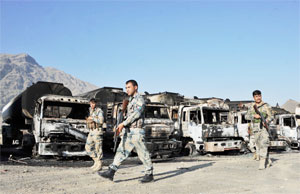
 AFGHANISTAN : Afghan security personnel patrol near burned NATO supply oil tankers following an overnight attack by Taliban militants in the Torkham area, near the Pakistan and Afghan border. — AFP
 KABUL, Sept 22 (agencies): Secret election results and an uneasy power-sharing deal have raised fears that the legacy of the US-led intervention in Afghanistan will be a government that lacks the legitimacy or strength to avert the risk of a return to civil war.
A vast array of foreign armies, diplomats, development experts and aid groups converged on Afghanistan after 2001 in a multi-billion-dollar effort to foster peace and progress after the harsh years of Taliban rule.
A credible, democratic government in Kabul was central to the mission's aims, which stretched from defeating the Taliban insurgency to building power stations, improving women's rights and boosting literacy rates.
Afghanistan's Taliban militants Monday decried a pact by rival election candidates to form a government of national unity as a "sham" orchestrated by the United States and unacceptable to the Afghan people.
Former finance minister Ashraf Ghani was named president-elect on Sunday after he signed a deal to share power with his opponent, former foreign minister Abdullah Abdullah, ending months of turmoil that has destabilized the country as most foreign troops prepare to leave.
Ghani's administration must now not only forge an effective government after so much acrimony, but also deal with an emboldened Taliban insurgency, with little, if any, help from foreign forces.
Election officials Sunday did not reveal the final vote count, simply declaring Ashraf Ghani as the president-elect and Abdullah Abdullah as "CEO", after weeks of negotiations between the two campaign teams.
Officials said figures would be released at an unspecified future date.
"We do not know if a government of national unity was merited by what happened at the polls," analyst Kate Clark said in a briefing paper on Monday for the Afghan Analysts Network.
"This political transition... cannot be called democratic, as it actually avoided democratic means to determine who won the election.
"Despite the huge numbers of voters turning out, in the end, the deal to form a successor administration to Karzai's was done behind closed doors and with huge amounts of foreign help."
Ghani and Abdullah-and their teams-clashed regularly during the standoff over allegations of massive fraud in the June 14 election, and the two camps face a tricky test in now working together in government.
"Afghanistan is in a very sensitive phase as widespread fraud was committed, and it would have been better if we had a transparent election.
© 2026 - All Rights with The Financial Express

