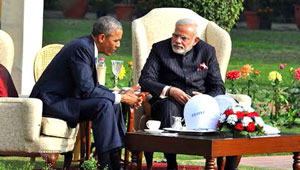
 Prime Minister Narendra Modi and US President Barack Obama during \'Walk and Talk\' at Hyderabad House in New Delhi.
NEW DELHI, Jan 25 (agencies): Indian Prime Minister Narendra and US President Barack Obama announced they had reached an agreement Sunday to break the deadlock that has been stalling a civilian nuclear power agreement.
"I am pleased that six years after we signed our bilateral agreement, we are moving towards commercial cooperation, consistent with our laws (and) international legal obligations," Modi said at a joint press conference with Obama in the Indian capital New Delhi.
Prime Minister Narendra Modi said India was moving towards commercial cooperation on civil nuclear trade with the United States, six years after the two sides signed the deal.
"I am pleased that six years after we signed our bilateral agreement, we are moving towards commercial cooperation, consistent with our laws (and) international legal obligations," Modi said at a joint news conference on the first day of a visit by US President Barack Obama to India to establish an enduring strategic partnerhsip.
India and the United States signed the civilian nuclear deal in 2008, but differences remained over an Indian nuclear liability law that makes equipment suppliers ultimately responsible for an accident. Countries like France and the US have asked India to follow global norms under which the primary liability lies with the operator.
"Today we achieved a breakthrough understanding on two issues that were holding up our ability to advance our civil nuclear cooperation and we are committed to moving towards full implementation," said Obama at the news conference.
"This is an important step that shows how we can work together to elevate our relationship."
Since all the nuclear power plants in the country are run by the government-owned Nuclear Power Corporation of India Ltd (NPCIL), following international norms will mean the government would have to pay heavy damages in case of an accident.
New Delhi had ruled out changes in its 2010 liability legislation that has choked off American investment, but offered to set up an insurance pool to indemnify companies that build reactors in the country against liability in case of a nuclear accident, as a way around the law.
Under the plan readied by state-run reinsurer GIC Re, insurance would be bought by the companies contracted to build the nuclear reactors who would then recoup the cost by charging more for their services. Alternatively, the NPCIL would take out insurance on behalf of these companies.
It is understood that the deadlock over the nuclear deal was done away with after one-on-one talks between the Modi and Obama over tea.
Both leaders held extensive discussions on enhancing cooperation in crucial areas of defence, trade and commerce and climate change after lunch and Hyderabad House.
After the official discussions followed by lunch, Modi and Obama went for a short stroll in the manicured gardens of there.
Meanwhile: On Sunday, on his second visit to India after 2010, President Barack Obama kept date with his "real hero" - Father of the Nation Mahatma Gandhi.
Soon after landing in India and after being accorded a ceremonial welcome at Rashtrapati Bhawan, Obama headed straight to Rajghat to pay tribute at Gandhi's memorial. The American President accompanied by coal minister Piyush Goyal, who has been designated as the minister in waiting for Obama's visit, placed a wreath and paid floral tribute at Gandhi's samadhi. He later planted a sapling at the premises to mark the occasion.
Also accompanying Obama were US ambassadorto India Richard Verma and assistant secretary of state for South and central Asia, Nisha Desai Biswal.
Gandhi has been a source of inspiration for Obama and on Sunday the US President once again reiterated his feelings about the Father of the Nation in the visitor's book at Rajghat. "What Dr Martin Luther King Jr said then remains true today - "the spirit of Gandhi is very much alive in India today. And it remains a great gift to the world. May we always live in this spirit - of love and peace - among all people and nations," Obama wrote in the log book.
In 2009, Obama during a visit to a US high school in Arlingtom Virginia had said that given a chance he would have liked to have dinner with Mahatma Gandhi, whom he considered a real hero.
The American President planted a sapling of Peepal tree, more popularly known as the wisdom tree. Legend has it that Gautam Buddha attained enlightenment while meditating under a Peepal tree.
Obama became the fourth US President to plant a sapling at Rajghat. Prior to him former US President Dwight G Eishenhower had planted a sapling when he visited India in 1959. The tree, however, was washed away in flood, Rajghat Samadhi Committee officials said.
In 1984, George W Bush senior planted a mango tree while former President Bill Clinton planted a Champa sapling during his visit in 2000.
Before leaving Rajghat, Obama was gifted a memento of Gandhi's bust, a replica of charkha (spinning wheel), a khadi shawl and three books on Mahatma Gandhi. "He told us that it is always a pleasure to visit Rajghat," said TRajnish Kumar, secretary, Rajghat Samadhi Committee.
© 2026 - All Rights with The Financial Express

