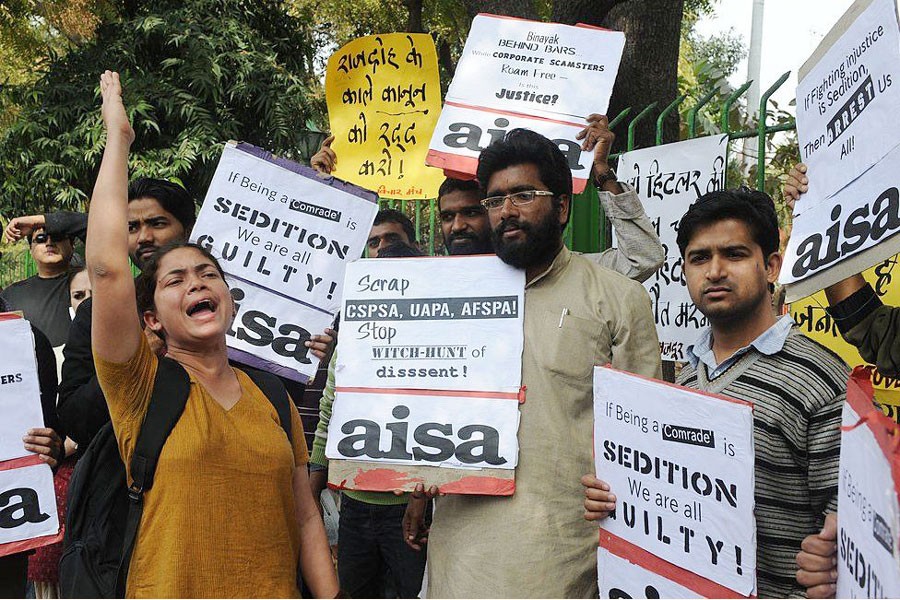
 Indian college lecturers, teachers and political activists hold placards as they protest against the sedition law in New Delhi on February 12, 2011 — AFP file photo
 NEW DELHI, May 11 (BBC): India's Supreme Court has put a controversial colonial-era sedition law on hold that critics say is used to stifle dissent.
The judges asked the government to refrain from registering any new cases which invoke sedition until it finishes hearing petitions challenging it.
The court also asked the authorities to pause all existing sedition trials.
The government has been accused of using the law against critics, such as politicians, journalists and activists.
On Tuesday, the government said that they would review the law after earlier defending it.
While pausing the court hearing on Wednesday, the judges said that those already charged under the law, and in jail, could seek bail from trial courts.
Kapil Sibal, senior leader of India's opposition Congress party and lawyer for the petitioners, told the Supreme Court that there were over 800 cases of sedition pending across India and as many as 13,000 people were in jail.
A majority of sedition cases filed against 405 Indians for criticising politicians and governments over the last decade were registered after 2014 when Prime Minister Narendra Modi took power, according to data compiled by the website Article14.
The Supreme Court's decision to pause the sedition law is a significant development.
For decades, successive governments have used the colonial-era law - the dreaded section 124a of the antiquated Indian Penal Code - against students, journalists, intellectuals, social activists, and those critical of the government to essentially suppress dissent and free speech.
A law which was mainly used against Indian political leaders seeking independence from British rule in the 19th and early 20th centuries has now been weaponised as a tool of suppression by successive democratically elected governments. That is, many say, is India's shame.
But it would be too early to celebrate.
It remains to be seen how Narendra Modi's government "re-examines and reconsiders" the draconian law. Will it be defanged and modified? Or will it be scrapped?
Most Indians will be happy to see the law, which they say has no place in a modern democracy, to be given a quick burial.
© 2026 - All Rights with The Financial Express

