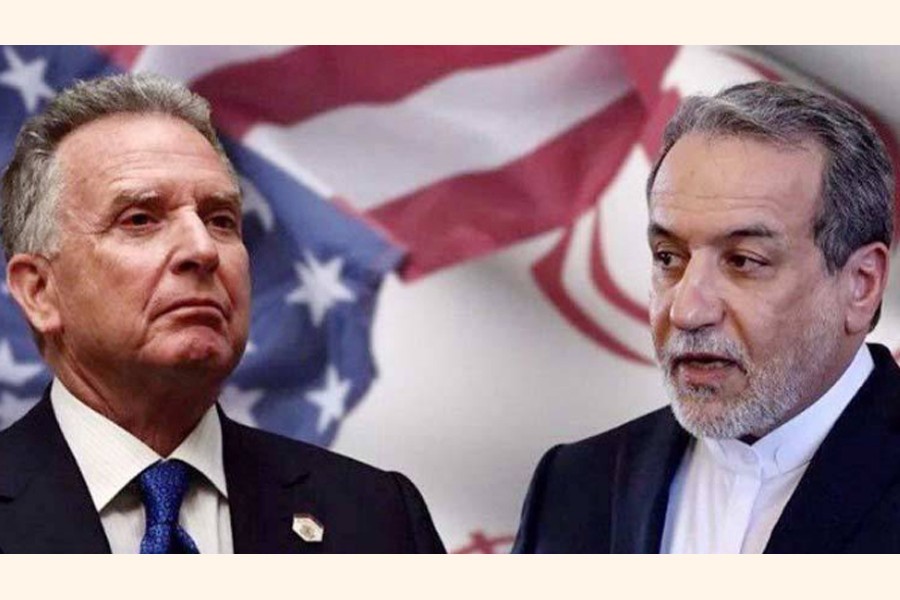
 Iran’s Foreign Minister Abbas Araghchi (right) and the US Special Envoy for the Middle East, Steve Witkoff, reached Muscat ahead of the talks on Friday.
  MUSCAT, Oman, Feb 06 (Agencies): Iran and the United States were holding talks in Oman on Friday that were seen as a critical chance to avert any new escalation between the foes, after President Donald Trump threatened military action.
With an American naval group led by an aircraft carrier in Middle Eastern waters, Iran has insisted the talks will be centred solely on its nuclear programme, although the US wants to discuss Tehran's backing for militant groups in the region and its ballistic missile programme.
The talks are the first between the two foes since the United States joined Israel's war with Iran in June with strikes on nuclear sites. They also come just under a month after Iranian authorities launched a crackdown on protests that left thousands dead according to rights groups.
US Middle East envoy Steve Witkoff, accompanied by Trump's influential son-in-law Jared Kushner, and Foreign Minister Abbas Araghchi on the Iranian side are leading their delegations at the talks.
Iranian state media described the talks as indirect and there was as yet no indication of the Iranian and American officials meeting directly.
Images published by the Oman foreign ministry showed both sides meeting separately with Oman's Foreign Minister Badr bin Hamad al-Busaidi.
"The deliberations centred upon establishing the requisite foundations for the resumption of both diplomatic and technical negotiations," said the Oman foreign ministry, describing the talks as "pivotal".
Araghchi said as the talks began that Tehran maintains "full readiness to defend the country's sovereignty and national security against any excessive demands or adventurism" by the United States.
"Iran enters diplomacy with open eyes and a steady memory of the past year. We engage in good faith and stand firm on our rights," he added on X.
According to Iran's state television, the Iranian delegation first handed over its message to Oman's foreign minister which was then passed on to the US.
A second such round of talks was now underway, it added.
The White House has made clear it wants the talks to rein in Tehran's ability to make a nuclear bomb, an ambition the Islamic republic has always denied.
The US delegation intends to explore "zero nuclear capacity" for Iran, White House Press Secretary Karoline Leavitt said, warning that Trump had "many options at his disposal aside from diplomacy".
"They're negotiating," Trump said of Iran on Thursday.
"They don't want us to hit them, we have a big fleet going there," he added, referring to the aircraft carrier group he has repeatedly called an "armada".
Meanwile, Iran's Foreign Minister Abbas Araghchi on Friday described the atmosphere of talks with the United States as positive, with the two sides agreeing to proceed with negotiations.
The talks took place following threats from Washington and after it recently deployed an aircraft carrier group to the Middle East following Iran's deadly response to anti-government protests.
"In a very positive atmosphere, our arguments were exchanged and the views of the other side were shared with us," Araghchi told Iranian state TV, adding that "it was a good start."
He noted the two sides had "agreed to proceed with the negotiations" and that the "way forward" would be decided after negotiators held consultations within their respective capitals.
The timing and the format of the next round will be decided "at a later date", Araghchi said, expressing hope that Washington would refrain from "threats and pressure" so that "the talks can continue".
Earlier, the Kremlin on Friday said Russia welcomed indirect talks that began between US and Iranian delegations in Oman.
“We welcome the negotiations that have just begun in Oman,” Kremlin spokesman Dmitry Peskov told reporters during a press briefing, expressing that Russia hopes these negotiations will be “productive” and lead to a de-escalation of regional tensions.
Moscow, until tensions de-escalate, would “like to see restraint on the part of all interested states,” Peskov added.
© 2026 - All Rights with The Financial Express

