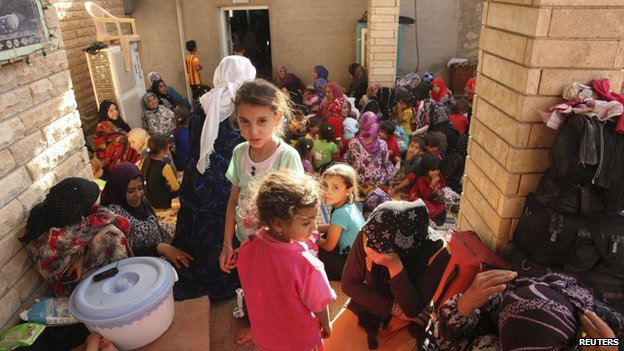
 The UN Children\'s Fund said the situation facing the 400,000 displaced people in the north was \'dire\'. — BBC Photo
 BAGHDAD, June 19 (AFP): Iraqi forces regained full control Thursday of the country's biggest oil refinery after heavy fighting with Sunni militants attempting to seize it, officials said.
"The security forces are in full control of the Baiji refinery," Lieutenant General Qassem Atta, Prime Minister Nuri al-Maliki's security spokesman, said in televised remarks.
Reuters report adds: Iraqi government forces battled Sunni militants for control of the country's biggest refinery on Thursday as Prime Minister Nuri al-Maliki waited for a US response to an appeal for air strikes to beat back the threat to Baghdad.
The sprawling Baiji refinery, 200 km (130 miles) north of the capital near Tikrit, was a battlefield as troops loyal to the Shia-led government held off insurgents from the Islamic State of Iraq and the Levant and its allies who had stormed the perimeter a day earlier, threatening national energy supplies.
Video aired by Al-Arabiya television showed smoke billowing from the plant and a black flag used by ISIL flying from a building. Workers trapped inside the complex, which spreads for miles close to the Tigris river, said Sunni militants seemed to hold most of the compound and that the security forces were concentrated around the refinery's control room. Iraqi security officials have denied that the plant was close to falling.
The 250-300 remaining staff were evacuated early on Thursday, one of those workers said by telephone. Military helicopters had attacked militant positions overnight, he added.
Baiji, 40 km (25 miles) north of Saddam Hussein's home city of Tikrit, lies squarely in territory captured in the past week by an array of armed Sunni groups, spearheaded by ISIL, which is seeking a new Islamic caliphate in Iraq and Syria. On Tuesday, staff shut down the plant, which makes much of the fuel Iraqis in the north need for both transport and generating electricity.
ISIL, which considers Iraq's Shi'ite Muslim majority as heretics in league with neighbouring, Shi'ite Iran, has led a Sunni charge across northern Iraq after capturing the major city of Mosul last week as Maliki's US-armed forces collapsed.
The group's advance has only been slowed by a regrouped military, Shi'ite militias and other volunteers. But on Tuesday, Sunni fighters took the small town of Mutasim, south of Samarra, giving them the prospect of encircling the city which houses a major Shi'ite shrine. A local police source said security forces withdrew without a fight when dozens of vehicles carrying insurgents converged on Mutasim from three directions.
ISIL, whose leader broke with al Qaeda after accusing the global jihadist movement of being too cautious, has now secured cities and territory in Iraq and Syria, in effect putting it well on the path to establishing its own well-armed enclave that Western countries fear could become a centre for terrorism.
The Iraqi government made public on Wednesday its request for US air strikes, two and half years after US forces ended the nine-year occupation that began by toppling Saddam in 2003.
Washington has given no indication it will agree to attack and some politicians have urged President Barack Obama to insist that Maliki goes as a condition for further US help.
Within hours of Iraqi Foreign Minister Hoshyar Zebari making the request public, General Martin Dempsey, the chairman of the Joint Chiefs of Staff, avoided a direct answer when asked by senators whether Washington would accede to the Iraq request.
"We have a request from the Iraqi government for air power," Dempsey said. Asked whether the United States should honour that request, he answered indirectly, saying: "It is in our national security interest to counter ISIL wherever we find them."
Meanwhile, President Barack Obama came under pressure from US lawmakers on Wednesday to persuade Iraqi Prime Minister Nuri al-Maliki to step down over what they see as failed leadership in the face of an insurgency threatening his country.
As Obama held an hour-long meeting with congressional leaders on US options in Iraq, administration officials joined a chorus of criticism of Maliki, faulting him for failing to heal sectarian rifts that militants have exploited.
Army General Martin Dempsey, chairman of the US military's Joint Chiefs of Staff, told a congressional hearing that Maliki's Shi'ite-led government had asked for US air power to help counter Sunni militants who have overrun northern Iraq.
The general did not say whether Washington would meet the request. But Dempsey signaled that the US military - apparently much like Obama - was in no rush to launch airstrikes in Iraq, citing the need to clarify a chaotic situation on the ground so any targets could be selected "responsibly."
In Oval Office talks, Obama briefed the lawmakers on efforts to get Iraqi leaders to "set aside sectarian agendas," reviewed options for "increased security assistance" and sought their views, the White House said.
A senior administration official said afterward that Obama did not lay out a course of action at the meeting and had yet to make a final decision.
At the same time, the Obama administration has quietly started consulting Congress about a plan for redirecting some current intelligence funding to help finance expanded US operations in Iraq, a US national security source said.
© 2026 - All Rights with The Financial Express

