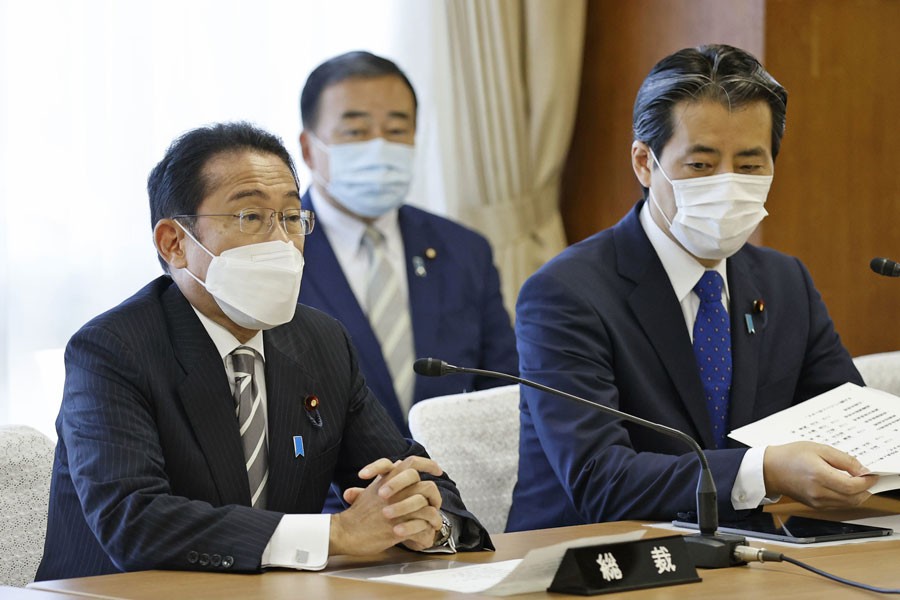
 Japanese Prime Minister Fumio Kishida, left, greets at the beginning of a meeting with his party members at the party's headquarters in Tokyo, Wednesday — AP
 TOKYO, Aug 10 (AP): Japanese Prime Minister Fumio Kishida reshuffled his Cabinet on Wednesday in an apparent bid to distance his administration from the conservative Unification Church, whose ties to the assassinated leader Shinzo Abe and senior ruling party leadership caused a major drop in approval ratings.
The Cabinet renewal was the second in just 10 months since Kishida took office following the July election victory that had been expected to ensure long-term stability until 2025. But Abe's shocking assassination on July 8 and its impact on politics increased uncertainty as public support for Kishida's Cabinet plunged.
Kishida told reporters Tuesday that a "strict review" of candidates' ties to the church would be a "prerequisite" in the new lineup of Cabinet officials and Liberal Democratic Party executives.
He said he had instructed his ministers and other senior officials to clarify their connection to the Unification Church "so that we can achieve political and administrative work that can be trusted by the people." At a governing party meeting earlier Wednesday, he called on his fellow lawmakers to unite and tackle the challenges with a sense of urgency.
Abe was fatally shot while giving a campaign speech two days before a parliamentary election. Police and media reports say the man arrested had targeted Abe over suspected ties to the Unification Church, which the man hated because his mother's massive financial donations to the church ruined his family.
Kishida said the main purpose of the reshuffle was to "break through one of biggest postwar crises" such as the coronavirus pandemic, inflation, growing tensions between China and self-ruled Taiwan and Russia's war on Ukraine. He was expected to further explain the new Cabinet at a news conference later Wednesday.
A survey released Monday by the NHK public television showed support for Kishida's Cabinet fell to 46% from 59%.
Most of the respondents said they think politicians have not sufficiently explained their ties to the Unification Church. Kishida's plan to hold a state funeral for Abe has also split public opinion because of Abe's archconservative stances on national security and wartime history. Critics also see a state funeral as the government attempt to glorify Abe's legacy.
Chief Cabinet Secretary Hirokazu Matsuno, who retained his post, announced the new lineup, including five who kept their posts, another five who were brought back and nine first-timers.
Seven ministers who acknowledged their ties to the church were removed. They include Defense Minister Nobuo Kishi, Abe's younger brother, who said that church followers were volunteers in his past election campaigns, and Public Safety Commission Chairman Satoshi Ninoyu, who attended an event organized by a church-related organization.
Kishi was replaced by former Defense Minister Yasukazu Hamada, and Taro Kono, who previously served as a vaccination tsar during the pandemic as well as foreign and defense minister, returned to the Cabinet as digital minister.
© 2026 - All Rights with The Financial Express

