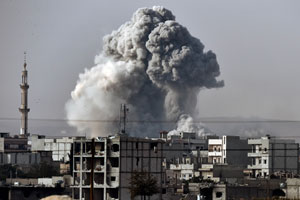
 TURKEY : Smoke rises from the the Syrian town of Ain al-Arab, known as Kobane by the Kurds, after a strike from the US-led coalition as it is seen from the Turkish-Syrian border in the southeastern village of Mursitpinar, Sanliurfa province Tuesday. — AFP
 BEIRUT, Oct 14 (AFP): Few people had ever heard of Kobane before recent weeks, but the once-sleepy Syrian border town has become a crucial symbolic battleground in the fight against Islamic State jihadists.
Desperate to preserve their hopes of autonomy in the face of the jihadists' expanding "caliphate", Kobane's rag-tag Kurdish defenders have been fighting for nearly a month to save the town.
The battle has riveted global media attention, partly because cameras across the border in Turkey can capture rare images of IS in action and the aftermath of air strikes by the US-led anti-jihadist coalition.
US officials have downplayed Kobane's importance despite the attention, insisting the most important threat from IS is elsewhere in Syria and Iraq.
But its fall, experts say, would have far-reaching consequences, first for the Kurds and not least by handing the publicity-savvy jihadists an important victory in the face of coalition air power.
"If the coalition, even with its superior technology, is unable to finish IS off it is because, according to them, it is God's will," said Syria specialist Fabrice Balanche.
The Kobane region is at the centre of three predominantly Kurdish enclaves in northern Syria, with Afrin to the west and Jazira in the northeast with its main cities of Qamishli and Hasakeh.
Kobane itself had a pre-war population of about 45,000 and was an Ottoman-era stop on the railway linking Turkey with Iraq.
Its name, pronounced "Kobaneh", is believed to be a corruption of "company", a nod to the railway firm that built the line.
Syria's about three million Kurds-some 15 percent of its population-declared an autonomous region in areas under their control since the uprising against President Bashar al-Assad erupted in 2011.
Kobane stands at its centre and its loss would split the Kurdish region in two.
"The Kurds in Syria have always lived concentrated in these three enclaves along the Turkish border, and to have one of them virtually wiped out is of course incredibly symbolic and threatening to them," said Aron Lund, the editor of the Carnegie Endowment for International Peace's "Syria in Crisis" website.
"They know that if Kobane falls, it won't end there," he said.
Seizing Kobane would give IS a base from which to move farther into Kurdish-controlled land, experts said, as it seeks to extend its territory in Syria and Iraq.
"Afrin will be the next target. Then they (the Kurds) will be confined to Hasakeh, where they also risk being attacked," Balanche said.
For the main Kurdish militia group, the People's Protection Units or YPG, defeat in Kobane is simply not an option, Lund said.
"The YPG... is also under pressure to show that it is not giving up on Syrian Kurds, it is prepared to fight hard to protect them, to the last man and woman," he said.
© 2026 - All Rights with The Financial Express

