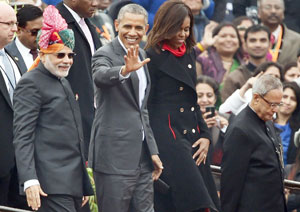
 INDIA : US President Barack Obama waves to spectators as he leaves with US First Lady Michelle Obama, Narendra Modi and Pranab Mukherjee after attending India\'s Republic Day parade on Rajpath in New Delhi Monday. — AFP
 NEW DELHI, Jan 26 (agencies):US President Barack Obama has attended India's Republic Day parade in Delhi, the first US head of state to do so. Mr Obama was chief guest at the annual military parade. He arrived on Sunday for a three-day visit seen as a sign of warming ties between the two countries.
After talks Sunday, both sides announced a breakthrough on a pact that will allow US companies to supply India with civilian nuclear technology. Indian PM Narendra Modi said it was a "new journey" of co-operation.
Uniformed soldiers in colourful headgear marched down Rajpath, or King's Avenue, where Mr Obama watched the parade with Mr Modi inside a bullet-proof glass enclosure.
The BBC's Sanjoy Majumder in Delhi says the ceremony showcased India's military might with soldiers marching in formation and the latest weapons on display, including several made in America.
Helicopters showered petals on the crowds and brass bands and dancers filed past the guests on a foggy, rainy morning.
Rain failed to dampen spirits at India's Republic Day parade Monday as Barack Obama became the first US president to attend the spectacular military and cultural display in a sign of the nations' growing closeness.
Thousands of cheering spectators braved wet weather and heavy security to watch the parade, which marks the birth of modern India and includes everything from tanks and state-of-the-art weaponry to camels and traditional dancers.
The invitation to the annual celebration is one of the biggest honours the country can bestow on a foreign leader and underscores the increasing warmth between Obama and India's Prime Minister Narendra Modi.
The leaders smiled and chatted as they watched from behind a bulletproof glass screen, Modi sporting a green and orange hat with a pink circular plume that rivalled the spectacular military headgear on display.
Obama gave a thumbs-up as stunt-riders on motorbikes formed their trademark human pyramid before the grand finale of the event, a fly-past by Indian fighter jets.
The display of military might came a day after Obama and Modi renewed a defence cooperation agreement, with the United States and India both seeking a counter-balance to a rising China.
The mounted Border Security Force on their brightly-decorated camels, a traditional highlight, drew loud cheers from spectators who were out in force.
"This day is all about patriotism and I'm lucky to be a part of it," said 20-year-old college student Ajith Kumar, attending the central Delhi event with his parents and younger sister.
"The fact that we have a guest like Obama has made it all the more special."
Obama's presence as chief guest represents a remarkable turnaround in his relationship with India's new leader, who only a year ago was persona non grata in Washington.
He began his visit Sunday with a bear hug from Modi, later saying their new "friendship" reflected a natural affinity between the two countries.
"I'm honoured to be the first American president to attend this celebration, as well as the first president to visit India twice," said Obama.
The parade celebrates the adoption in 1950 of the Indian Constitution-the day that India became a republic-more than two years after gaining independence from Britain.
A float representing Modi's home state of Gujarat featured a statue of Sardar Patel, a founding father of the republic and personal hero of the premier, who is building the world's tallest statue in his honour.
Alongside the carnival floats and military hardware were reminders of India's achievements, including a dance by schoolchildren representing the country's Mars mission.
Roads were closed around the area, which has been declared a no-fly zone, and snipers were positioned on rooftops along the route, where 15,000 new CCTV cameras have been installed.
No cameras were allowed near the spectacle, with even the White House press pack forced to hand over their phones.
The growing camaraderie between Modi and Obama comes after a tense row involving the arrest and strip-search of an Indian diplomat in New York marred relations in late 2013.
Modi's election in May 2014 was a potential headache for the US, which had blacklisted the Hindu nationalist for more than a decade after deadly communal riots in Gujarat when he was state chief minister.
© 2026 - All Rights with The Financial Express

